

Ready & Packaged Foods
All →Vegetables & Legumes
All →Desserts & Confectionery
All →Meat & Protein
All →Grains & Bakery
All →Beverages
All →Milk & Dairy
All →

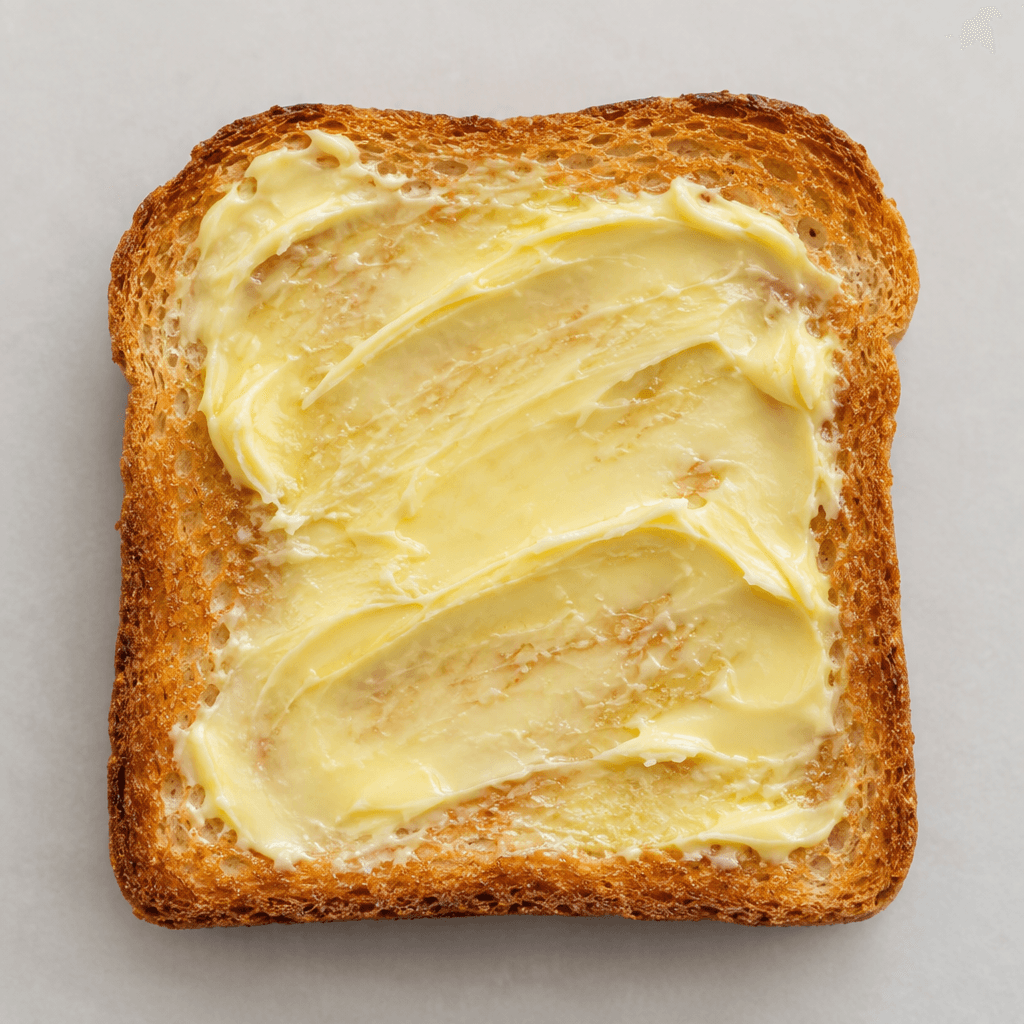
Toast butter Calories
Spreadable milk fat, energy-dense toast topping
CALORIES
GI
POTASSIUM
FIBER
Quick answer
1 tablespoon (medium) of Toast butter (14 g) has 100 calories. That works out to 717 calories per 100 g. It contains 0 g of carbs, 0.1 g of protein, 11.4 g of fat and 0 g of fiber. Its 95.8 µg of Vitamin A covers 11% of the Daily Value. Its glycemic index is 0 (low), so it raises blood sugar slowly.
What is Toast butter?
Toast butter is butter made from milk cream and served spread over toasted bread. It is less a separate recipe than a familiar way to enjoy butter: spread it while the toast is warm and it softens into a smooth, slightly glossy layer. Its flavour is rich, creamy and sometimes lightly salted, depending on the butter used.
It is a classic breakfast topping in many places, often paired with jam, honey or marmalade; it also works alongside eggs or savoury toast toppings. Toast butter is energy-dense and consists mostly of fat, with 81.1 g of fat per 100 g. For a lighter serving, use a thin layer and add fresh fruit or tomatoes on the side.
Toast butter Nutrition Facts
Selected: 100 g
717
KCAL / 100G
Carbs
0.1g
· 0% DV
Protein
0.9g
· 2% DV
Fat
81.1g
· 104% DV
Fiber
0g
· 0% DV
DV is the share of the daily value covered, on a 2,000 kcal reference diet.
Calories come from: Carbs 0% · Protein 0% · Fat 100%
Toast butter Vitamins & Minerals
Vitamins
Vitamin A
684µg · 76% DV
Vitamin E
2.32mg · 15% DV
Vitamin D
1.5µg · 8% DV
B12
0.17µg · 7% DV
Minerals
Phosphorus
24mg · 3% DV
Calcium
24mg · 2% DV
Iodine
3µg · 2% DV
Selenium
1µg · 2% DV
How Nutritious Is Toast butter?
Nutrient density
Low
How many vitamins, minerals and how much fiber this food carries per calorie. A high score means a lot of nutrition for few calories.
Satiety score
Low
An EatBetter score computed from fiber, protein and calorie density. A high score means staying full longer on the same calories.
Both scores are calculated per 100 g and do not change with the selected portion. The satiety score is EatBetter's own calculation, not a clinical measure.
Toast butter Glycemic Index
GLYCEMIC INDEX
GLYCEMIC LOAD
Accounts for portion size — a more realistic measure than GI alone.
How to Burn Off Toast butter
To burn the 717 calories in 100 g:
🚶
Walking (5 km/h)
🏃
Running (8 km/h)
🚴
Cycling
🏊
Swimming
Times are calculated with the MET equation for a 70 kg adult. Actual burn varies with your weight, age and pace.
Is Toast butter Processed?
NOVA 2
Minimally Processed
1. Unprocessed
2. Minimally Processed
3. Processed
4. Ultra-Processed
NOVA classifies foods into 4 groups by industrial processing. NOVA 1 (unprocessed) is the healthiest.
Does Toast butter Contain Allergens?
Contains these allergens:
Which Diets Is Toast butter Good For?
Vegan
— Not suitable
Vegetarian
✓ Suitable
Gluten-Free
✓ Suitable
Dairy-Free
— Not suitable
Mediterranean
✓ Suitable
Paleo
✓ Suitable
Whole30
— Not suitable
DASH
— Not suitable
Keto
✓ Suitable
Low FODMAP
— Not suitable
Toast butter Fat Profile
SATURATED
51.37g
MONOUNSATURATED
21.02g
POLYUNSATURATED
3.04g
Omega 6:3 ratio 6.8:1
Above the ideal 4:1 (6.8:1).
Compare Toast butter
Foods Similar to Toast butter
Frequently Asked Questions About Toast butter
What is toast butter?
Toast butter is butter spread on toast; it is not a separate kind of butter. It can be added to bread before toasting for a crisp surface or spread on the finished toast for a softer texture.
Should you put toast butter on bread before or after toasting?
Put toast butter on before toasting if you want the bread’s surface to brown and crisp. Spread it on afterward if you prefer the butter to remain more noticeable and the toast to stay softer.
How do you soften toast butter quickly for spreading?
Cut toast butter into small pieces and let them sit at room temperature until spreadable. For a faster option, press a small amount onto the warm toast with the back of a knife; avoid overheating it until it melts.
Can you use toast butter to make a grilled cheese sandwich?
Yes, toast butter works well on the outside of bread for a grilled cheese sandwich. Spread a thin layer on the outer faces, add cheese between the slices, then cook until the bread is browned and the cheese melts.
Which bread works best with toast butter?
Toast butter works with everything from soft sandwich bread to sourdough and whole-grain loaves. A sturdy slice is especially useful for toppings, while an open-textured bread absorbs the butter more readily.
What goes well on toast with toast butter?
Toast butter pairs well with sweet toppings such as jam or honey, and with savoury choices such as eggs or sliced tomatoes. Spread the butter first, then add toppings so they adhere to the toast.
Does toast butter need to be refrigerated?
Yes, keep toast butter refrigerated in its wrapper or a covered container to protect its flavour and freshness. Take out only what you plan to use, and return the rest to the refrigerator promptly.
Can you freeze toast butter?
Yes, toast butter can be frozen if wrapped tightly to keep out air and odours. Thaw it in the refrigerator before use; any slight change in texture is usually unimportant when spreading it on toast.
How can you tell if toast butter has gone bad?
Discard toast butter if it smells sour or rancid, tastes noticeably off, or shows mould. Keep it covered and use a clean knife each time to reduce contamination and help it stay fresh.
Does toast butter make you gain weight?
Toast butter is energy-dense, so generous or frequent servings can add substantially to a meal’s energy intake. A thin spread is an easy way to enjoy buttered toast while keeping the topping modest.
Have another question about Toast butter?
Ask the AI nutrition coach — calories, portions, alternatives and more, answered in seconds in the app.

Scan calories with your camera
Instant AI nutrition analysis

Nutrition data compiled from USDA FoodData Central and scientific sources.