

Ready & Packaged Foods
All →Vegetables & Legumes
All →Desserts & Confectionery
All →Meat & Protein
All →Grains & Bakery
All →Beverages
All →Milk & Dairy
All →

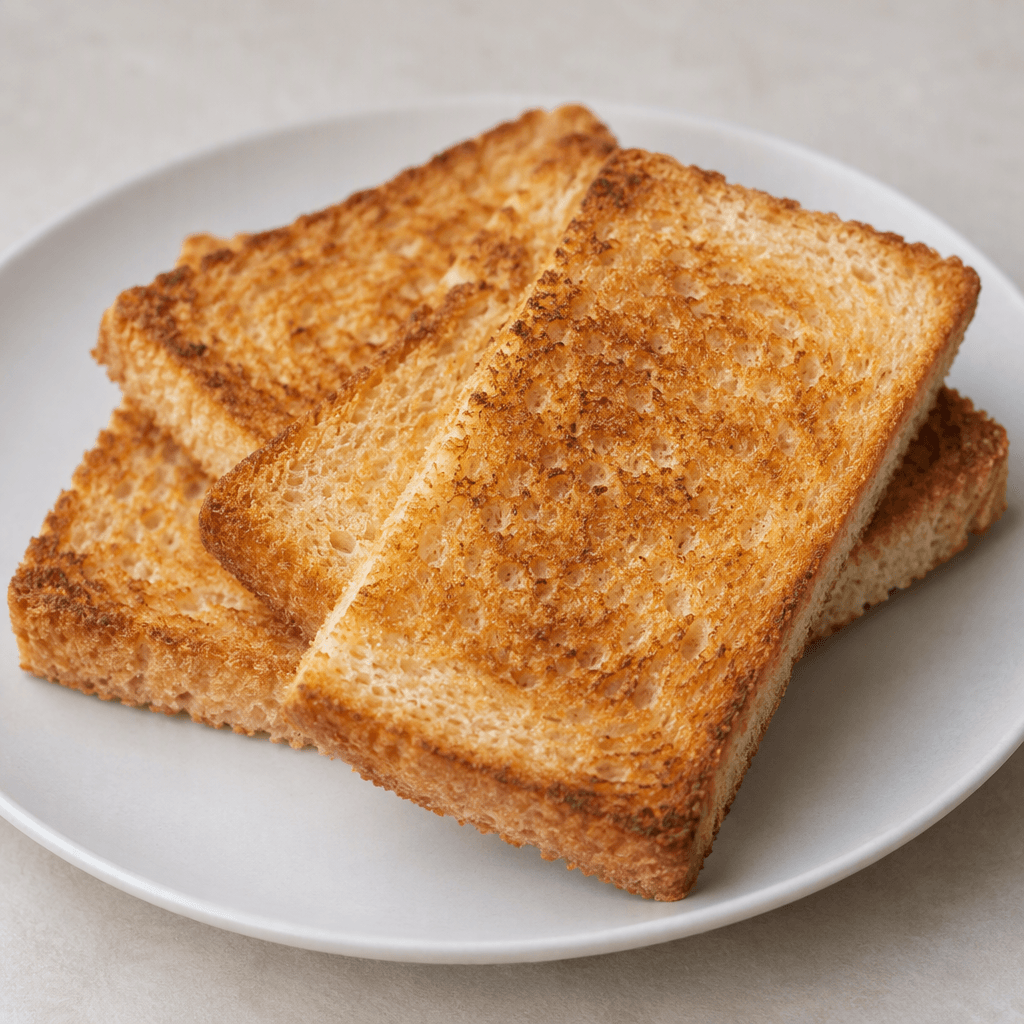
Toast Calories
Toasted bread, quick carbohydrate source
In season: Spring · Summer · Autumn · Winter
CALORIES
GI
POTASSIUM
FIBER
Quick answer
1 slice (medium) of Toast (30 g) has 80 calories. That works out to 265 calories per 100 g. It contains 14.7 g of carbs, 2.6 g of protein, 1 g of fat and 0.8 g of fiber. Its 6.6 µg of Selenium covers 12% of the Daily Value. Its glycemic index is 70 (high), so it raises blood sugar quickly.
What is Toast?
Toast is bread heated until its surface turns crisp and golden. It is a simple preparation rather than a dish tied to one particular cuisine, and it is eaten in many parts of the world. In the UK and elsewhere, it commonly appears at breakfast; in the US, it may accompany eggs or be served with butter and jam.
Its browned exterior contrasts with a softer centre, and its mild flavour works with both sweet and savoury toppings. Toast is mostly a source of carbohydrates, making it a quick, convenient base for a meal. Add eggs, beans or nut butter for a more filling option, or top it with fresh tomato for something lighter.
Toast Nutrition Facts
Selected: 100 g
265
KCAL / 100G
Carbs
49g
· 18% DV
Protein
8.5g
· 17% DV
Fat
3.2g
· 4% DV
Fiber
2.7g
· 10% DV
DV is the share of the daily value covered, on a 2,000 kcal reference diet.
Calories come from: Carbs 76% · Protein 13% · Fat 11%
Toast Vitamins & Minerals
Vitamins
B1
0.22mg · 18% DV
B3
2.1mg · 13% DV
B2
0.13mg · 10% DV
Folate
40µg · 10% DV
Minerals
Manganese
1mg · 43% DV
Selenium
22µg · 40% DV
Iron
4mg · 22% DV
Sodium
450mg · 20% DV
How Nutritious Is Toast?
Nutrient density
Low
How many vitamins, minerals and how much fiber this food carries per calorie. A high score means a lot of nutrition for few calories.
Satiety score
Medium
An EatBetter score computed from fiber, protein and calorie density. A high score means staying full longer on the same calories.
Both scores are calculated per 100 g and do not change with the selected portion. The satiety score is EatBetter's own calculation, not a clinical measure.
Toast Glycemic Index
GLYCEMIC INDEX
GLYCEMIC LOAD
Accounts for portion size — a more realistic measure than GI alone.
How to Burn Off Toast
To burn the 265 calories in 100 g:
🚶
Walking (5 km/h)
🏃
Running (8 km/h)
🚴
Cycling
🏊
Swimming
Times are calculated with the MET equation for a 70 kg adult. Actual burn varies with your weight, age and pace.
Is Toast Processed?
NOVA 3
Processed
1. Unprocessed
2. Minimally Processed
3. Processed
4. Ultra-Processed
NOVA classifies foods into 4 groups by industrial processing. NOVA 1 (unprocessed) is the healthiest.
Does Toast Contain Allergens?
Contains these allergens:
Which Diets Is Toast Good For?
Vegan
— Not suitable
Vegetarian
✓ Suitable
Gluten-Free
— Not suitable
Dairy-Free
— Not suitable
Mediterranean
— Not suitable
Paleo
— Not suitable
Whole30
— Not suitable
DASH
— Not suitable
Keto
— Not suitable
Low FODMAP
— Not suitable
Toast Fat Profile
SATURATED
0.7g
MONOUNSATURATED
0.6g
POLYUNSATURATED
1.1g
Omega 6:3 ratio 15:1
Above the ideal 4:1 (15:1).
Compare Toast
Foods Similar to Toast
Frequently Asked Questions About Toast
Is toast healthier than untoasted bread?
Toast is not automatically healthier than untoasted bread; toasting mainly changes its texture, flavour and water content. Choose the bread you prefer, and avoid routinely eating heavily browned or burnt slices.
How do you make toast without a toaster?
You can make toast in a dry skillet or under a grill. In a skillet, cook the bread over moderate heat and turn it when golden; under a grill, watch it closely because it can brown quickly.
Can you toast frozen bread?
Yes, you can toast bread straight from frozen. Use a lower setting or an extra toasting cycle so the centre warms through without the outside becoming too dark.
Why does toast go soggy?
Toast goes soggy when steam gets trapped around it, often because slices are stacked or covered while warm. Set freshly toasted slices apart on a rack so moisture can escape.
How do you keep toast crispy after making it?
Keep toast crispy by serving it soon after toasting and leaving slices uncovered and unstacked. A warm plate or closed container traps steam, which softens the browned surface.
Can you put butter on toast before toasting it?
It is usually better to butter toast after it comes out of the toaster. Butter can drip onto the heating elements, smoke or make a mess; for skillet toast, a little butter in the pan is an option.
Does toasting bread reduce its carbohydrates?
No, toasting does not meaningfully remove the bread’s carbohydrates; it mainly drives off moisture and browns the surface. A slice may weigh less after toasting, but the bread itself has not become a low-carbohydrate food.
Is burnt toast bad for you?
It is better not to make a habit of eating burnt toast. Starchy foods can form acrylamide when cooked at very high temperatures, so aim for golden brown and discard slices that are heavily charred.
Can you reheat toast?
Yes, you can reheat toast briefly in a toaster or dry skillet to restore some crispness. A microwave warms it but tends to make the bread soft or chewy rather than crisp.
Can dogs eat toast?
Plain toast is not toxic to most dogs in a small amount, but it offers little nutritional benefit and should not replace their regular food. Avoid toppings and breads containing ingredients such as raisins, garlic or xylitol.
Have another question about Toast?
Ask the AI nutrition coach — calories, portions, alternatives and more, answered in seconds in the app.

Scan calories with your camera
Instant AI nutrition analysis

Nutrition data compiled from USDA FoodData Central and scientific sources.