

Ready & Packaged Foods
All →Vegetables & Legumes
All →Desserts & Confectionery
All →Meat & Protein
All →Grains & Bakery
All →Beverages
All →Milk & Dairy
All →

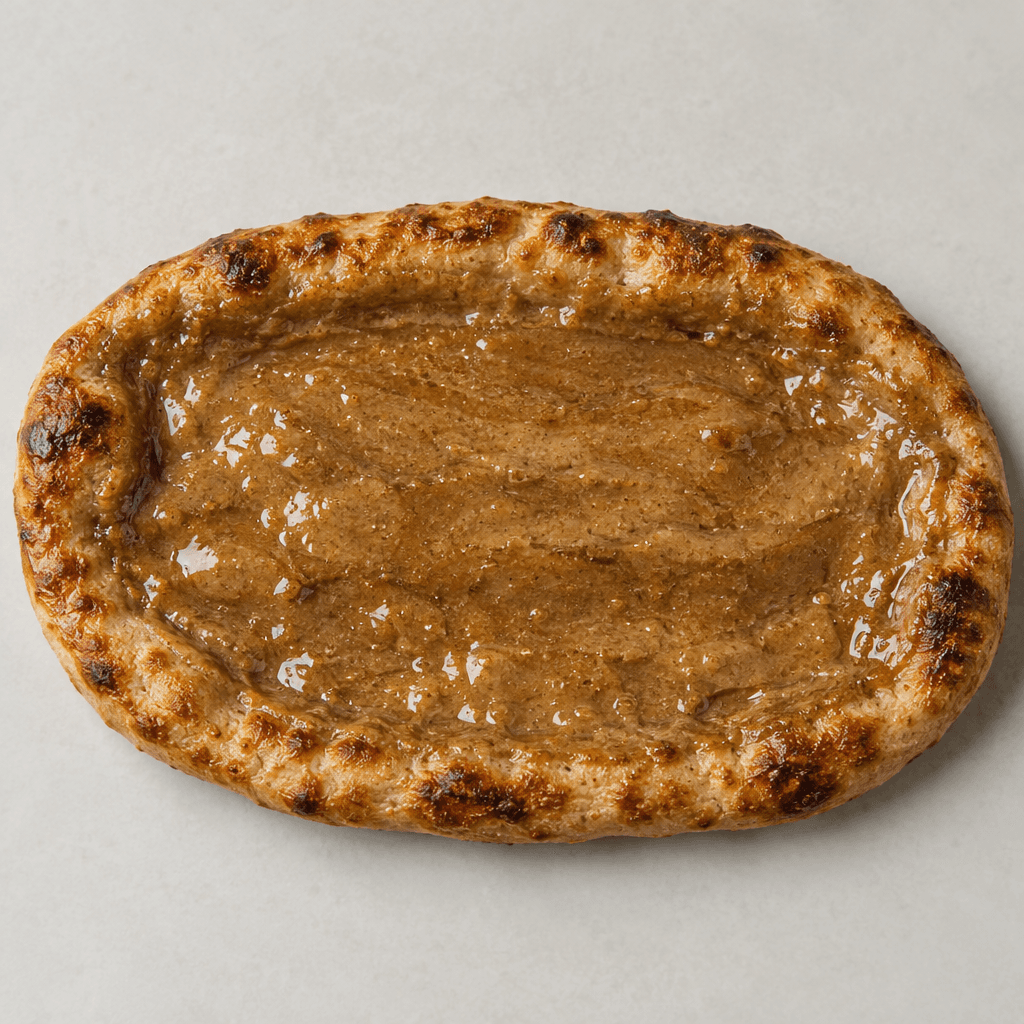
Tahini pide Calories
Traditional Turkish flatbread with sesame paste, provides energy and healthy fats.
In season: Spring · Summer · Autumn · Winter
CALORIES
GI
POTASSIUM
FIBER
Quick answer
1 piece (medium) of Tahini pide (120 g) has 408 calories. That works out to 340 calories per 100 g. It contains 55.2 g of carbs, 9.8 g of protein, 16.2 g of fat and 4.4 g of fiber. Its 0.3 mg of Copper covers 29% of the Daily Value. Its glycemic index is 65 (medium), so it raises blood sugar at a moderate pace.
What is Tahini pide?
Tahini pide is a Turkish flatbread topped with tahini, often sweetened with sugar, then baked until the edges are browned and the surface is glossy. Its elongated shape has a soft, bready centre and a richer, sometimes lightly crisp edge. The sesame paste brings a deep, toasted flavour balanced by sweetness.
In Turkey it is commonly eaten warm or at room temperature for breakfast or with tea, and it also makes a substantial snack. For readers elsewhere, it is best enjoyed as a sweet-leaning savoury bread rather than a light side: the dough and tahini make it energy-dense, with a mix of carbohydrates and fats. A small piece with unsweetened tea or plain yoghurt makes a simple pairing.
Tahini pide Nutrition Facts
Selected: 100 g
340
KCAL / 100G
Carbs
46g
· 17% DV
Protein
8.2g
· 16% DV
Fat
13.5g
· 17% DV
Fiber
3.7g
· 13% DV
DV is the share of the daily value covered, on a 2,000 kcal reference diet.
Calories come from: Carbs 54% · Protein 10% · Fat 36%
Tahini pide Vitamins & Minerals
Vitamins
B1
0.18mg · 15% DV
B3
2.1mg · 13% DV
Biotin
3.5µg · 12% DV
Folate
32µg · 8% DV
Minerals
Selenium
9µg · 16% DV
Phosphorus
110mg · 16% DV
Sodium
320mg · 14% DV
Calcium
120mg · 12% DV
How Nutritious Is Tahini pide?
Nutrient density
Medium
How many vitamins, minerals and how much fiber this food carries per calorie. A high score means a lot of nutrition for few calories.
Satiety score
Medium
An EatBetter score computed from fiber, protein and calorie density. A high score means staying full longer on the same calories.
Both scores are calculated per 100 g and do not change with the selected portion. The satiety score is EatBetter's own calculation, not a clinical measure.
Tahini pide Glycemic Index
GLYCEMIC INDEX
GLYCEMIC LOAD
Accounts for portion size — a more realistic measure than GI alone.
How to Burn Off Tahini pide
To burn the 340 calories in 100 g:
🚶
Walking (5 km/h)
🏃
Running (8 km/h)
🚴
Cycling
🏊
Swimming
Times are calculated with the MET equation for a 70 kg adult. Actual burn varies with your weight, age and pace.
Is Tahini pide Processed?
NOVA 3
Processed
1. Unprocessed
2. Minimally Processed
3. Processed
4. Ultra-Processed
NOVA classifies foods into 4 groups by industrial processing. NOVA 1 (unprocessed) is the healthiest.
Does Tahini pide Contain Allergens?
Contains these allergens:
Which Diets Is Tahini pide Good For?
Vegan
— Not suitable
Vegetarian
✓ Suitable
Gluten-Free
— Not suitable
Dairy-Free
— Not suitable
Mediterranean
✓ Suitable
Paleo
— Not suitable
Whole30
— Not suitable
DASH
— Not suitable
Keto
— Not suitable
Low FODMAP
— Not suitable
Tahini pide Fat Profile
SATURATED
2.1g
MONOUNSATURATED
4.7g
POLYUNSATURATED
3.1g
Omega 6:3 ratio 31.1:1
Above the ideal 4:1 (31.1:1).
Compare Tahini pide
Foods Similar to Tahini pide
Frequently Asked Questions About Tahini pide
What is tahini pide?
Tahini pide is a Turkish flatbread topped with tahini, usually sweetened with sugar, then baked. It is often oval or elongated, with a soft or crisp-edged crust and a rich, nutty layer on top.
How is tahini pide traditionally made?
Tahini pide is made by spreading a tahini mixture over prepared bread dough and baking it until the crust browns. Sugar is commonly mixed into the tahini, though recipes and shaping methods vary between bakeries and regions.
Is tahini pide sweet or savory?
Tahini pide is usually sweet, even though its dough may taste more like ordinary bread. Tahini gives it a nutty, slightly savory note, while sugar in the topping makes the overall flavor sweet.
Where does tahini pide come from?
Tahini pide is strongly associated with Bursa, Turkey, where bakeries sell it as a local specialty. Versions are also made elsewhere in Turkey, so it is better described as a Bursa-associated pide than an exclusively regional food.
How is tahini pide different from tahini çörek?
Tahini pide is generally a flat, open bread with tahini spread on top, while tahini çörek is often thicker or shaped by rolling and folding the dough. The names and exact styles can vary by bakery and region.
What goes well with tahini pide?
Tahini pide is commonly eaten on its own with Turkish tea. Its sweet, nutty topping also works as a breakfast or snack, but pairing it with another very sweet food can make the meal overly rich.
How should you store tahini pide?
Let tahini pide cool completely, then keep it in an airtight container at room temperature if you plan to eat it soon. For longer storage, freeze it rather than refrigerating it, which can make the bread stale faster.
Can you freeze tahini pide?
Yes, tahini pide freezes well. Cool it fully, wrap individual portions tightly, and thaw before reheating. Freezing portions separately makes it easier to take out only what you need and helps protect the bread’s texture.
What is the best way to reheat tahini pide?
Reheat tahini pide in a low-to-moderate oven until warmed through; this helps revive the crust without scorching the tahini topping. A microwave is quicker, but it can leave the bread soft rather than crisp.
Can tahini pide raise blood sugar?
Yes, tahini pide can raise blood sugar because it is made with bread dough and often includes sugar in the topping. People with diabetes may need to account for the portion in their meal plan and follow their clinician’s advice.
Have another question about Tahini pide?
Ask the AI nutrition coach — calories, portions, alternatives and more, answered in seconds in the app.

Scan calories with your camera
Instant AI nutrition analysis

Nutrition data compiled from USDA FoodData Central and scientific sources.