

Ready & Packaged Foods
All →Vegetables & Legumes
All →Desserts & Confectionery
All →Meat & Protein
All →Grains & Bakery
All →Beverages
All →Milk & Dairy
All →

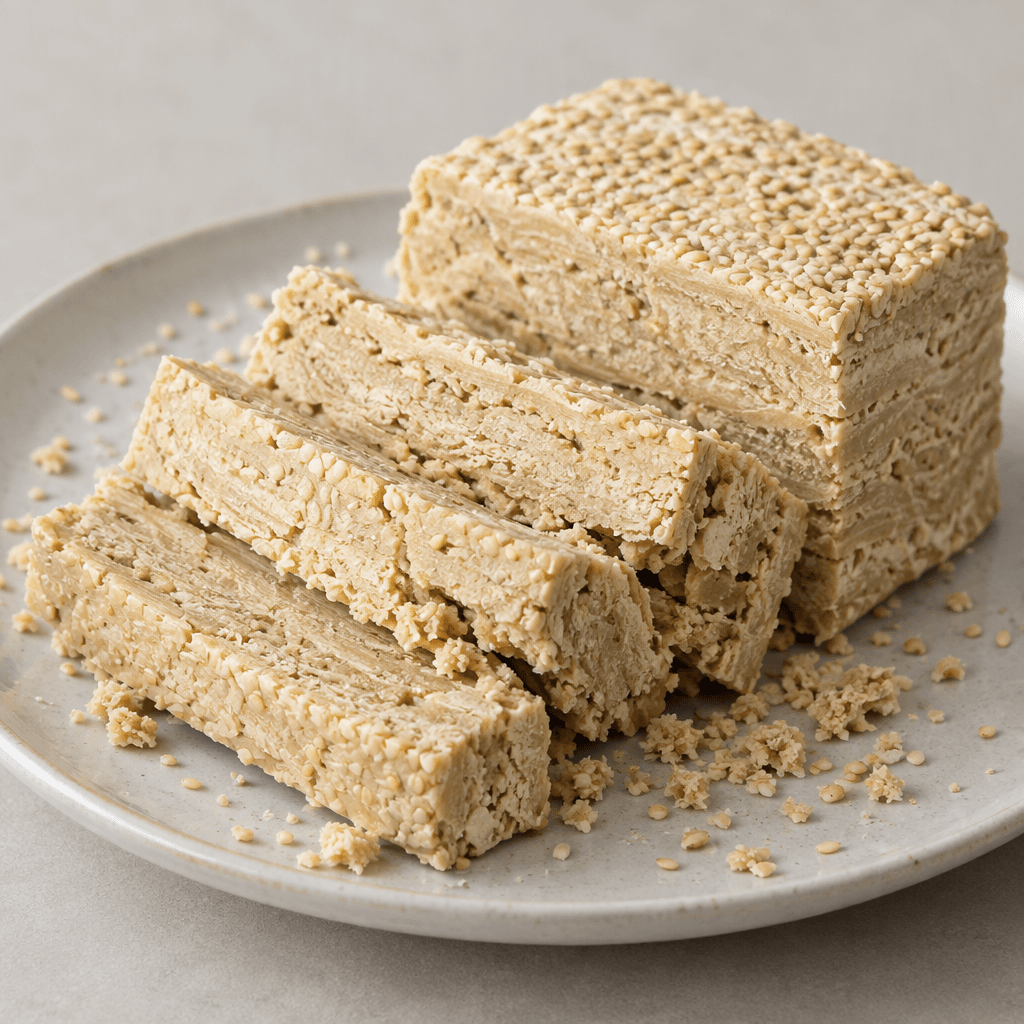
Tahini Halva Calories
Traditional sweet made from sesame paste and sugar
In season: Spring · Summer · Autumn · Winter
CALORIES
GI
POTASSIUM
FIBER
Quick answer
1 slice (medium) of Tahini Halva (40 g) has 204 calories. That works out to 510 calories per 100 g. It contains 20.8 g of carbs, 5 g of protein, 11.2 g of fat and 1.4 g of fiber. Its 0.3 mg of Copper covers 31% of the Daily Value. Its glycemic index is 70 (high), so it raises blood sugar quickly.
What is Tahini Halva?
Tahini Halva is a traditional sesame sweet, made by combining tahini—ground sesame paste—with a concentrated sugar mixture. In Turkey it is commonly sold in compact blocks, sliced to serve; plain versions sit alongside varieties with cocoa, pistachio or other additions.
Its texture is dry, layered and crumbly, with a roasted sesame flavour balanced by pronounced sweetness. In Turkey, people may have a slice at breakfast, with tea, or after a fish meal. Elsewhere, it is often enjoyed as a small sweet with coffee or tea, or used as a filling and topping for desserts. It is energy-dense and provides some protein from sesame, so a modest slice makes a satisfying treat. Pair it with fresh fruit for a lighter-feeling serving.
Tahini Halva Nutrition Facts
Selected: 100 g
510
KCAL / 100G
Carbs
52g
· 19% DV
Protein
12.5g
· 25% DV
Fat
28g
· 36% DV
Fiber
3.5g
· 13% DV
DV is the share of the daily value covered, on a 2,000 kcal reference diet.
Calories come from: Carbs 41% · Protein 10% · Fat 49%
Tahini Halva Vitamins & Minerals
Vitamins
Biotin
7µg · 23% DV
Vitamin K
17µg · 14% DV
Vitamin E
1.8mg · 12% DV
B1
0.13mg · 11% DV
Minerals
Copper
1mg · 111% DV
Phosphorus
320mg · 46% DV
Manganese
1mg · 43% DV
Calcium
410mg · 41% DV
How Nutritious Is Tahini Halva?
Nutrient density
Medium
How many vitamins, minerals and how much fiber this food carries per calorie. A high score means a lot of nutrition for few calories.
Satiety score
Medium
An EatBetter score computed from fiber, protein and calorie density. A high score means staying full longer on the same calories.
Both scores are calculated per 100 g and do not change with the selected portion. The satiety score is EatBetter's own calculation, not a clinical measure.
Tahini Halva Glycemic Index
GLYCEMIC INDEX
GLYCEMIC LOAD
Accounts for portion size — a more realistic measure than GI alone.
How to Burn Off Tahini Halva
To burn the 510 calories in 100 g:
🚶
Walking (5 km/h)
🏃
Running (8 km/h)
🚴
Cycling
🏊
Swimming
Times are calculated with the MET equation for a 70 kg adult. Actual burn varies with your weight, age and pace.
Is Tahini Halva Processed?
NOVA 3
Processed
1. Unprocessed
2. Minimally Processed
3. Processed
4. Ultra-Processed
NOVA classifies foods into 4 groups by industrial processing. NOVA 1 (unprocessed) is the healthiest.
Does Tahini Halva Contain Allergens?
Contains these allergens:
Which Diets Is Tahini Halva Good For?
Vegan
✓ Suitable
Vegetarian
✓ Suitable
Gluten-Free
— Not suitable
Dairy-Free
— Not suitable
Mediterranean
✓ Suitable
Paleo
— Not suitable
Whole30
— Not suitable
DASH
— Not suitable
Keto
— Not suitable
Low FODMAP
— Not suitable
Tahini Halva Fat Profile
SATURATED
4.2g
MONOUNSATURATED
11.8g
POLYUNSATURATED
11.2g
Omega 6:3 ratio 87.5:1
Above the ideal 4:1 (87.5:1).
Compare Tahini Halva
Foods Similar to Tahini Halva
Frequently Asked Questions About Tahini Halva
What is tahini halva made of?
Tahini halva is made mainly from sesame paste and cooked sugar syrup. Traditional recipes may also use an extract from soapwort root to help create its distinctive fibrous, flaky texture.
How do you eat tahini halva?
Tahini halva is usually sliced or broken into small pieces and eaten as a sweet, often with tea or coffee. It can also be served with salty cheese or crumbled over desserts.
Why is tahini halva crumbly?
Tahini halva is meant to have a layered, crumbly texture, so it naturally breaks apart when sliced. If it seems unusually dry or crumbles excessively, it may have been stored too long or exposed to air.
How should you store tahini halva after opening?
Keep tahini halva sealed in a cool, dry place away from direct sunlight. Refrigeration is usually unnecessary and can make the halva firm; a tightly closed container helps prevent it from drying out.
Can you freeze tahini halva?
Yes, tahini halva can be frozen in an airtight container, though thawing may change its texture and make it more crumbly. Let it thaw while still wrapped to limit moisture from forming on the surface.
What is the difference between tahini halva and Turkish delight?
Tahini halva is a dense sesame confection with a dry, flaky texture, while Turkish delight is a soft, chewy sweet usually made from starch and sugar. They differ in their main ingredients and how they feel to eat.
Why is tahini halva served after fish in Turkey?
Tahini halva is a traditional sweet ending to many Turkish fish meals. The custom is about serving a dessert after dinner; claims that halva removes mercury or cancels out fish’s effects are not supported by evidence.
Can you melt tahini halva?
Yes, tahini halva softens and can melt when warmed, making it useful as a topping or dessert ingredient. Heat it gently and check often, since it can scorch or become too runny if overheated.
Does tahini halva go bad?
Yes, tahini halva can lose quality or spoil, especially if moisture or heat reaches it. Discard it if you notice mold, an unusual smell, or a distinctly rancid taste; keep it sealed in a cool, dry place.
Is tahini halva healthy to eat every day?
Tahini halva can be enjoyed as a sweet, but it contains both sugar and sesame paste, so it is better treated as an occasional or modest portion rather than an everyday staple. Pairing a small piece with unsweetened tea can keep it from becoming an oversized snack.
Have another question about Tahini Halva?
Ask the AI nutrition coach — calories, portions, alternatives and more, answered in seconds in the app.

Scan calories with your camera
Instant AI nutrition analysis

Nutrition data compiled from USDA FoodData Central and scientific sources.