

Ready & Packaged Foods
All →Vegetables & Legumes
All →Desserts & Confectionery
All →Meat & Protein
All →Grains & Bakery
All →Beverages
All →Milk & Dairy
All →

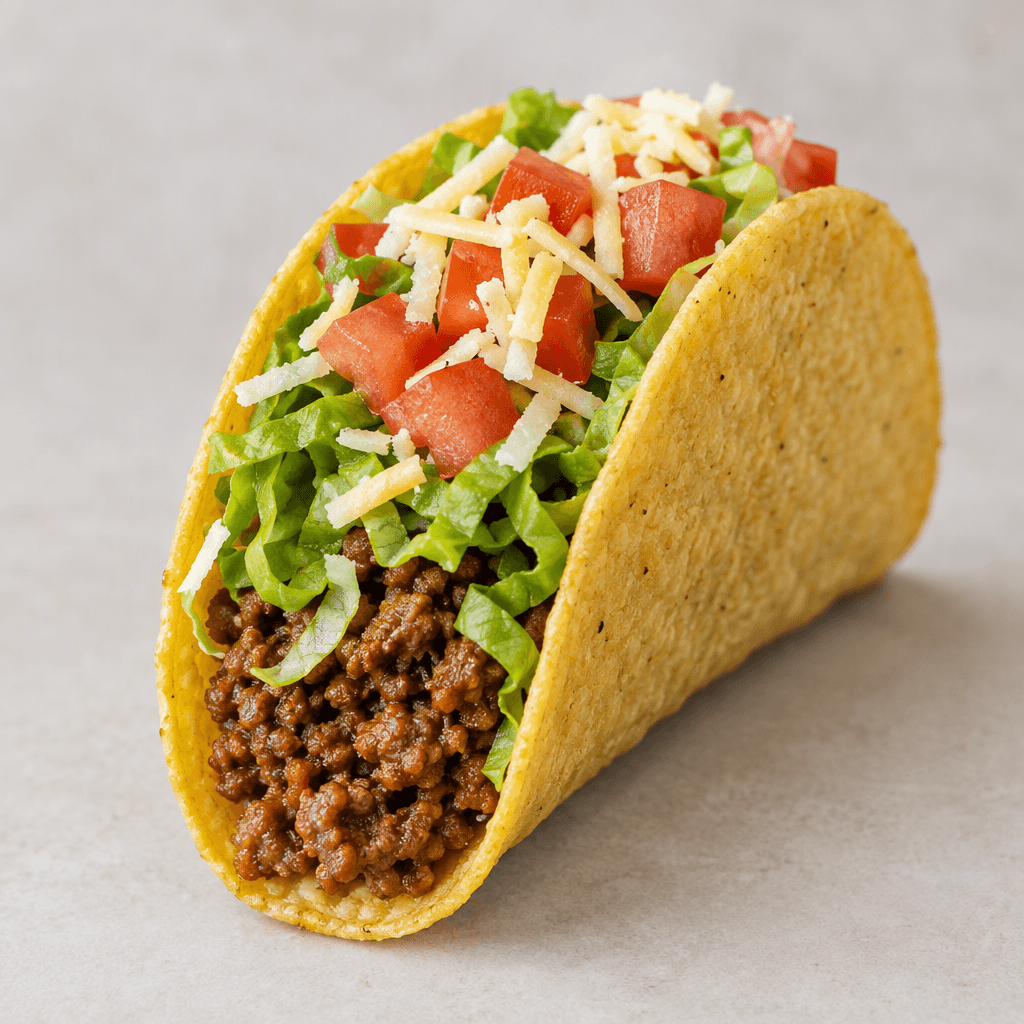
Taco Calories
Corn or wheat tortilla, meat or vegetable filling, assorted toppings
In season: Spring · Summer · Autumn · Winter
CALORIES
GI
POTASSIUM
FIBER
Quick answer
1 piece (medium) of Taco (90 g) has 162 calories. That works out to 180 calories per 100 g. It contains 19.8 g of carbs, 6.8 g of protein, 5.9 g of fat and 2.5 g of fiber. Its 288 mg of Sodium covers 13% of the Daily Value. Its glycemic index is 55 (medium), so it raises blood sugar at a moderate pace.
What is Taco?
Tacos trace their roots to Mexico, where fillings are tucked into tortillas, traditionally soft corn tortillas. The crisp, U-shaped shell shown here is a hard-shell style that is especially familiar in the United States. Fillings range from meat and beans to vegetables, with toppings such as lettuce, tomato, cheese and salsa.
A taco is usually eaten by hand, freshly assembled so the shell stays crisp or a soft tortilla stays pliable. It makes an easy casual meal and is often served with lime, salsa or beans. The tortilla supplies most of the carbohydrates, while meat or beans contribute protein; vegetables add some fibre. For a lighter filling, use plenty of vegetables and salsa, and go easy on the cheese.
Taco Nutrition Facts
Selected: 100 g
180
KCAL / 100G
Carbs
22g
· 8% DV
Protein
7.5g
· 15% DV
Fat
6.5g
· 8% DV
Fiber
2.8g
· 10% DV
DV is the share of the daily value covered, on a 2,000 kcal reference diet.
Calories come from: Carbs 50% · Protein 17% · Fat 33%
Taco Vitamins & Minerals
Vitamins
B3
2.1mg · 13% DV
B12
0.25µg · 10% DV
B5
0.45mg · 9% DV
B1
0.09mg · 8% DV
Minerals
Sodium
320mg · 14% DV
Phosphorus
90mg · 13% DV
Selenium
6µg · 11% DV
Zinc
1mg · 9% DV
How Nutritious Is Taco?
Nutrient density
Medium
How many vitamins, minerals and how much fiber this food carries per calorie. A high score means a lot of nutrition for few calories.
Satiety score
Medium
An EatBetter score computed from fiber, protein and calorie density. A high score means staying full longer on the same calories.
Both scores are calculated per 100 g and do not change with the selected portion. The satiety score is EatBetter's own calculation, not a clinical measure.
Taco Glycemic Index
GLYCEMIC INDEX
GLYCEMIC LOAD
Accounts for portion size — a more realistic measure than GI alone.
How to Burn Off Taco
To burn the 180 calories in 100 g:
🚶
Walking (5 km/h)
🏃
Running (8 km/h)
🚴
Cycling
🏊
Swimming
Times are calculated with the MET equation for a 70 kg adult. Actual burn varies with your weight, age and pace.
Is Taco Processed?
NOVA 3
Processed
1. Unprocessed
2. Minimally Processed
3. Processed
4. Ultra-Processed
NOVA classifies foods into 4 groups by industrial processing. NOVA 1 (unprocessed) is the healthiest.
Does Taco Contain Allergens?
Contains these allergens:
Which Diets Is Taco Good For?
Vegan
— Not suitable
Vegetarian
— Not suitable
Gluten-Free
— Not suitable
Dairy-Free
— Not suitable
Mediterranean
✓ Suitable
Paleo
— Not suitable
Whole30
— Not suitable
DASH
— Not suitable
Keto
— Not suitable
Low FODMAP
— Not suitable
Taco Fat Profile
SATURATED
2.1g
MONOUNSATURATED
2.3g
POLYUNSATURATED
1g
Omega 6:3 ratio 16.3:1
Above the ideal 4:1 (16.3:1).
Compare Taco
Foods Similar to Taco
Frequently Asked Questions About Taco
What is a taco made of?
A taco is made by placing a filling in or on a tortilla, usually corn or wheat. Common fillings include seasoned meat, fish, or beans, with toppings such as salsa, onion, lettuce, tomato, cheese, or avocado.
How do you make tacos at home?
To make tacos at home, cook a filling, warm the tortillas, and add toppings just before serving. For a simple version, season and brown minced meat, then serve it with lettuce, tomato, grated cheese, and salsa.
Where did tacos originate?
Tacos originated in Mexico, where regional cooking traditions use different tortillas, fillings, and salsas. The crisp, folded shell filled with seasoned ground beef is especially associated with American-style tacos, rather than representing every Mexican taco.
What is the difference between a taco and a burrito?
A taco is usually served open or loosely folded in a smaller tortilla, while a burrito is wrapped closed in a larger flour tortilla. Burritos commonly include substantial fillings such as rice and beans as well as meat or vegetables.
What meat is best for tacos?
Ground beef is a convenient choice for quick tacos, while sliced steak, chicken, pork, and fish all work well. The best cut depends on the style: for example, carne asada uses grilled beef, while al pastor traditionally uses marinated pork.
Are tacos made with corn or flour tortillas?
Tacos can be made with either corn or flour tortillas. Corn tortillas are a staple of Mexican taco traditions, while flour tortillas are common in some regions and in many US-style versions; warm either type before filling so it bends without cracking.
What toppings go on tacos?
Popular taco toppings include salsa, chopped onion, cilantro, lime, avocado, and cheese. Lettuce and tomato are common on American-style tacos; add toppings after cooking and keep wet sauces moderate so the tortilla does not become soggy.
What is the difference between hard-shell and soft tacos?
A hard-shell taco uses a crisp, U-shaped tortilla, often made by frying or baking a shaped corn tortilla. A soft taco uses a warm, flexible tortilla and is folded around the filling; soft corn tortillas are common in traditional Mexican styles.
How do you stop taco shells from getting soggy?
Keep taco shells crisp by adding the filling shortly before serving and draining off excess liquid first. Serve watery salsa separately, and store leftover filling apart from the shells so moisture does not soften them.
How long do leftover tacos last in the fridge?
Store cooked taco filling in a sealed container in the refrigerator and use it within 3–4 days. Keep tortillas, shells, and fresh toppings separate; reheat the filling until steaming hot and assemble the tacos just before eating.
Have another question about Taco?
Ask the AI nutrition coach — calories, portions, alternatives and more, answered in seconds in the app.

Scan calories with your camera
Instant AI nutrition analysis

Nutrition data compiled from USDA FoodData Central and scientific sources.