

Ready & Packaged Foods
All →Vegetables & Legumes
All →Desserts & Confectionery
All →Meat & Protein
All →Grains & Bakery
All →Beverages
All →Milk & Dairy
All →

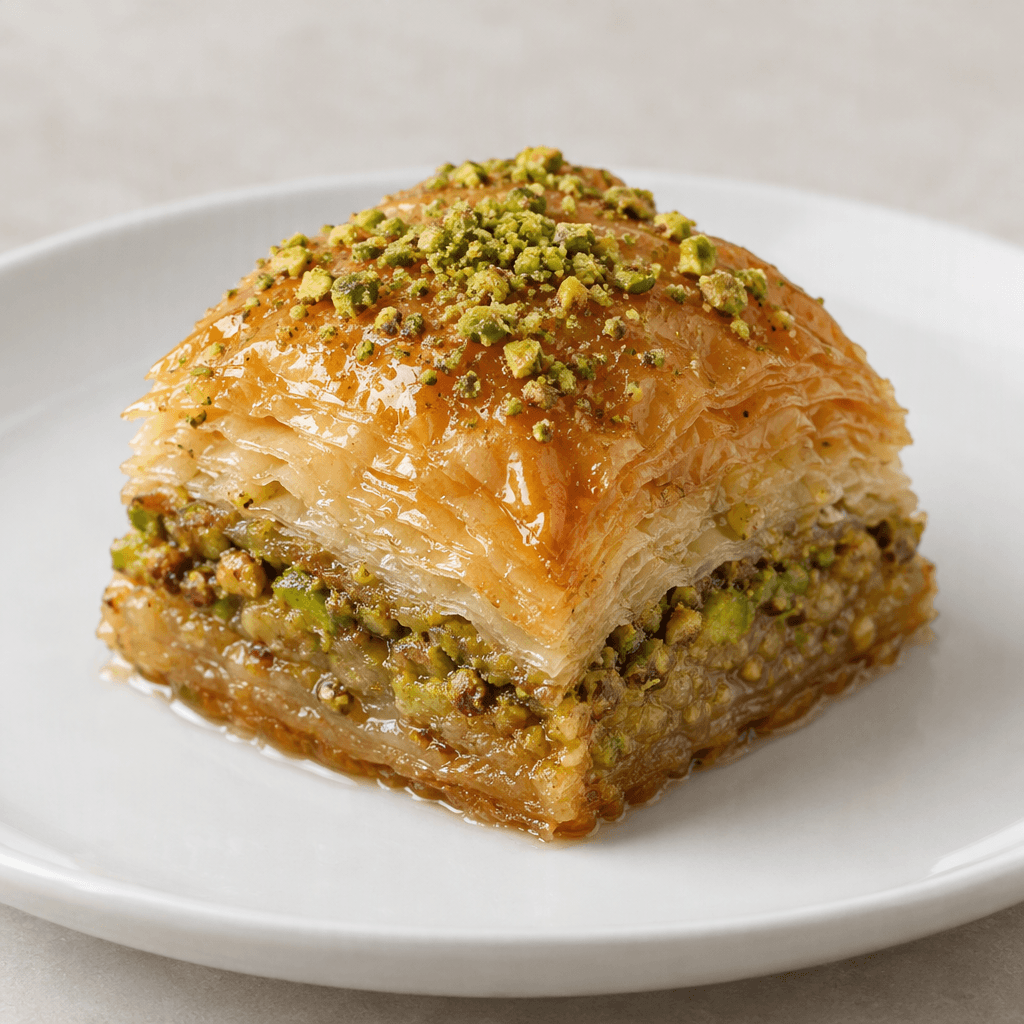
Syrupy pastry dessert Calories
Syrupy pastry dessert
In season: Spring · Summer · Autumn · Winter
CALORIES
GI
POTASSIUM
FIBER
Quick answer
1 piece (medium) of Syrupy pastry dessert (80 g) has 264 calories. That works out to 330 calories per 100 g. It contains 48 g of carbs, 3.4 g of protein, 6.8 g of fat and 1 g of fiber. Its 0.1 mg of Manganese covers 5% of the Daily Value. Its glycemic index is 75 (high), so it raises blood sugar quickly.
What is Syrupy pastry dessert?
A syrupy pastry dessert is made by layering thin pastry, baking it until golden, then pouring syrup over it. In Turkish cuisine, baklava is a familiar example, often finished with chopped pistachios; recipes and shapes vary across regions. The result is crisp at the edges and tender where the pastry has absorbed the syrup.
In Turkey it is commonly served after a meal or at celebrations, with tea or Turkish coffee. Elsewhere, it is enjoyed as a small sweet alongside coffee or shared at gatherings. Its pastry and syrup make it energy-dense and rich in carbohydrates, so a modest piece is often satisfying. For a less-heavy serving, pair a smaller portion with unsweetened tea or coffee.
Syrupy pastry dessert Nutrition Facts
Selected: 100 g
330
KCAL / 100G
Carbs
60g
· 22% DV
Protein
4.2g
· 8% DV
Fat
8.5g
· 11% DV
Fiber
1.2g
· 4% DV
DV is the share of the daily value covered, on a 2,000 kcal reference diet.
Calories come from: Carbs 72% · Protein 5% · Fat 23%
Syrupy pastry dessert Vitamins & Minerals
Vitamins
B1
0.06mg · 5% DV
B2
0.05mg · 4% DV
B5
0.2mg · 4% DV
Biotin
1.2µg · 4% DV
Minerals
Iron
1mg · 6% DV
Phosphorus
45mg · 6% DV
Selenium
2.5µg · 5% DV
Calcium
40mg · 4% DV
How Nutritious Is Syrupy pastry dessert?
Nutrient density
Low
How many vitamins, minerals and how much fiber this food carries per calorie. A high score means a lot of nutrition for few calories.
Satiety score
Low
An EatBetter score computed from fiber, protein and calorie density. A high score means staying full longer on the same calories.
Both scores are calculated per 100 g and do not change with the selected portion. The satiety score is EatBetter's own calculation, not a clinical measure.
Syrupy pastry dessert Glycemic Index
GLYCEMIC INDEX
GLYCEMIC LOAD
Accounts for portion size — a more realistic measure than GI alone.
How to Burn Off Syrupy pastry dessert
To burn the 330 calories in 100 g:
🚶
Walking (5 km/h)
🏃
Running (8 km/h)
🚴
Cycling
🏊
Swimming
Times are calculated with the MET equation for a 70 kg adult. Actual burn varies with your weight, age and pace.
Is Syrupy pastry dessert Processed?
NOVA 3
Processed
1. Unprocessed
2. Minimally Processed
3. Processed
4. Ultra-Processed
NOVA classifies foods into 4 groups by industrial processing. NOVA 1 (unprocessed) is the healthiest.
Does Syrupy pastry dessert Contain Allergens?
Contains these allergens:
Which Diets Is Syrupy pastry dessert Good For?
Vegan
— Not suitable
Vegetarian
— Not suitable
Gluten-Free
— Not suitable
Dairy-Free
— Not suitable
Mediterranean
— Not suitable
Paleo
— Not suitable
Whole30
— Not suitable
DASH
— Not suitable
Keto
— Not suitable
Low FODMAP
— Not suitable
Syrupy pastry dessert Fat Profile
SATURATED
2.7g
MONOUNSATURATED
2.5g
POLYUNSATURATED
1.2g
Omega 6:3 ratio 55:1
Above the ideal 4:1 (55:1).
Compare Syrupy pastry dessert
Foods Similar to Syrupy pastry dessert
Frequently Asked Questions About Syrupy pastry dessert
What is a syrupy pastry dessert made of?
A syrupy pastry dessert is generally made with pastry or thin dough layers, fat, and a sugar-based syrup. Depending on the recipe, it may also include eggs, dairy, or nuts; the ingredients vary because this name describes a broad style of dessert.
Why does a syrupy pastry dessert fail to absorb the syrup?
A syrupy pastry dessert may not absorb syrup if the pastry is underbaked, the syrup is too thick, or their temperatures do not suit the recipe. Pouring the syrup evenly and letting the dessert rest gives it time to soak into the layers.
Why does syrup crystallize on a syrupy pastry dessert?
Syrup on a syrupy pastry dessert can crystallize if sugar crystals remain on the pan or the syrup is stirred while boiling. Dissolve the sugar before boiling, avoid scraping crystals into the finished syrup, and follow the recipe's instructions for adding lemon juice.
How should you serve a syrupy pastry dessert?
Serve a syrupy pastry dessert in small pieces, usually at room temperature, so the pastry and syrup are easy to enjoy together. Coffee or unsweetened tea makes a common pairing, while chopped nuts or a little cream can complement some versions.
How should you store a syrupy pastry dessert?
Keep a syrupy pastry dessert in a covered container in a cool, dry place and eat it within a few days for the best texture. Refrigeration can make crisp pastry layers soft, so use it only when the recipe or its perishable toppings call for it.
Can you freeze a syrupy pastry dessert?
Yes, you can freeze a syrupy pastry dessert, although thawing may soften its crisp layers. Freeze individual portions in an airtight container, thaw them in the refrigerator, and add fresh toppings after thawing if the recipe includes nuts or cream.
Can you reheat a syrupy pastry dessert without making it soggy?
Yes, a syrupy pastry dessert can be warmed briefly in a low oven, which is less likely to soften the pastry than a microwave. Avoid overheating it: hot syrup can become sticky, and the layers may lose their crispness.
Is a syrupy pastry dessert the same as baklava?
No, a syrupy pastry dessert is a broad description, while baklava is one particular layered pastry dessert, commonly made with thin sheets of dough and nuts. Other syrup-soaked pastries have different shapes, doughs, and fillings.
Can you make a syrupy pastry dessert less sweet?
Yes, you can use less syrup or add it gradually, stopping when the pastry is soaked to your liking. Changing the syrup amount can affect texture, so adjust it cautiously rather than reducing the sugar in the dough or pastry itself.
What makes the bottom of a syrupy pastry dessert soggy?
The bottom of a syrupy pastry dessert often turns soggy when excess syrup pools underneath or the pastry is not baked through. Bake it until the base is fully cooked, then distribute the syrup evenly instead of pouring it all into one spot.
Have another question about Syrupy pastry dessert?
Ask the AI nutrition coach — calories, portions, alternatives and more, answered in seconds in the app.

Scan calories with your camera
Instant AI nutrition analysis

Nutrition data compiled from USDA FoodData Central and scientific sources.