

Ready & Packaged Foods
All →Vegetables & Legumes
All →Desserts & Confectionery
All →Meat & Protein
All →Grains & Bakery
All →Beverages
All →Milk & Dairy
All →

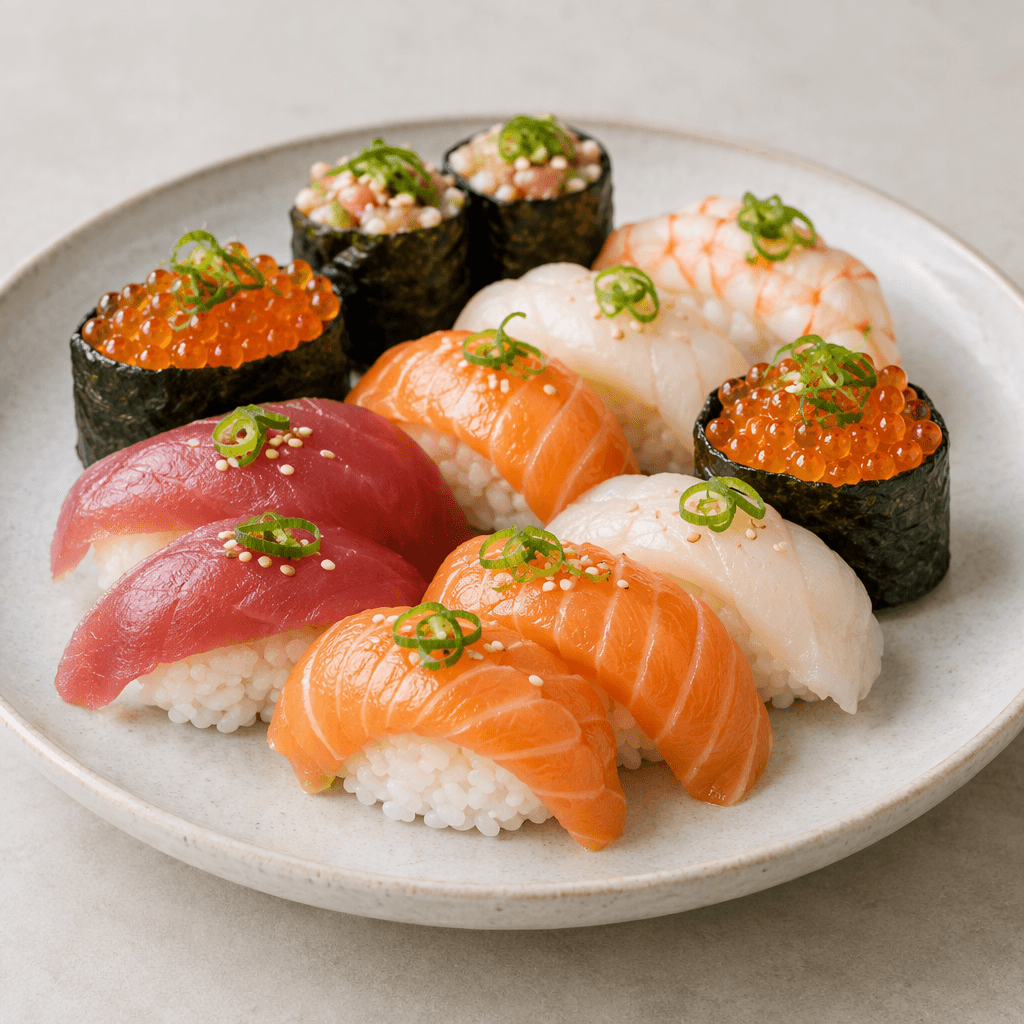
Sushi Calories
Popular Japanese dish of rice and fish
In season: Spring · Summer · Autumn · Winter
CALORIES
GI
POTASSIUM
FIBER
Quick answer
6 piece (medium) of Sushi (120 g) has 156 calories. That works out to 130 calories per 100 g. It contains 31.2 g of carbs, 5.4 g of protein, 1.4 g of fat and 0.8 g of fiber. Its 1.1 µg of B12 covers 45% of the Daily Value. Its glycemic index is 55 (medium), so it raises blood sugar at a moderate pace.
What is Sushi?
Sushi comes from Japan and brings together vinegared rice with ingredients such as fish, seafood, vegetables and seaweed. Familiar styles include nigiri, with a topping on a small mound of rice, and maki, rolled in seaweed; sushi does not always contain raw fish.
It is commonly served with soy sauce, pickled ginger and wasabi, whether as a shared meal or a quick lunch. Outside Japan, you’ll find it in restaurants and takeaway shops worldwide, with local variations alongside traditional combinations. Sushi is rice-led, so carbohydrates make up much of its nutritional profile, while fish adds some protein. For a lighter choice, try vegetable-filled rolls or sashimi alongside a smaller portion of rice, and go easy on the soy sauce.
Sushi Nutrition Facts
Selected: 100 g
130
KCAL / 100G
Carbs
26g
· 9% DV
Protein
4.5g
· 9% DV
Fat
1.2g
· 2% DV
Fiber
0.7g
· 3% DV
DV is the share of the daily value covered, on a 2,000 kcal reference diet.
Calories come from: Carbs 78% · Protein 14% · Fat 8%
Sushi Vitamins & Minerals
Vitamins
B12
0.9µg · 38% DV
B3
1.2mg · 8% DV
B5
0.25mg · 5% DV
B6
0.09mg · 5% DV
Minerals
Selenium
7µg · 13% DV
Sodium
220mg · 10% DV
Iodine
8µg · 5% DV
Phosphorus
38mg · 5% DV
How Nutritious Is Sushi?
Nutrient density
Medium
How many vitamins, minerals and how much fiber this food carries per calorie. A high score means a lot of nutrition for few calories.
Satiety score
Medium
An EatBetter score computed from fiber, protein and calorie density. A high score means staying full longer on the same calories.
Both scores are calculated per 100 g and do not change with the selected portion. The satiety score is EatBetter's own calculation, not a clinical measure.
Sushi Glycemic Index
GLYCEMIC INDEX
GLYCEMIC LOAD
Accounts for portion size — a more realistic measure than GI alone.
How to Burn Off Sushi
To burn the 130 calories in 100 g:
🚶
Walking (5 km/h)
🏃
Running (8 km/h)
🚴
Cycling
🏊
Swimming
Times are calculated with the MET equation for a 70 kg adult. Actual burn varies with your weight, age and pace.
Is Sushi Processed?
NOVA 2
Minimally Processed
1. Unprocessed
2. Minimally Processed
3. Processed
4. Ultra-Processed
NOVA classifies foods into 4 groups by industrial processing. NOVA 1 (unprocessed) is the healthiest.
Does Sushi Contain Allergens?
Contains these allergens:
Which Diets Is Sushi Good For?
Vegan
— Not suitable
Vegetarian
— Not suitable
Gluten-Free
— Not suitable
Dairy-Free
— Not suitable
Mediterranean
✓ Suitable
Paleo
— Not suitable
Whole30
— Not suitable
DASH
— Not suitable
Keto
— Not suitable
Low FODMAP
— Not suitable
Sushi Fat Profile
SATURATED
0.25g
MONOUNSATURATED
0.35g
POLYUNSATURATED
0.18g
Omega 6:3 ratio 0.2:1
Below the ideal 4:1 — a good omega balance.
Compare Sushi
Foods Similar to Sushi
Frequently Asked Questions About Sushi
What is sushi made of?
Sushi is made with rice seasoned with vinegar, usually paired with seafood, vegetables, egg, or other fillings. Raw fish is one possible topping or filling, not a required ingredient.
Does sushi always contain raw fish?
No, sushi does not always contain raw fish. Many pieces use cooked seafood, egg, or vegetables, and some sushi contains no fish at all; the defining ingredient is seasoned rice.
What is the difference between sushi and sashimi?
Sushi includes rice seasoned with vinegar, while sashimi is sliced raw seafood or meat served without sushi rice. Sushi may feature raw fish, but sashimi is not sushi simply because it is served alongside rice.
How do you eat sushi?
Eat sushi in one bite when the piece is small enough, using clean fingers or chopsticks. You can dip it lightly in soy sauce, and eat pickled ginger between different pieces to refresh your palate.
What are the main types of sushi?
Common sushi types include nigiri, a topping over rice; maki, rice and fillings rolled in seaweed; and temaki, a hand-rolled cone. Ingredients vary, so sushi can include cooked seafood, raw fish, or vegetables.
Is sushi healthy?
Sushi can be part of a balanced meal, especially when it features fish or vegetables and modest amounts of sauce. Fried fillings, creamy toppings, and generous soy sauce can add more fat or sodium.
Why is ginger served with sushi?
Pickled ginger is served with sushi to refresh your palate between different pieces, so each filling has a distinct taste. Wasabi, by contrast, adds a sharp heat; both are optional accompaniments.
Why is sushi rice sticky?
Sushi rice is sticky because it is made with short-grain rice, whose starch helps the grains cling together. That texture makes sushi easier to shape into rolls and nigiri without the pieces falling apart.
How long does sushi last in the fridge?
Refrigerate sushi promptly and, especially when it contains raw fish, aim to eat it the same day. Do not eat sushi that has been left at room temperature for too long; the rice also loses its texture as it sits.
Can you eat sushi while pregnant?
It is safer to avoid sushi made with raw fish or raw seafood during pregnancy. Choose thoroughly cooked fillings instead, and ask your healthcare professional which fish and portions are suitable for you.
Have another question about Sushi?
Ask the AI nutrition coach — calories, portions, alternatives and more, answered in seconds in the app.

Scan calories with your camera
Instant AI nutrition analysis

Nutrition data compiled from USDA FoodData Central and scientific sources.