

Ready & Packaged Foods
All →Vegetables & Legumes
All →Desserts & Confectionery
All →Meat & Protein
All →Grains & Bakery
All →Beverages
All →Milk & Dairy
All →

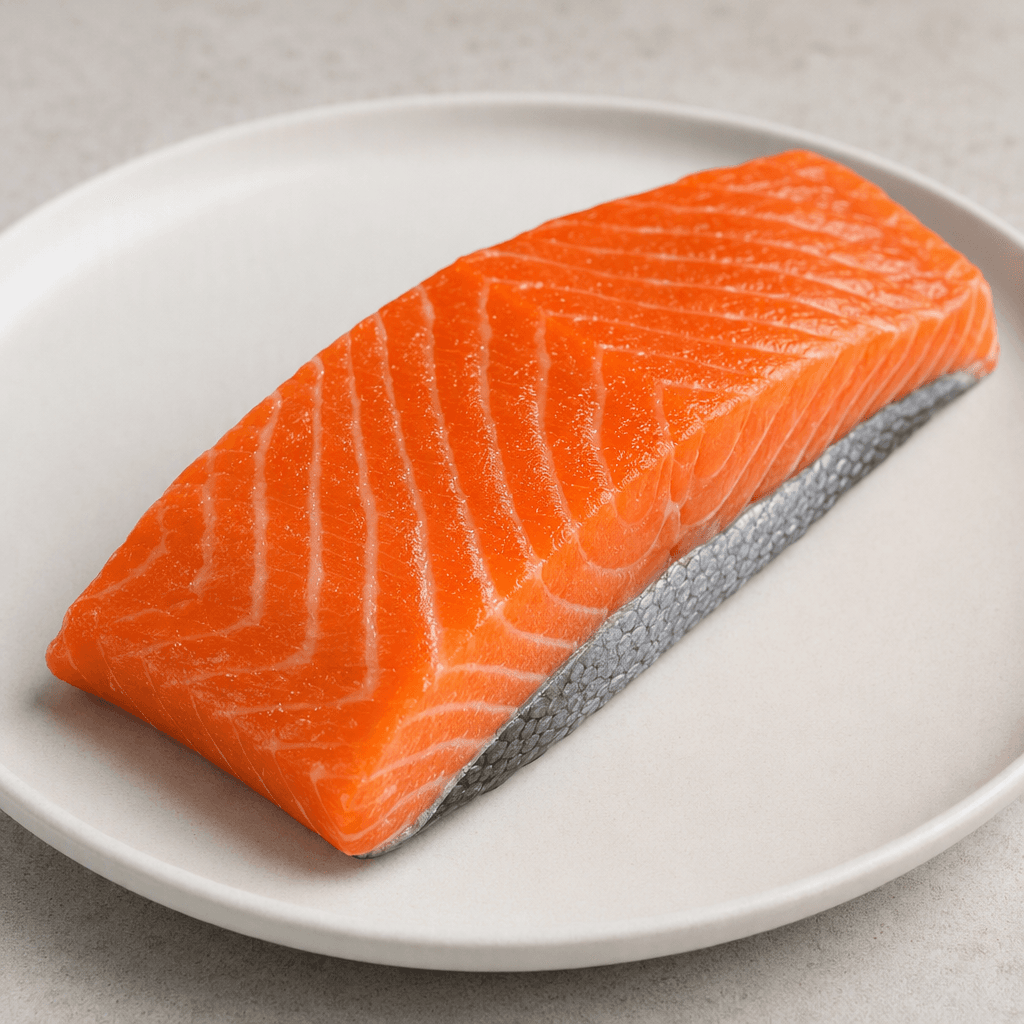
Salmon Fillet Calories
Rich in omega-3, high protein, source of B vitamins
In season: Spring · Summer · Autumn · Winter
CALORIES
GI
POTASSIUM
FIBER
Quick answer
1 piece (medium) of Salmon Fillet (120 g) has 247 calories. That works out to 206 calories per 100 g. It contains 0 g of carbs, 26.4 g of protein, 15.6 g of fat and 0 g of fiber. Its 3.8 µg of B12 covers 160% of the Daily Value. Its glycemic index is 0 (low), so it raises blood sugar slowly.
What is Salmon Fillet?
A salmon fillet is a boneless cut of salmon, often sold with the skin on and ready to cook. Its coral-coloured flesh has fine streaks of fat and a firm texture that separates into moist flakes when cooked. Salmon is especially familiar in northern European and Pacific cuisines, and is now widely enjoyed around the world.
Bake, pan-sear, grill or poach it; it pairs easily with lemon, herbs, vegetables or grains. The mild, rich flavour works for a quick weeknight meal as well as a more formal dinner. Salmon fillet is high in protein and omega-3 fats, with no carbohydrates. For a lighter plate, bake it with little added oil and serve with vegetables.
Salmon Fillet Nutrition Facts
Selected: 100 g
206
KCAL / 100G
Carbs
0g
· 0% DV
Protein
22g
· 44% DV
Fat
13g
· 17% DV
Fiber
0g
· 0% DV
DV is the share of the daily value covered, on a 2,000 kcal reference diet.
Calories come from: Carbs 0% · Protein 43% · Fat 57%
Salmon Fillet Vitamins & Minerals
Vitamins
B12
3.2µg · 133% DV
Vitamin D
13µg · 65% DV
B3
8.5mg · 53% DV
B6
0.8mg · 47% DV
Minerals
Selenium
36µg · 65% DV
Phosphorus
200mg · 29% DV
Iodine
30µg · 20% DV
Potassium ⭐
384mg · 11% DV
How Nutritious Is Salmon Fillet?
Nutrient density
Very high
How many vitamins, minerals and how much fiber this food carries per calorie. A high score means a lot of nutrition for few calories.
Satiety score
Medium
An EatBetter score computed from fiber, protein and calorie density. A high score means staying full longer on the same calories.
Both scores are calculated per 100 g and do not change with the selected portion. The satiety score is EatBetter's own calculation, not a clinical measure.
Salmon Fillet Glycemic Index
GLYCEMIC INDEX
GLYCEMIC LOAD
Accounts for portion size — a more realistic measure than GI alone.
How to Burn Off Salmon Fillet
To burn the 206 calories in 100 g:
🚶
Walking (5 km/h)
🏃
Running (8 km/h)
🚴
Cycling
🏊
Swimming
Times are calculated with the MET equation for a 70 kg adult. Actual burn varies with your weight, age and pace.
Is Salmon Fillet Processed?
NOVA 1
Unprocessed
1. Unprocessed
2. Minimally Processed
3. Processed
4. Ultra-Processed
NOVA classifies foods into 4 groups by industrial processing. NOVA 1 (unprocessed) is the healthiest.
Does Salmon Fillet Contain Allergens?
Contains these allergens:
Which Diets Is Salmon Fillet Good For?
Vegan
— Not suitable
Vegetarian
— Not suitable
Gluten-Free
✓ Suitable
Dairy-Free
— Not suitable
Mediterranean
✓ Suitable
Paleo
✓ Suitable
Whole30
— Not suitable
DASH
— Not suitable
Keto
✓ Suitable
Low FODMAP
— Not suitable
Salmon Fillet Fat Profile
SATURATED
3.1g
MONOUNSATURATED
3.8g
POLYUNSATURATED
3.2g
Omega 6:3 ratio 0.2:1
Below the ideal 4:1 — a good omega balance.
Compare Salmon Fillet
Foods Similar to Salmon Fillet
Frequently Asked Questions About Salmon Fillet
How long should you bake a salmon fillet?
Bake a salmon fillet at 400°F (200°C) for about 12–15 minutes, depending on its thickness. Start checking the thickest part early; the flesh should turn opaque and separate into flakes without becoming dry.
Should you cook a salmon fillet skin-side up or down?
Start a salmon fillet skin-side down, especially when pan-searing it. The skin protects the flesh from direct heat and can turn crisp; flip the fillet near the end if you want the top lightly browned too.
What temperature should a salmon fillet reach?
For a fully cooked salmon fillet, the thickest part should reach 145°F (63°C). Check with a food thermometer inserted sideways into the center, since the outside can look cooked while the middle is still underdone.
How do you cook a salmon fillet in an air fryer?
Air-fry a salmon fillet at 400°F (200°C) for roughly 7–10 minutes, adjusting for thickness. Place it in a single layer and check the center for doneness; thinner pieces can cook faster than the timer suggests.
What seasoning goes well with a salmon fillet?
Lemon, black pepper, garlic, and dill are classic seasonings for a salmon fillet. Pat the surface dry first, then add a little oil and seasoning so it browns well rather than steaming in excess moisture.
Can you cook a salmon fillet straight from frozen?
Yes, you can cook a salmon fillet from frozen, though it takes longer than cooking a thawed piece. Bake it until the center reaches 145°F (63°C), and avoid relying on the outside color to judge doneness.
Can you eat the skin on a salmon fillet?
Yes, salmon fillet skin is edible when it has been properly scaled and cooked. Pan-searing skin-side down makes it crisp; if you prefer not to eat it, the skin usually separates easily after cooking.
Should you rinse a salmon fillet before cooking it?
No, do not rinse a salmon fillet before cooking. Water does not reliably remove harmful bacteria and can spread them around the sink and nearby surfaces; pat the fish dry with a clean paper towel instead.
How long does raw salmon fillet last in the fridge?
Keep raw salmon fillet refrigerated at 40°F (4°C) or colder and cook it within one to two days. Store it covered on a low shelf so its juices cannot drip onto other foods.
How do you remove pin bones from a salmon fillet?
Run your fingers gently along the center of the salmon fillet to find any pin bones, then pull each one out with clean tweezers. Grip the exposed tip and pull in the direction the bone points.
Have another question about Salmon Fillet?
Ask the AI nutrition coach — calories, portions, alternatives and more, answered in seconds in the app.

Scan calories with your camera
Instant AI nutrition analysis

Nutrition data compiled from USDA FoodData Central and scientific sources.