

Ready & Packaged Foods
All →Vegetables & Legumes
All →Desserts & Confectionery
All →Meat & Protein
All →Grains & Bakery
All →Beverages
All →Milk & Dairy
All →

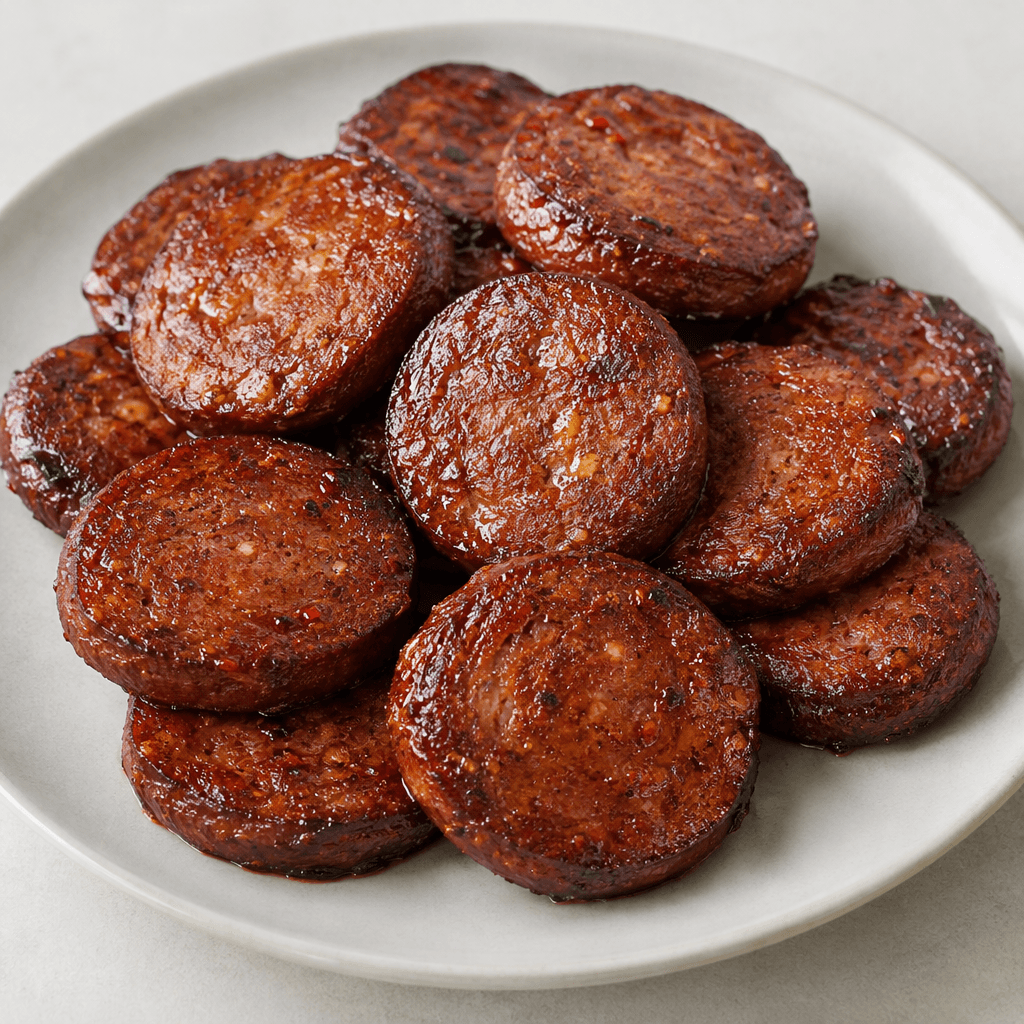
Sujuk (cooked) Calories
Spicy, rich in protein and fat, contains iron and B vitamins
In season: Spring · Summer · Autumn · Winter
CALORIES
GI
POTASSIUM
FIBER
Quick answer
1 slice (medium) of Sujuk (cooked) (25 g) has 103 calories. That works out to 410 calories per 100 g. It contains 0.6 g of carbs, 4.9 g of protein, 9 g of fat and 0 g of fiber. Its 0.5 µg of B12 covers 22% of the Daily Value. Its glycemic index is 0 (low), so it raises blood sugar slowly.
What is Sujuk (cooked)?
Cooked sujuk is sliced, cooked Turkish sausage, traditionally seasoned with garlic and spices such as cumin. Pan-frying gives it browned edges and a tender, richly flavoured centre, with some of its own fat rendering into the pan.
In Turkey and in Turkish communities worldwide, it is often served at breakfast with eggs, tucked into bread, or added to a hot sandwich. Its flavour is savoury and spicy, and it is rich in protein and fat while low in carbohydrates. Pair it with fresh tomatoes, peppers or greens; cooking it in a dry pan lets you enjoy the browned slices without adding extra oil.
Sujuk (cooked) Nutrition Facts
Selected: 100 g
410
KCAL / 100G
Carbs
2.5g
· 1% DV
Protein
19.5g
· 39% DV
Fat
36g
· 46% DV
Fiber
0g
· 0% DV
DV is the share of the daily value covered, on a 2,000 kcal reference diet.
Calories come from: Carbs 2% · Protein 19% · Fat 79%
Sujuk (cooked) Vitamins & Minerals
Vitamins
B12
2.1µg · 88% DV
B1
0.45mg · 38% DV
B3
4.1mg · 26% DV
B2
0.32mg · 25% DV
Minerals
Sodium
1200mg · 52% DV
Zinc
3mg · 27% DV
Phosphorus
180mg · 26% DV
Selenium
13µg · 24% DV
How Nutritious Is Sujuk (cooked)?
Nutrient density
Medium
How many vitamins, minerals and how much fiber this food carries per calorie. A high score means a lot of nutrition for few calories.
Satiety score
Low
An EatBetter score computed from fiber, protein and calorie density. A high score means staying full longer on the same calories.
Both scores are calculated per 100 g and do not change with the selected portion. The satiety score is EatBetter's own calculation, not a clinical measure.
Sujuk (cooked) Glycemic Index
GLYCEMIC INDEX
GLYCEMIC LOAD
Accounts for portion size — a more realistic measure than GI alone.
How to Burn Off Sujuk (cooked)
To burn the 410 calories in 100 g:
🚶
Walking (5 km/h)
🏃
Running (8 km/h)
🚴
Cycling
🏊
Swimming
Times are calculated with the MET equation for a 70 kg adult. Actual burn varies with your weight, age and pace.
Is Sujuk (cooked) Processed?
NOVA 3
Processed
1. Unprocessed
2. Minimally Processed
3. Processed
4. Ultra-Processed
NOVA classifies foods into 4 groups by industrial processing. NOVA 1 (unprocessed) is the healthiest.
Does Sujuk (cooked) Contain Allergens?
No known major allergens
Which Diets Is Sujuk (cooked) Good For?
Vegan
— Not suitable
Vegetarian
— Not suitable
Gluten-Free
✓ Suitable
Dairy-Free
— Not suitable
Mediterranean
✓ Suitable
Paleo
✓ Suitable
Whole30
— Not suitable
DASH
— Not suitable
Keto
✓ Suitable
Low FODMAP
— Not suitable
Sujuk (cooked) Fat Profile
SATURATED
14.2g
MONOUNSATURATED
16.5g
POLYUNSATURATED
2.1g
Omega 6:3 ratio 4.4:1
Above the ideal 4:1 (4.4:1).
Compare Sujuk (cooked)
Foods Similar to Sujuk (cooked)
Frequently Asked Questions About Sujuk (cooked)
How do you reheat cooked sujuk?
Reheat cooked sujuk in a skillet over low to medium heat, turning the slices until warm. It is already cooked, so prolonged frying is unnecessary and can make the slices dry while releasing more fat.
Can you eat cooked sujuk cold?
Yes, cooked sujuk can be eaten cold if it was cooked safely and kept refrigerated. Once it has been left at room temperature for an extended period, discard it rather than relying on reheating to make it safe.
Why does cooked sujuk curl or split in the pan?
Cooked sujuk can curl or split because its casing and meat contract at different rates as they heat. Make shallow cuts around the edge before reheating, or use a lower heat so the slices warm more evenly.
Do you need to remove the casing from cooked sujuk?
Only remove the casing if it is an inedible plastic-like wrapper; a natural or edible casing can be left on. Check the product packaging when the casing is unclear, and peel it away before serving if it is not meant to be eaten.
How long does cooked sujuk last in the fridge?
Store cooked sujuk in a covered container in the refrigerator and use it within three to four days. Refrigerate leftovers promptly, and discard them if they develop an unusual smell, slimy texture, or unexpected discoloration.
Can you freeze cooked sujuk slices?
Yes, cooked sujuk slices freeze well when sealed in an airtight container or freezer bag. Separate the slices so you can take out what you need, thaw them in the refrigerator, and avoid freezing them again after thawing.
What can you serve with cooked sujuk?
Cooked sujuk pairs well with eggs, flatbread, tomatoes, and fresh vegetables. Since it has a rich, spiced flavor, a simple accompaniment such as sliced cucumber or a crisp salad can balance the plate without competing with it.
Can you fry cooked sujuk without adding oil?
Yes, you can usually fry cooked sujuk without added oil because its fat renders as it warms. Start with a cool or lightly warmed pan over moderate heat, and drain excess fat if you prefer a less oily result.
Is cooked sujuk the same as chorizo?
No, cooked sujuk and chorizo are different sausages. Sujuk is associated with Turkish and neighboring cuisines and is typically seasoned with garlic and warm spices; chorizo varies by region and has its own seasoning and preparation.
Is cooked sujuk too salty to eat often?
Cooked sujuk is often salty as well as rich, so frequent large portions can add substantial sodium to your meals. If you need to limit sodium for a medical reason, ask your clinician or dietitian how it fits your diet.
Have another question about Sujuk (cooked)?
Ask the AI nutrition coach — calories, portions, alternatives and more, answered in seconds in the app.

Scan calories with your camera
Instant AI nutrition analysis

Nutrition data compiled from USDA FoodData Central and scientific sources.