

Ready & Packaged Foods
All →Vegetables & Legumes
All →Desserts & Confectionery
All →Meat & Protein
All →Grains & Bakery
All →Beverages
All →Milk & Dairy
All →

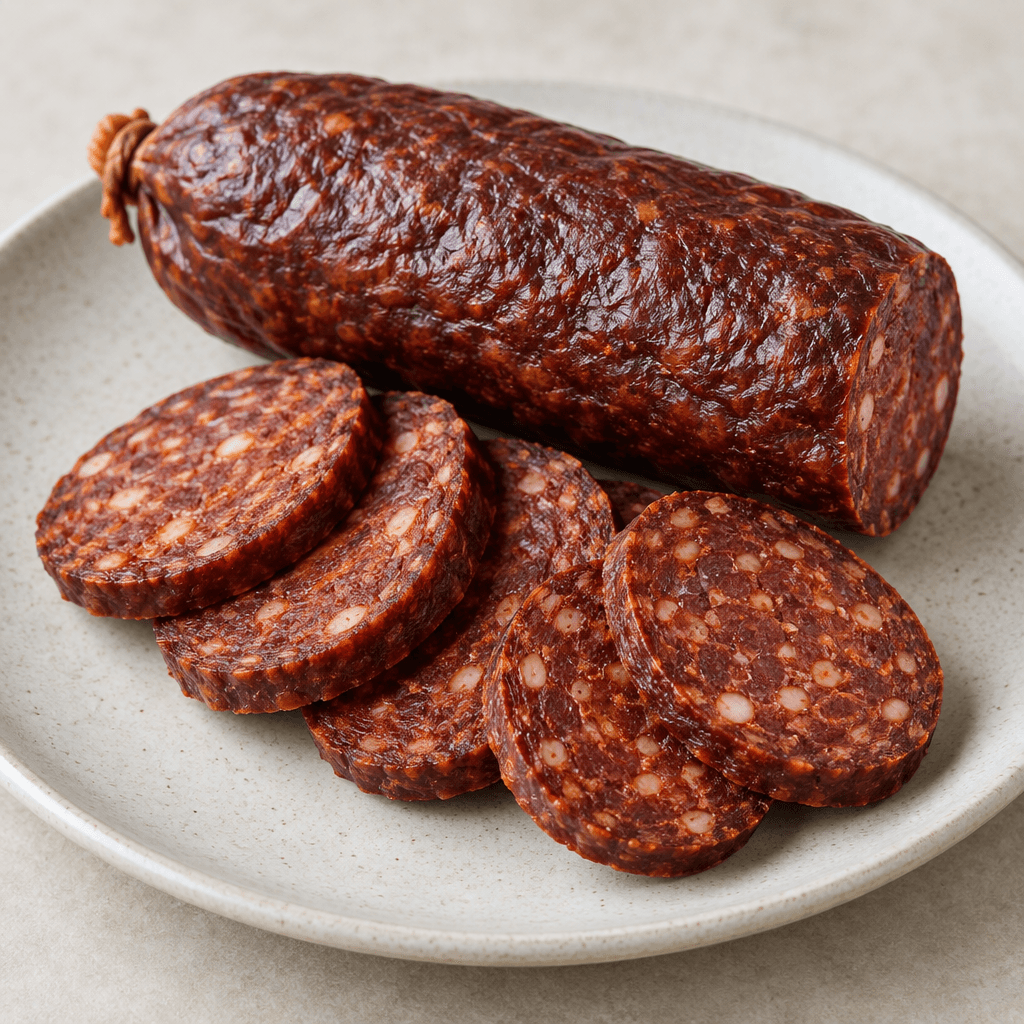
Sujuk Calories
Spicy, fermented Turkish/Central Asian sausage, high in protein and fat
In season: Spring · Summer · Autumn · Winter
CALORIES
GI
POTASSIUM
FIBER
Quick answer
2 slice (medium) of Sujuk (40 g) has 164 calories. That works out to 410 calories per 100 g. It contains 1 g of carbs, 8.8 g of protein, 14.4 g of fat and 0 g of fiber. Its 0.9 µg of B12 covers 37% of the Daily Value. Its glycemic index is 0 (low), so it raises blood sugar slowly.
What is Sujuk?
Sujuk is a firm, fermented and dried sausage associated with Turkey and parts of Central Asia. Turkish versions are commonly made with beef seasoned with garlic and spices such as cumin and red pepper. Its deep red, dense interior gives way to a bold, savoury aroma when sliced and heated.
In Turkey, it is often fried for breakfast, served with eggs, or added to pide, beans and sandwiches. Across the wider region, it is also enjoyed in flatbreads and cooked dishes; elsewhere, it works much like other strongly seasoned sausages, in small amounts. Sujuk is rich in both protein and fat, so a few slices bring plenty of flavour. Cook it without extra oil and pair it with tomatoes or greens for a lighter plate.
Sujuk Nutrition Facts
Selected: 100 g
410
KCAL / 100G
Carbs
2.5g
· 1% DV
Protein
22g
· 44% DV
Fat
36g
· 46% DV
Fiber
0g
· 0% DV
DV is the share of the daily value covered, on a 2,000 kcal reference diet.
Calories come from: Carbs 2% · Protein 21% · Fat 77%
Sujuk Vitamins & Minerals
Vitamins
B12
2.2µg · 92% DV
B1
0.6mg · 50% DV
B3
5.5mg · 34% DV
B2
0.3mg · 23% DV
Minerals
Sodium
1200mg · 52% DV
Zinc
3mg · 27% DV
Phosphorus
180mg · 26% DV
Selenium
13µg · 24% DV
How Nutritious Is Sujuk?
Nutrient density
Medium
How many vitamins, minerals and how much fiber this food carries per calorie. A high score means a lot of nutrition for few calories.
Satiety score
Low
An EatBetter score computed from fiber, protein and calorie density. A high score means staying full longer on the same calories.
Both scores are calculated per 100 g and do not change with the selected portion. The satiety score is EatBetter's own calculation, not a clinical measure.
Sujuk Glycemic Index
GLYCEMIC INDEX
GLYCEMIC LOAD
Accounts for portion size — a more realistic measure than GI alone.
How to Burn Off Sujuk
To burn the 410 calories in 100 g:
🚶
Walking (5 km/h)
🏃
Running (8 km/h)
🚴
Cycling
🏊
Swimming
Times are calculated with the MET equation for a 70 kg adult. Actual burn varies with your weight, age and pace.
Is Sujuk Processed?
NOVA 3
Processed
1. Unprocessed
2. Minimally Processed
3. Processed
4. Ultra-Processed
NOVA classifies foods into 4 groups by industrial processing. NOVA 1 (unprocessed) is the healthiest.
Does Sujuk Contain Allergens?
No known major allergens
Which Diets Is Sujuk Good For?
Vegan
— Not suitable
Vegetarian
— Not suitable
Gluten-Free
✓ Suitable
Dairy-Free
— Not suitable
Mediterranean
✓ Suitable
Paleo
✓ Suitable
Whole30
— Not suitable
DASH
— Not suitable
Keto
✓ Suitable
Low FODMAP
— Not suitable
Sujuk Fat Profile
SATURATED
14.5g
MONOUNSATURATED
16.5g
POLYUNSATURATED
2.1g
Omega 6:3 ratio 3.8:1
Below the ideal 4:1 — a good omega balance.
Compare Sujuk
Foods Similar to Sujuk
Frequently Asked Questions About Sujuk
How do you cook sujuk?
Cook sujuk slowly in a pan over medium-low heat so the slices warm through and release their fat without burning. Start with a dry pan; the sausage usually provides enough fat for frying. Turn the slices as they brown.
What is sujuk made of?
Sujuk is a seasoned sausage usually made from beef, animal fat, garlic, and spices such as cumin and paprika. The meat mixture is stuffed into a casing and fermented and dried, creating its firm texture and bold, savory flavor.
What does sujuk taste like?
Sujuk tastes savory, garlicky, and strongly spiced, often with notes of cumin and paprika. Its flavor can be quite salty and its heat varies by recipe; cooking it releases its fat and makes the spices more pronounced.
Can you eat sujuk raw?
Not every sujuk is ready to eat without cooking. Although it is often fermented and dried, some varieties are intended to be cooked; follow the package’s preparation instructions, and cook it thoroughly if you are unsure.
Is sujuk the same as chorizo?
No. Sujuk is a Turkish and regional sausage commonly seasoned with garlic and cumin, while Spanish chorizo typically gets its characteristic flavor and color from smoked paprika. Both are spiced sausages, but their ingredients, curing methods, and regional styles differ.
How is sujuk served for breakfast?
Sujuk is often served hot at breakfast, especially alongside eggs, bread, tomatoes, or cheese. For a simple Turkish-style breakfast, brown the slices in a pan and cook eggs in the fat they release; add no extra oil unless the pan is dry.
How should you store sujuk after opening it?
Keep opened sujuk refrigerated and tightly wrapped, or place it in a sealed container to limit drying and contact with other foods. Since storage instructions vary between dried and softer varieties, follow the package guidance and use it promptly once cut.
Can you freeze sujuk?
Yes, sujuk can be frozen. Slice it or divide it into portions before sealing it in a freezer-safe bag, so you can thaw only what you need. Thaw it in the refrigerator and avoid refreezing it after thawing.
Why does sujuk release so much oil when cooked?
Sujuk releases oil because its animal fat melts as the sausage heats up. Cook it over medium-low heat to reduce splattering and prevent the spices from burning, then drain off excess fat if you prefer a less oily dish.
Is sujuk healthy to eat regularly?
Sujuk can provide protein, but it is also a processed meat that can be high in fat and salt. Eating it occasionally and in modest portions, rather than making it a daily staple, is a practical way to enjoy it.
Have another question about Sujuk?
Ask the AI nutrition coach — calories, portions, alternatives and more, answered in seconds in the app.

Scan calories with your camera
Instant AI nutrition analysis

Nutrition data compiled from USDA FoodData Central and scientific sources.