

Ready & Packaged Foods
All →Vegetables & Legumes
All →Desserts & Confectionery
All →Meat & Protein
All →Grains & Bakery
All →Beverages
All →Milk & Dairy
All →

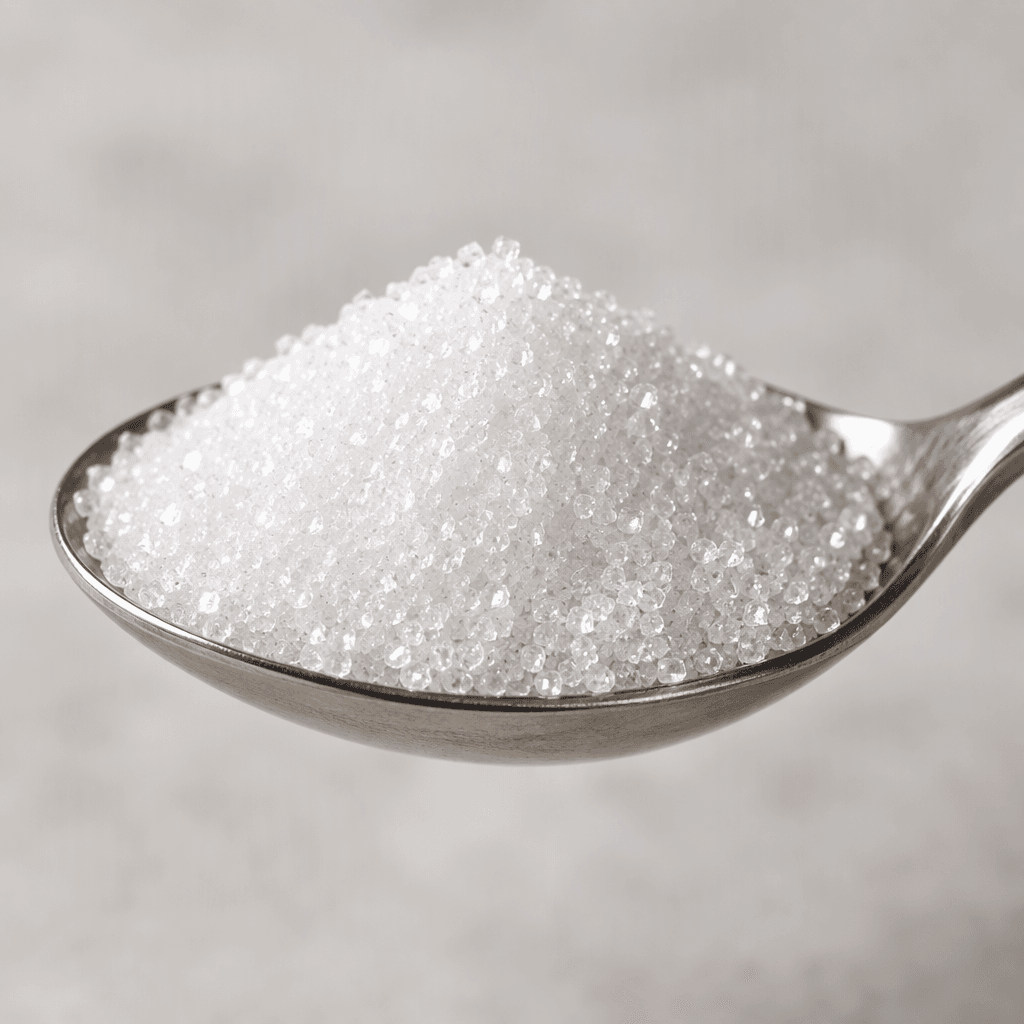
Sugar (teaspoon) Calories
Quick energy, high glycemic index, pure carbohydrate
In season: Spring · Summer · Autumn · Winter
CALORIES · 100 G
GI
POTASSIUM · 100 G
FIBER · 100 G
Quick answer
1 teaspoon (medium) of Sugar (teaspoon) (4 g) has 15 calories. That works out to 387 calories per 100 g. It contains 4 g of carbs, 0 g of protein, 0 g of fat and 0 g of fiber. Its glycemic index is 65 (high), so it raises blood sugar quickly.
Sugar (teaspoon) Nutrition Facts
Selected: 1 teaspoon (medium) · 4 g
15
KCAL / 4G
Carbs
4g
· 1% DV
Protein
0g
· 0% DV
Fat
0g
· 0% DV
Fiber
0g
· 0% DV
DV is the share of the daily value covered, on a 2,000 kcal reference diet.
Calories come from: Carbs 100% · Protein 0% · Fat 0%
Sugar (teaspoon) nutrition facts table · 1 teaspoon (medium) (4 g)
| Nutrient | Amount | % DV |
|---|---|---|
| Calories | 15 kcal | |
| Total fat | 0 g | 0% |
| Saturated fat | 0 g | 0% |
| Trans fat | 0 g | |
| Sodium | 0.04 mg | 0% |
| Total carbohydrate | 4 g | 1% |
| Fiber | 0 g | 0% |
| Protein | 0 g | 0% |
Calories: Calories measure energy. Average daily need is 2,000 kcal. Excess calories are stored as fat, too few cause weight loss.
Carbs: Your body's primary energy source. The brain runs exclusively on carbs. Daily need: 275g.
Protein: Essential for muscle repair and cell growth. Daily need: 50g. Keeps you full and boosts metabolism.
Fat: Needed for hormone production and vitamin absorption. Daily need: 78g. Limit saturated fats, choose unsaturated.
Fiber: Critical for digestive health and satiety. Daily need: 28g. Stabilizes blood sugar, lowers cholesterol.

Log this food in EatBetter
100,000+ people use it
- Get your daily calorie target
- Snap your meal, log it in seconds
- See every vitamin and mineral

📸 Scan the code to get the app free.

How Many Calories in 1 Teaspoon of Sugar (teaspoon)?
| Serving | Amount | Calories |
|---|---|---|
| 1 teaspoon (medium) | 4 g | 15 kcal |
| 1 piece (large) | 5 g | 19 kcal |
| 2 teaspoon (double) | 8 g | 31 kcal |
| 1 serving (large) | 10 g | 39 kcal |
| 1 tablespoon (medium) | 12 g | 46 kcal |
| 1 tablespoon (large) | 15 g | 58 kcal |
| 1 pack (small) | 20 g | 77 kcal |
| 100 g | 100 g | 387 kcal |
| 1 cup (whole) | 200 g | 774 kcal |
Calculated from 387 calories per 100 g.
Frequently Asked Questions About Sugar (teaspoon)
Is sugar bad for you?
Too much sugar can harm your health, especially by contributing to tooth decay and excess weight. You do not need to eliminate it entirely, but cutting back on added sugar in drinks and everyday foods is a useful step.
Does eating sugar cause diabetes?
Sugar alone does not directly cause diabetes. Type 1 diabetes is not caused by eating sugar; for type 2, frequent sugary drinks and excess weight can raise risk, alongside other factors such as genetics and activity level.
Can people with diabetes eat sugar?
Yes, people with diabetes can eat sugar, but it can raise blood glucose quickly, so portions and meal timing matter. Anyone using insulin or glucose-lowering medication should follow an individualized plan from their diabetes care team.
Does sugar make you gain weight?
It can, when it adds more energy to your diet than your body uses. Sugary drinks and frequent sweets are easy to consume without feeling full, so reducing added sugar in drinks can be a practical change.
Is brown sugar healthier than white sugar?
No, brown sugar is not meaningfully healthier than white sugar. It contains molasses, which gives it its color and flavor, but your body still treats it as sugar; use either kind in moderation.
Does sugar expire?
Dry, uncontaminated sugar is very unlikely to spoil, though it can harden into lumps if exposed to moisture. Discard it if it gets wet, develops an unusual smell or appearance, or is contaminated by pests.
How should sugar be stored?
Store sugar in a clean, airtight container in a cool, dry place. Moisture can make it clump, while an open container can pick up odors or attract pests; always use a dry spoon.
Does sugar make children hyperactive?
Research has not shown that sugar directly causes hyperactivity in children. Sugary treats are often eaten at exciting events, which can make the two seem linked; limiting frequent sugary snacks still helps protect children’s teeth.
Is sugar addictive?
Sugar is not considered addictive in the same clinical sense as drugs, though people can strongly crave sweet foods and find habits hard to change. Regular meals and keeping fewer sugary snacks within easy reach can help reduce cravings.
How is white sugar made?
White sugar is made by extracting sugar-rich juice from sugar cane or sugar beet, then purifying and concentrating it. The sugar is crystallized, separated from the remaining liquid, and dried before being sold as granulated sugar.
Sugar (teaspoon) Vitamins & Minerals
Vitamins
Vitamin A
0µg · 0% DV
B1
0mg · 0% DV
B2
0mg · 0% DV
B3
0mg · 0% DV
Minerals
Copper
0mg · 0% DV
Manganese
0mg · 0% DV
Calcium
0.04mg · 0% DV
Phosphorus
0.02mg · 0% DV
Potassium ⭐
0.08mg · 0% DV
Sodium
0.04mg · 0% DV
Sugar (teaspoon) Glycemic Index
GLYCEMIC INDEX
GLYCEMIC LOAD
Accounts for portion size — a more realistic measure than GI alone.
How to Burn Off Sugar (teaspoon)
To burn the 15 calories in 1 teaspoon (medium) (4 g):
🚶
Walking (5 km/h)
🏃
Running (8 km/h)
🚴
Cycling
🏊
Swimming
Times are calculated with the MET equation for a 70 kg adult. Actual burn varies with your weight, age and pace.
What is Sugar (teaspoon)?
Sugar, measured here by the teaspoon, is the familiar table sweetener usually made from sugar beet or sugar cane. It dissolves readily in hot drinks and is also used in baking, desserts, sauces and preserves. Across the English-speaking world, people add it to tea or coffee to taste, while recipes use it to sweeten and help give baked goods their texture and colour.
Its clean sweetness can be adjusted easily from cup to cup. Sugar is almost entirely carbohydrate, with 99.8 g per 100 g, and provides quick energy. If you want a less-sweet drink, start with a smaller spoonful; cinnamon or citrus can add flavour without adding more sugar.
How Nutritious Is Sugar (teaspoon)?
Nutrient density
Low
How many vitamins, minerals and how much fiber this food carries per calorie. A high score means a lot of nutrition for few calories.
Satiety score
Low
An EatBetter score computed from fiber, protein and calorie density. A high score means staying full longer on the same calories.
Both scores are calculated per 100 g and do not change with the selected portion. The satiety score is EatBetter's own calculation, not a clinical measure.
Is Sugar (teaspoon) Processed?
NOVA 3
Processed
1. Unprocessed
2. Minimally Processed
3. Processed
4. Ultra-Processed
NOVA classifies foods into 4 groups by industrial processing. NOVA 1 (unprocessed) is the healthiest.
Does Sugar (teaspoon) Contain Allergens?
No known major allergens
Which Diets Is Sugar (teaspoon) Good For?
Vegan
✓ Suitable
Vegetarian
✓ Suitable
Gluten-Free
✓ Suitable
Dairy-Free
— Not suitable
Mediterranean
✓ Suitable
Paleo
— Not suitable
Whole30
— Not suitable
DASH
— Not suitable
Keto
— Not suitable
Low FODMAP
— Not suitable
Sugar (teaspoon) Fat Profile
SATURATED
0g
MONOUNSATURATED
0g
POLYUNSATURATED
0g
Compare Sugar (teaspoon)
Foods Similar to Sugar (teaspoon)
Have another question about Sugar (teaspoon)?
Ask the AI nutrition coach — calories, portions, alternatives and more, answered in seconds in the app.

Scan calories with your camera
Instant AI nutrition analysis

Nutrition data compiled from USDA FoodData Central and scientific sources.