

Ready & Packaged Foods
All →Vegetables & Legumes
All →Desserts & Confectionery
All →Meat & Protein
All →Grains & Bakery
All →Beverages
All →Milk & Dairy
All →

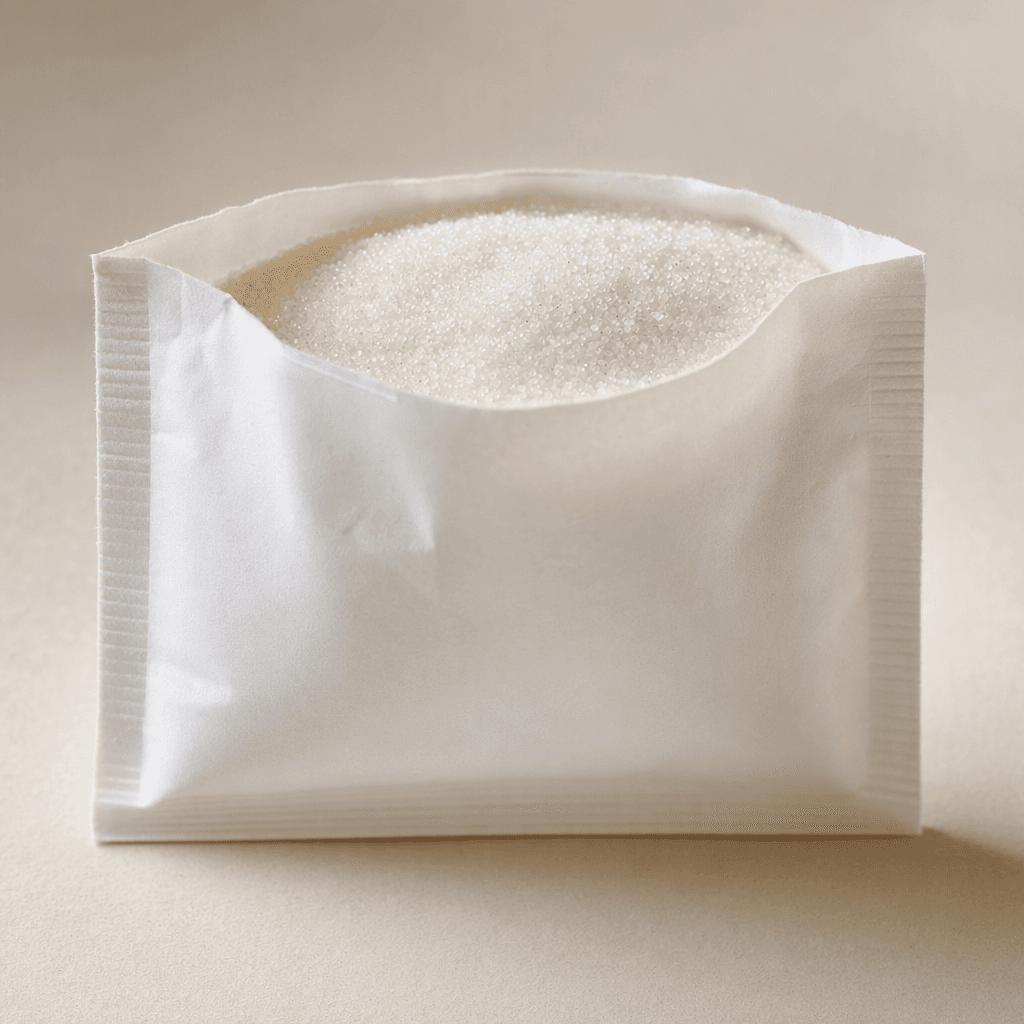
Sugar packet Calories
Single-serve refined white sugar
CALORIES · 100 G
GI
POTASSIUM · 100 G
FIBER · 100 G
Quick answer
1 pack (mini) of Sugar packet (4 g) has 15 calories. That works out to 387 calories per 100 g. It contains 4 g of carbs, 0 g of protein, 0 g of fat and 0 g of fiber. Its glycemic index is 65 (medium), so it raises blood sugar at a moderate pace.
Sugar packet Nutrition Facts
Selected: 1 pack (mini) · 4 g
15
KCAL / 4G
Carbs
4g
· 1% DV
Protein
0g
· 0% DV
Fat
0g
· 0% DV
Fiber
0g
· 0% DV
DV is the share of the daily value covered, on a 2,000 kcal reference diet.
Calories come from: Carbs 100% · Protein 0% · Fat 0%
Sugar packet nutrition facts table · 1 pack (mini) (4 g)
| Nutrient | Amount | % DV |
|---|---|---|
| Calories | 15 kcal | |
| Total fat | 0 g | 0% |
| Saturated fat | 0 g | 0% |
| Trans fat | 0 g | |
| Sodium | 0.04 mg | 0% |
| Total carbohydrate | 4 g | 1% |
| Fiber | 0 g | 0% |
| Protein | 0 g | 0% |
Calories: Calories measure energy. Average daily need is 2,000 kcal. Excess calories are stored as fat, too few cause weight loss.
Carbs: Your body's primary energy source. The brain runs exclusively on carbs. Daily need: 275g.
Protein: Essential for muscle repair and cell growth. Daily need: 50g. Keeps you full and boosts metabolism.
Fat: Needed for hormone production and vitamin absorption. Daily need: 78g. Limit saturated fats, choose unsaturated.
Fiber: Critical for digestive health and satiety. Daily need: 28g. Stabilizes blood sugar, lowers cholesterol.

Log this food in EatBetter
100,000+ people use it
- Get your daily calorie target
- Snap your meal, log it in seconds
- See every vitamin and mineral

📸 Scan the code to get the app free.

How Many Calories in 1 Mini Pack of Sugar packet?
| Serving | Amount | Calories |
|---|---|---|
| 1 pack (mini) | 4 g | 15 kcal |
| 1 g | 1 g | 4 kcal |
| 1 teaspoon (small) | 4 g | 15 kcal |
| ½ tablespoon (half) | 6 g | 23 kcal |
| 2 pack (double) | 8 g | 31 kcal |
| 2 teaspoon (medium) | 8 g | 31 kcal |
| 3 pack (triple) | 12 g | 46 kcal |
| 1 tablespoon (medium) | 12.5 g | 48 kcal |
| 100 g | 100 g | 387 kcal |
Calculated from 387 calories per 100 g.
Frequently Asked Questions About Sugar packet
What is a sugar packet made of?
A typical sugar packet contains granulated white sucrose, the same basic sugar used in a bowl of table sugar. The packet is a single-serving format; it does not make the sugar a different sweetener.
Do sugar packets expire?
Dry sugar keeps well and does not spoil easily, but its quality can suffer if moisture or contaminants get into the packet. Follow any date printed on the package, and discard packets that are wet, damaged, or dirty.
Can you use a sugar packet instead of granulated sugar in baking?
Yes, the sugar itself can be used in baking, but packet sizes can vary. For a reliable result, measure the amount your recipe calls for rather than assuming every packet contains the same quantity.
Why does sugar in a packet get hard or lumpy?
Moisture makes sugar crystals stick together, so a damp or torn packet may contain lumps. Store unopened packets somewhere dry, and keep any sugar from an opened packet in a clean, tightly closed container.
Are sugar packets the same as sugar cubes?
They are usually made from the same ingredient, sucrose, but sugar packets contain loose granules while sugar cubes are pressed into shape. Either can sweeten a drink; a cube may take longer to dissolve.
Can sugar packets dissolve in iced coffee or cold drinks?
Yes, sugar from a packet dissolves in cold drinks, though more slowly than in hot ones. Stir thoroughly after adding it; otherwise, some granules may settle at the bottom of the glass.
Can you substitute a sugar packet for a teaspoon of sugar?
Not reliably, because packet sizes differ by brand and country. If a recipe or drink needs a precise amount, measure the sugar rather than treating every packet as an exact teaspoon.
How should you store opened sugar packets?
Once opened, keep the sugar in a clean, dry, airtight container instead of leaving the torn packet exposed. This helps prevent moisture, kitchen odors, and spills from affecting the granules.
Is sugar from a sugar packet safe for people with diabetes?
Sugar from a packet can raise blood glucose, so its effect needs to be counted in a person’s eating and diabetes-management plan. Ask your doctor or dietitian how it fits your individual plan.
Can sugar packets contribute to weight gain?
They can contribute if frequent use adds more energy than your body uses over time. Sugar in coffee, tea, or other drinks is easy to overlook, so consider how often you add it throughout the day.
Sugar packet Vitamins & Minerals
Vitamins
Vitamin A
0µg · 0% DV
B1
0mg · 0% DV
B2
0mg · 0% DV
B3
0mg · 0% DV
Minerals
Calcium
0.04mg · 0% DV
Potassium ⭐
0.08mg · 0% DV
Iron
0mg · 0% DV
Sodium
0.04mg · 0% DV
Sugar packet Glycemic Index
GLYCEMIC INDEX
GLYCEMIC LOAD
Accounts for portion size — a more realistic measure than GI alone.
How to Burn Off Sugar packet
To burn the 15 calories in 1 pack (mini) (4 g):
🚶
Walking (5 km/h)
🏃
Running (8 km/h)
🚴
Cycling
🏊
Swimming
Times are calculated with the MET equation for a 70 kg adult. Actual burn varies with your weight, age and pace.
What is Sugar packet?
A sugar packet is a single-serving sachet of fine white granulated sugar, commonly placed beside tea and coffee in cafés, restaurants, hotels and offices. It is a convenient way to sweeten a drink without keeping a sugar bowl on the table.
The crystals dissolve quickly and add straightforward sweetness. In many places, packets are offered with coffee or tea, and diners can choose how much to add; they are also handy for taking along when travelling. Nutritionally, the contents are essentially carbohydrate, with no meaningful protein or fibre. A mini packet is typically about 4 g. For a less-sweet drink, start with part of a packet, or bring out the flavour with spices or citrus instead.
How Nutritious Is Sugar packet?
Satiety score
Low
An EatBetter score computed from fiber, protein and calorie density. A high score means staying full longer on the same calories.
Both scores are calculated per 100 g and do not change with the selected portion. The satiety score is EatBetter's own calculation, not a clinical measure.
Is Sugar packet Processed?
NOVA 3
Processed
1. Unprocessed
2. Minimally Processed
3. Processed
4. Ultra-Processed
NOVA classifies foods into 4 groups by industrial processing. NOVA 1 (unprocessed) is the healthiest.
Does Sugar packet Contain Allergens?
No known major allergens
Which Diets Is Sugar packet Good For?
Vegan
✓ Suitable
Vegetarian
✓ Suitable
Gluten-Free
✓ Suitable
Dairy-Free
— Not suitable
Mediterranean
— Not suitable
Paleo
— Not suitable
Whole30
— Not suitable
DASH
— Not suitable
Keto
— Not suitable
Low FODMAP
— Not suitable
Sugar packet Fat Profile
SATURATED
0g
MONOUNSATURATED
0g
POLYUNSATURATED
0g
Compare Sugar packet
Foods Similar to Sugar packet
Have another question about Sugar packet?
Ask the AI nutrition coach — calories, portions, alternatives and more, answered in seconds in the app.

Scan calories with your camera
Instant AI nutrition analysis

Nutrition data compiled from USDA FoodData Central and scientific sources.