

Ready & Packaged Foods
All →Vegetables & Legumes
All →Desserts & Confectionery
All →Meat & Protein
All →Grains & Bakery
All →Beverages
All →Milk & Dairy
All →

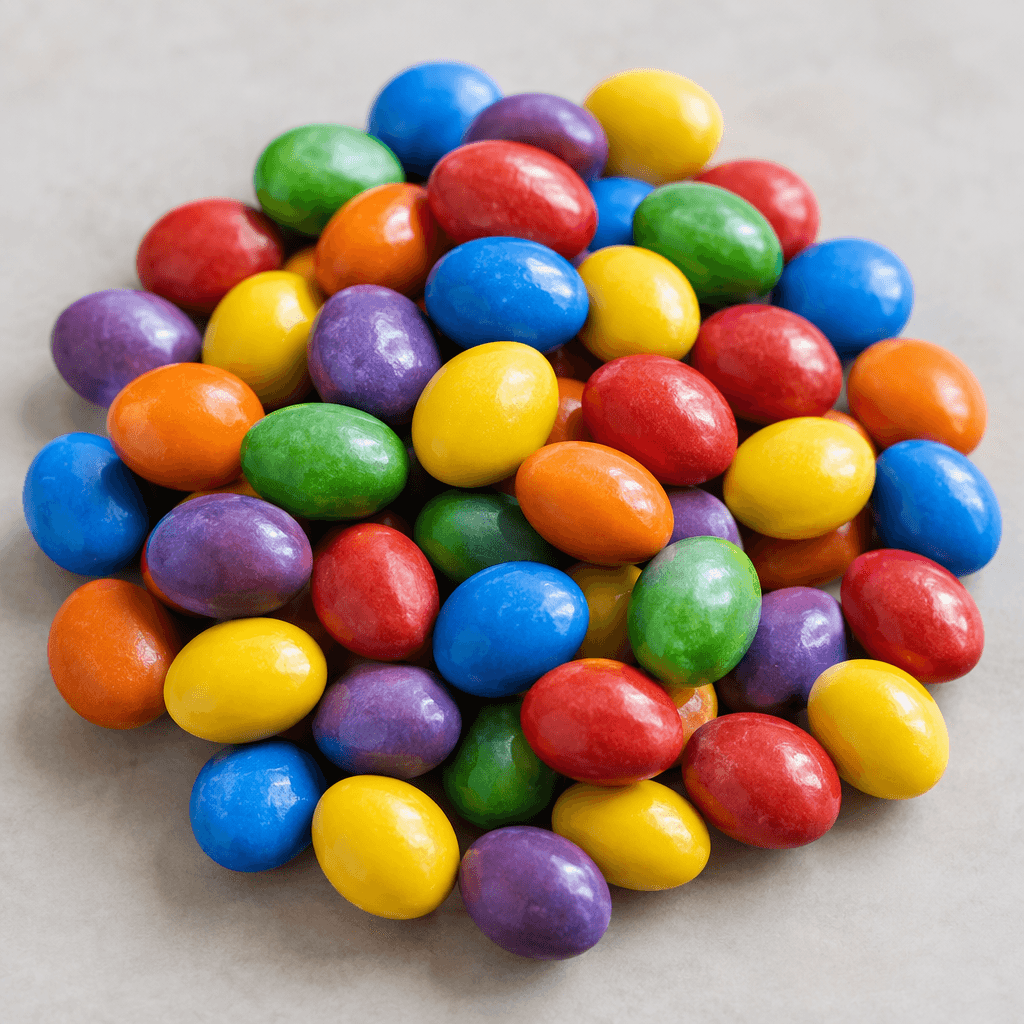
Sugar-Coated Chocolate Calories
Chocolate center with colorful sugar coating, sweet confection
CALORIES
GI
POTASSIUM
FIBER
Quick answer
1 serving (medium) of Sugar-Coated Chocolate (40 g) has 188 calories. That works out to 470 calories per 100 g. It contains 30.4 g of carbs, 1.6 g of protein, 6.8 g of fat and 0.8 g of fiber. Its 0.1 mg of Copper covers 7% of the Daily Value. Its glycemic index is 65 (high), so it raises blood sugar quickly.
What is Sugar-Coated Chocolate?
Sugar-coated chocolate consists of small chocolate centres enclosed in a hard, glossy shell of coloured sugar. It is sold as a confection in many countries, often in assorted colours and sizes, and is also used to decorate cakes and other desserts.
The shell gives each piece a crisp first bite, followed by a softer chocolate centre. Enjoy a few as a sweet snack, serve them in a bowl at gatherings, or pair them with coffee or tea. They are mainly a source of carbohydrate and sugar, with relatively little protein or fibre. A small handful can add colour and sweetness to a dessert without making it the main event.
Sugar-Coated Chocolate Nutrition Facts
Selected: 100 g
470
KCAL / 100G
Carbs
76g
· 28% DV
Protein
4g
· 8% DV
Fat
17g
· 22% DV
Fiber
2g
· 7% DV
DV is the share of the daily value covered, on a 2,000 kcal reference diet.
Calories come from: Carbs 64% · Protein 3% · Fat 33%
Sugar-Coated Chocolate Vitamins & Minerals
Vitamins
B2
0.08mg · 6% DV
B5
0.2mg · 4% DV
B12
0.1µg · 4% DV
B1
0.03mg · 3% DV
Minerals
Phosphorus
90mg · 13% DV
Zinc
1mg · 9% DV
Magnesium
35mg · 8% DV
Calcium
60mg · 6% DV
How Nutritious Is Sugar-Coated Chocolate?
Nutrient density
Low
How many vitamins, minerals and how much fiber this food carries per calorie. A high score means a lot of nutrition for few calories.
Satiety score
Low
An EatBetter score computed from fiber, protein and calorie density. A high score means staying full longer on the same calories.
Both scores are calculated per 100 g and do not change with the selected portion. The satiety score is EatBetter's own calculation, not a clinical measure.
Sugar-Coated Chocolate Glycemic Index
GLYCEMIC INDEX
GLYCEMIC LOAD
Accounts for portion size — a more realistic measure than GI alone.
How to Burn Off Sugar-Coated Chocolate
To burn the 470 calories in 100 g:
🚶
Walking (5 km/h)
🏃
Running (8 km/h)
🚴
Cycling
🏊
Swimming
Times are calculated with the MET equation for a 70 kg adult. Actual burn varies with your weight, age and pace.
Is Sugar-Coated Chocolate Processed?
NOVA 4
Ultra-Processed
1. Unprocessed
2. Minimally Processed
3. Processed
4. Ultra-Processed
NOVA classifies foods into 4 groups by industrial processing. NOVA 1 (unprocessed) is the healthiest.
Does Sugar-Coated Chocolate Contain Allergens?
Contains these allergens:
Which Diets Is Sugar-Coated Chocolate Good For?
Vegan
— Not suitable
Vegetarian
✓ Suitable
Gluten-Free
— Not suitable
Dairy-Free
— Not suitable
Mediterranean
— Not suitable
Paleo
— Not suitable
Whole30
— Not suitable
DASH
— Not suitable
Keto
— Not suitable
Low FODMAP
— Not suitable
Sugar-Coated Chocolate Fat Profile
SATURATED
10g
MONOUNSATURATED
4.5g
POLYUNSATURATED
0.6g
Omega 6:3 ratio 20:1
Above the ideal 4:1 (20:1).
Compare Sugar-Coated Chocolate
Foods Similar to Sugar-Coated Chocolate
Frequently Asked Questions About Sugar-Coated Chocolate
What is sugar-coated chocolate?
Sugar-coated chocolate is a small piece of chocolate covered in a hard, usually colourful sugar shell. The contrast between the crisp outside and chocolate centre is what distinguishes it from an uncoated chocolate sweet.
Why does sugar-coated chocolate have a hard shell?
The shell forms as thin layers of sugar coating are applied and dried around the chocolate centre. It gives sugar-coated chocolate its crisp bite, adds colour, and helps keep the chocolate from directly touching your fingers.
Is sugar-coated chocolate the same as chocolate lentils?
They are often similar kinds of confectionery: small chocolate centres covered with a hard sugar shell. The name “chocolate lentils” is used for some products and in some regions, but shapes, coatings, and recipes can vary by manufacturer.
Does sugar-coated chocolate melt in your hand?
Its sugar shell can slow the chocolate from making direct contact with your fingers, so sugar-coated chocolate is often less messy to handle than plain chocolate. It can still soften or melt in warm conditions, especially if the shell is damaged.
Can sugar-coated chocolate be used in cookies?
Yes, sugar-coated chocolate can be mixed into cookie dough or pressed onto cookies before baking. The shells may crack in the oven, and the colour can bleed, so add the pieces near the end of baking if you want them to keep their shape.
Can you freeze sugar-coated chocolate?
You can freeze sugar-coated chocolate, but condensation during thawing may make its shell sticky or dull. If you freeze it, seal it well and let it warm up while still wrapped to reduce moisture forming on the surface.
Why does sugar-coated chocolate turn white?
White patches can appear when temperature changes cause cocoa butter to rise to the chocolate’s surface, or when moisture affects the sugar shell. This is often a quality change rather than spoilage, but discard it if it smells or tastes off.
How should sugar-coated chocolate be stored?
Keep sugar-coated chocolate sealed in a cool, dry place away from sunlight and heat. Humidity can soften or roughen the shell, while warmth can melt the centre; follow the package date for the specific product.
Can sugar-coated chocolate decorate a cake?
Yes, sugar-coated chocolate works well as a colourful topping for cakes, cupcakes, and biscuits. Add it shortly before serving, particularly on moist or creamy surfaces, because the coating can soften and its colour may transfer.
How is sugar-coated chocolate different from a chocolate truffle?
Sugar-coated chocolate has a crisp sugar shell around a small chocolate centre, while a truffle is typically a soft chocolate confection, often made with a ganache centre. Their textures and the way they are coated are quite different.
Have another question about Sugar-Coated Chocolate?
Ask the AI nutrition coach — calories, portions, alternatives and more, answered in seconds in the app.

Scan calories with your camera
Instant AI nutrition analysis

Nutrition data compiled from USDA FoodData Central and scientific sources.