

Ready & Packaged Foods
All →Vegetables & Legumes
All →Desserts & Confectionery
All →Meat & Protein
All →Grains & Bakery
All →Beverages
All →Milk & Dairy
All →

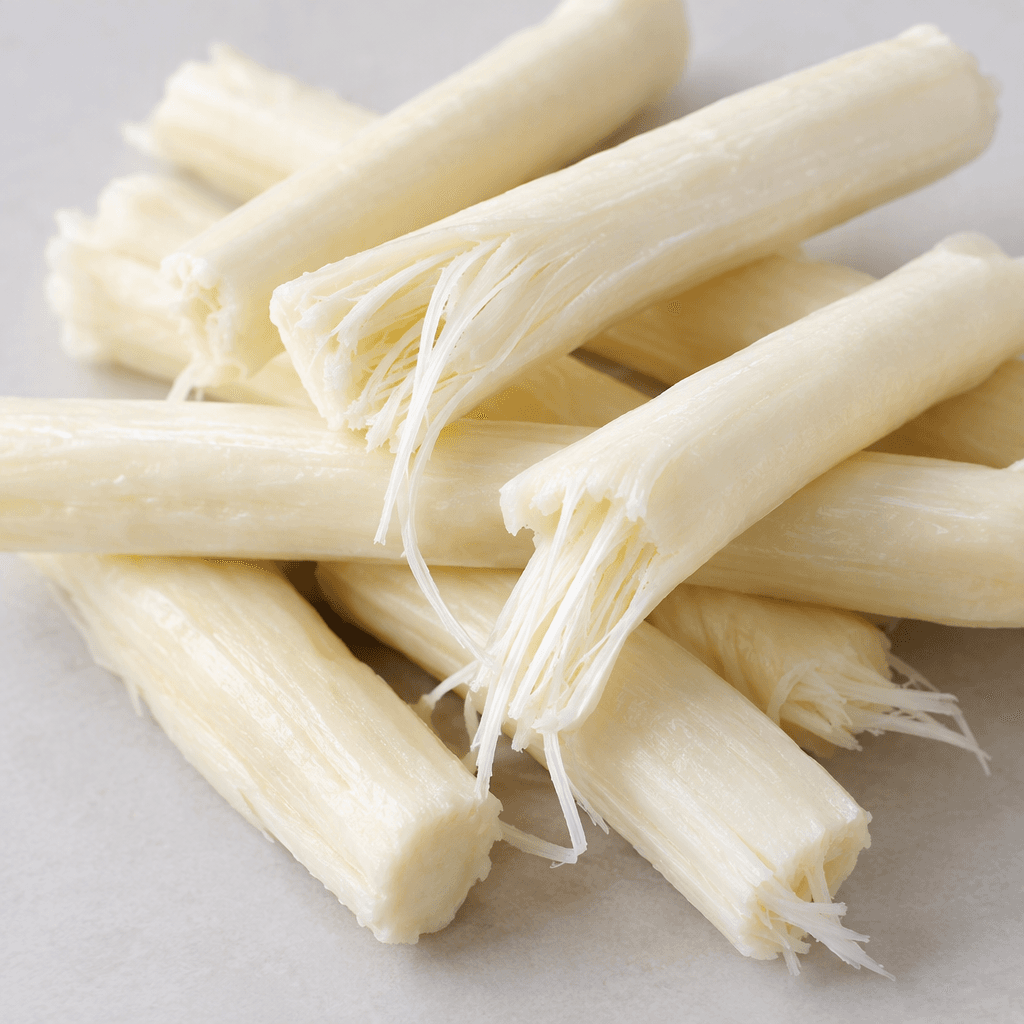
String Cheese Calories
High in protein and calcium, low-carb snack
In season: Spring · Summer · Autumn · Winter
CALORIES
GI
POTASSIUM
FIBER
Quick answer
1 piece (medium) of String Cheese (28 g) has 84 calories. That works out to 300 calories per 100 g. It contains 0.7 g of carbs, 6.2 g of protein, 6.2 g of fat and 0 g of fiber. Its 196 mg of Calcium covers 20% of the Daily Value. Its glycemic index is 30 (low), so it raises blood sugar slowly.
What is String Cheese?
String cheese is a mild cheese made by heating and stretching curds until they form long, separable strands. It is commonly sold in individual sticks, and its fibrous texture is easiest to notice when you pull it apart.
In Turkey, it is often served at breakfast with bread, olives or tomatoes, or eaten as a simple snack with tea. Elsewhere, it is a handy lunchbox or on-the-go snack; you can also tear it over salads or tuck it into sandwiches. It provides protein and calcium, with about 2.5 g of carbohydrate per 100 g. Pair a stick with fresh vegetables for a filling, lighter snack.
String Cheese Nutrition Facts
Selected: 100 g
300
KCAL / 100G
Carbs
2.5g
· 1% DV
Protein
22g
· 44% DV
Fat
22g
· 28% DV
Fiber
0g
· 0% DV
DV is the share of the daily value covered, on a 2,000 kcal reference diet.
Calories come from: Carbs 3% · Protein 30% · Fat 67%
String Cheese Vitamins & Minerals
Vitamins
B12
1.2µg · 50% DV
B2
0.35mg · 27% DV
Vitamin A
220µg · 24% DV
B5
0.7mg · 14% DV
Minerals
Calcium
700mg · 70% DV
Phosphorus
480mg · 69% DV
Sodium
650mg · 28% DV
Zinc
3mg · 27% DV
How Nutritious Is String Cheese?
Nutrient density
Medium
How many vitamins, minerals and how much fiber this food carries per calorie. A high score means a lot of nutrition for few calories.
Satiety score
Medium
An EatBetter score computed from fiber, protein and calorie density. A high score means staying full longer on the same calories.
Both scores are calculated per 100 g and do not change with the selected portion. The satiety score is EatBetter's own calculation, not a clinical measure.
String Cheese Glycemic Index
GLYCEMIC INDEX
GLYCEMIC LOAD
Accounts for portion size — a more realistic measure than GI alone.
How to Burn Off String Cheese
To burn the 300 calories in 100 g:
🚶
Walking (5 km/h)
🏃
Running (8 km/h)
🚴
Cycling
🏊
Swimming
Times are calculated with the MET equation for a 70 kg adult. Actual burn varies with your weight, age and pace.
Is String Cheese Processed?
NOVA 3
Processed
1. Unprocessed
2. Minimally Processed
3. Processed
4. Ultra-Processed
NOVA classifies foods into 4 groups by industrial processing. NOVA 1 (unprocessed) is the healthiest.
Does String Cheese Contain Allergens?
Contains these allergens:
Which Diets Is String Cheese Good For?
Vegan
— Not suitable
Vegetarian
✓ Suitable
Gluten-Free
✓ Suitable
Dairy-Free
— Not suitable
Mediterranean
✓ Suitable
Paleo
— Not suitable
Whole30
— Not suitable
DASH
— Not suitable
Keto
✓ Suitable
Low FODMAP
— Not suitable
String Cheese Fat Profile
SATURATED
14g
MONOUNSATURATED
6g
POLYUNSATURATED
1g
Omega 6:3 ratio 6:1
Above the ideal 4:1 (6:1).
Compare String Cheese
Foods Similar to String Cheese
Frequently Asked Questions About String Cheese
What is string cheese made of?
String cheese is usually made from pasteurized milk, cultures, salt, and enzymes that help form curds. The curds are heated and stretched during production, creating the aligned fibers that let the cheese pull apart into strings.
Why does string cheese peel into strings?
String cheese peels into strings because its curds are heated and stretched during cheesemaking, lining up the cheese’s protein fibers. Pulling it lengthwise follows those fibers, so it separates into strands rather than breaking into chunks.
Is string cheese the same as mozzarella?
String cheese is often a low-moisture mozzarella, but the names are not always interchangeable. Recipes and texture vary by brand; string cheese is made to peel into strands, while mozzarella sold for cooking may be softer or more moist.
Does string cheese need to be refrigerated?
Yes, string cheese needs refrigeration because it is a perishable dairy food. Keep it chilled in its wrapper or a sealed container, and return it to the refrigerator promptly after serving rather than leaving it out for extended periods.
Can you freeze string cheese?
Yes, you can freeze string cheese in an airtight package, although thawing may make it drier or more crumbly and less satisfying to peel. Thaw it in the refrigerator and use it in cooked dishes if the texture changes.
Can you eat string cheese without peeling it?
Yes, you can eat string cheese without peeling it; pulling it into strands is just a way to eat it, not a safety requirement. Check that you have removed the individual wrapper, which is not edible.
Can string cheese be used in cooking?
Yes, string cheese works in dishes such as toasted sandwiches, baked pasta, and stuffed snacks. It softens and melts when heated, though its lower moisture and firm texture can make it less creamy than fresh mozzarella.
Is string cheese a good snack for weight loss?
String cheese can be a convenient, portioned snack because its protein may help you feel satisfied. It does not cause weight loss by itself, but pairing it with fruit or vegetables can make a more filling snack.
Can you eat string cheese during pregnancy?
Yes, string cheese made from pasteurized milk is generally safe during pregnancy. Avoid cheese made from unpasteurized milk because it can carry harmful bacteria, and check the package if the milk source is unclear.
Why is string cheese sometimes rubbery?
String cheese can feel rubbery because it is a firm, low-moisture cheese made to hold its shape and peel into strands. If it has become unusually tough, dry, or has an off smell, it may be stale or spoiled.
Have another question about String Cheese?
Ask the AI nutrition coach — calories, portions, alternatives and more, answered in seconds in the app.

Scan calories with your camera
Instant AI nutrition analysis

Nutrition data compiled from USDA FoodData Central and scientific sources.