

Ready & Packaged Foods
All →Vegetables & Legumes
All →Desserts & Confectionery
All →Meat & Protein
All →Grains & Bakery
All →Beverages
All →Milk & Dairy
All →

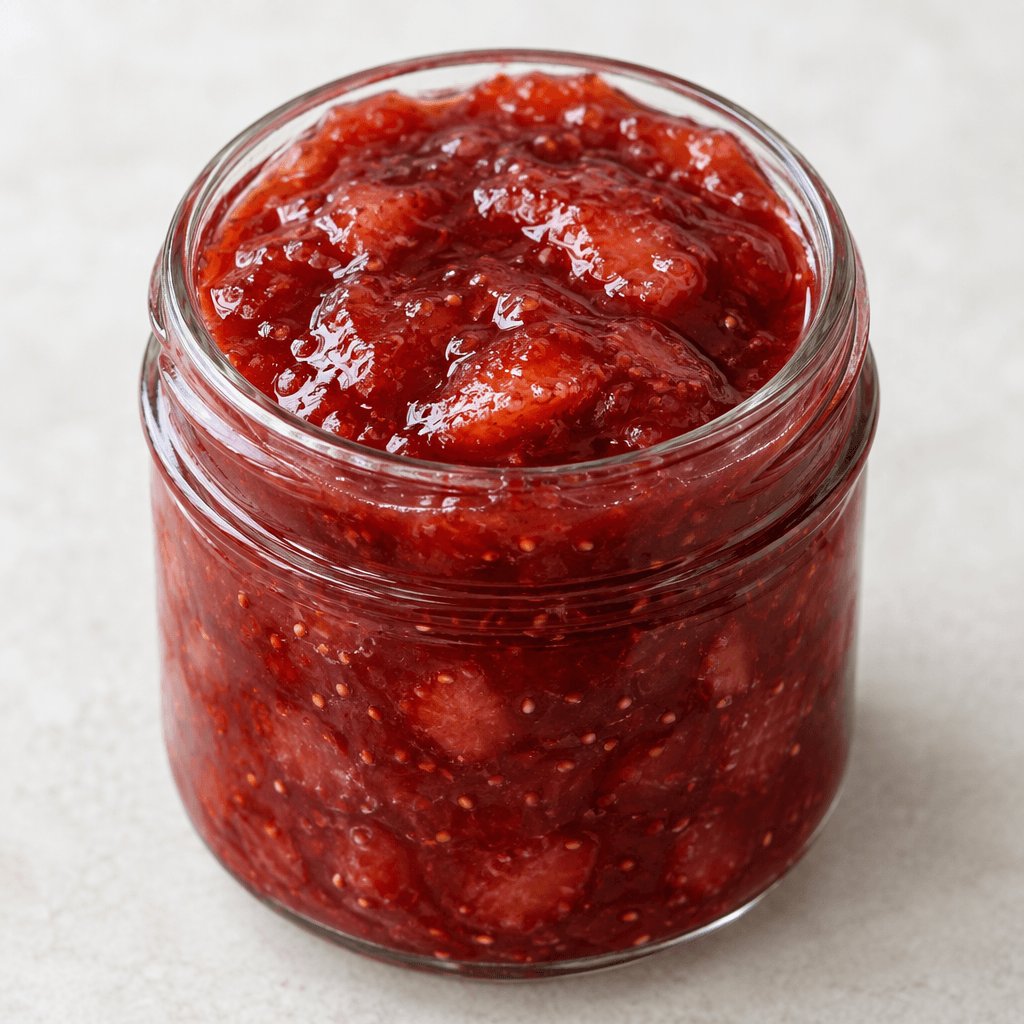
Strawberry jam Calories
Sweet, fruity, breakfast spread, sugary
In season: Spring · Summer
CALORIES
GI
POTASSIUM
FIBER
Quick answer
1 tablespoon (medium) of Strawberry jam (20 g) has 50 calories. That works out to 250 calories per 100 g. It contains 12.8 g of carbs, 0.1 g of protein, 0 g of fat and 0.2 g of fiber. Its glycemic index is 65 (high), so it raises blood sugar quickly.
What is Strawberry jam?
Strawberry jam is made by cooking strawberries with sugar until the fruit softens and the juices thicken into a spread. It is a familiar preserve in many countries, traditionally a way to enjoy ripe summer berries beyond their short season.
Its flavour is sweet and fruity, with a soft, spreadable texture that may include little pieces of strawberry. It is commonly served on toast, bread or scones; in the UK, it is also a classic partner for afternoon tea and cream scones. Strawberry jam is mostly carbohydrate, with very little protein or fibre, so a small spoonful adds plenty of sweetness. Pair it with plain yoghurt or wholegrain toast for a more balanced breakfast.
Strawberry jam Nutrition Facts
Selected: 100 g
250
KCAL / 100G
Carbs
64g
· 23% DV
Protein
0.4g
· 1% DV
Fat
0.1g
· 0% DV
Fiber
1.2g
· 4% DV
DV is the share of the daily value covered, on a 2,000 kcal reference diet.
Calories come from: Carbs 99% · Protein 1% · Fat 0%
Strawberry jam Vitamins & Minerals
Vitamins
Vitamin C
8mg · 9% DV
B2
0.02mg · 2% DV
B5
0.08mg · 2% DV
B6
0.03mg · 2% DV
Minerals
Magnesium
7mg · 2% DV
Calcium
14mg · 1% DV
Phosphorus
8mg · 1% DV
Potassium ⭐
50mg · 1% DV
How Nutritious Is Strawberry jam?
Nutrient density
Low
How many vitamins, minerals and how much fiber this food carries per calorie. A high score means a lot of nutrition for few calories.
Satiety score
Low
An EatBetter score computed from fiber, protein and calorie density. A high score means staying full longer on the same calories.
Both scores are calculated per 100 g and do not change with the selected portion. The satiety score is EatBetter's own calculation, not a clinical measure.
Strawberry jam Glycemic Index
GLYCEMIC INDEX
GLYCEMIC LOAD
Accounts for portion size — a more realistic measure than GI alone.
How to Burn Off Strawberry jam
To burn the 250 calories in 100 g:
🚶
Walking (5 km/h)
🏃
Running (8 km/h)
🚴
Cycling
🏊
Swimming
Times are calculated with the MET equation for a 70 kg adult. Actual burn varies with your weight, age and pace.
Is Strawberry jam Processed?
NOVA 3
Processed
1. Unprocessed
2. Minimally Processed
3. Processed
4. Ultra-Processed
NOVA classifies foods into 4 groups by industrial processing. NOVA 1 (unprocessed) is the healthiest.
Does Strawberry jam Contain Allergens?
No known major allergens
Which Diets Is Strawberry jam Good For?
Vegan
✓ Suitable
Vegetarian
✓ Suitable
Gluten-Free
✓ Suitable
Dairy-Free
— Not suitable
Mediterranean
✓ Suitable
Paleo
— Not suitable
Whole30
— Not suitable
DASH
— Not suitable
Keto
— Not suitable
Low FODMAP
— Not suitable
Strawberry jam Fat Profile
SATURATED
0.01g
MONOUNSATURATED
0.01g
POLYUNSATURATED
0.02g
Omega 6:3 ratio 2:1
Below the ideal 4:1 — a good omega balance.
Compare Strawberry jam
Foods Similar to Strawberry jam
Frequently Asked Questions About Strawberry jam
How do you make strawberry jam at home?
Strawberry jam is made by cooking prepared strawberries with sugar until the mixture thickens. A little lemon juice can balance the sweetness; test the texture on a chilled plate before filling clean jars.
Why is my strawberry jam runny?
Strawberry jam can stay runny if it contains too much liquid, has not cooked long enough, or lacks enough natural pectin and acidity. Simmer it longer and test again, remembering that it thickens further as it cools.
Does strawberry jam need to be refrigerated after opening?
Yes, refrigerate strawberry jam after opening. Use a clean, dry spoon each time to keep crumbs and moisture out of the jar, which helps preserve its quality.
How long does homemade strawberry jam last?
The safe storage time for homemade strawberry jam depends on its recipe and whether it was properly processed for shelf storage. Follow a tested canning recipe; once opened, keep the jar refrigerated and discard it if you notice spoilage.
Can you freeze strawberry jam?
Yes, strawberry jam can be frozen in a freezer-safe container. Leave room for expansion, thaw it in the refrigerator, and use it soon after thawing rather than freezing it again.
Can strawberry jam be made with frozen strawberries?
Yes, you can make strawberry jam with frozen strawberries. Thaw them first and include their released juice in the mixture; frozen fruit may make the cooking time or final texture different from fresh berries.
What is the difference between strawberry jam and strawberry preserves?
Strawberry jam is usually made with crushed fruit, while strawberry preserves tend to contain larger, more distinct pieces of fruit. Product names are not used identically by every maker, so the texture is the clearest distinction.
Why does strawberry jam get moldy?
Strawberry jam can grow mold when it is exposed to air, moisture, or contaminated utensils, especially after opening. If you see mold, discard the whole jar rather than scooping off the surface.
Can you make strawberry jam without pectin?
Yes, strawberry jam can be made without added pectin. Strawberries contain some natural pectin, and lemon juice helps the mixture set; cooking and cooling tests help you judge when it has reached the texture you want.
What can you put strawberry jam on besides toast?
Strawberry jam works well in yogurt, oatmeal, pancakes, and cake fillings, as well as on toast. A small spoonful can also add fruit flavor to a simple dessert or sandwich.
Have another question about Strawberry jam?
Ask the AI nutrition coach — calories, portions, alternatives and more, answered in seconds in the app.

Scan calories with your camera
Instant AI nutrition analysis

Nutrition data compiled from USDA FoodData Central and scientific sources.