

Ready & Packaged Foods
All →Vegetables & Legumes
All →Desserts & Confectionery
All →Meat & Protein
All →Grains & Bakery
All →Beverages
All →Milk & Dairy
All →

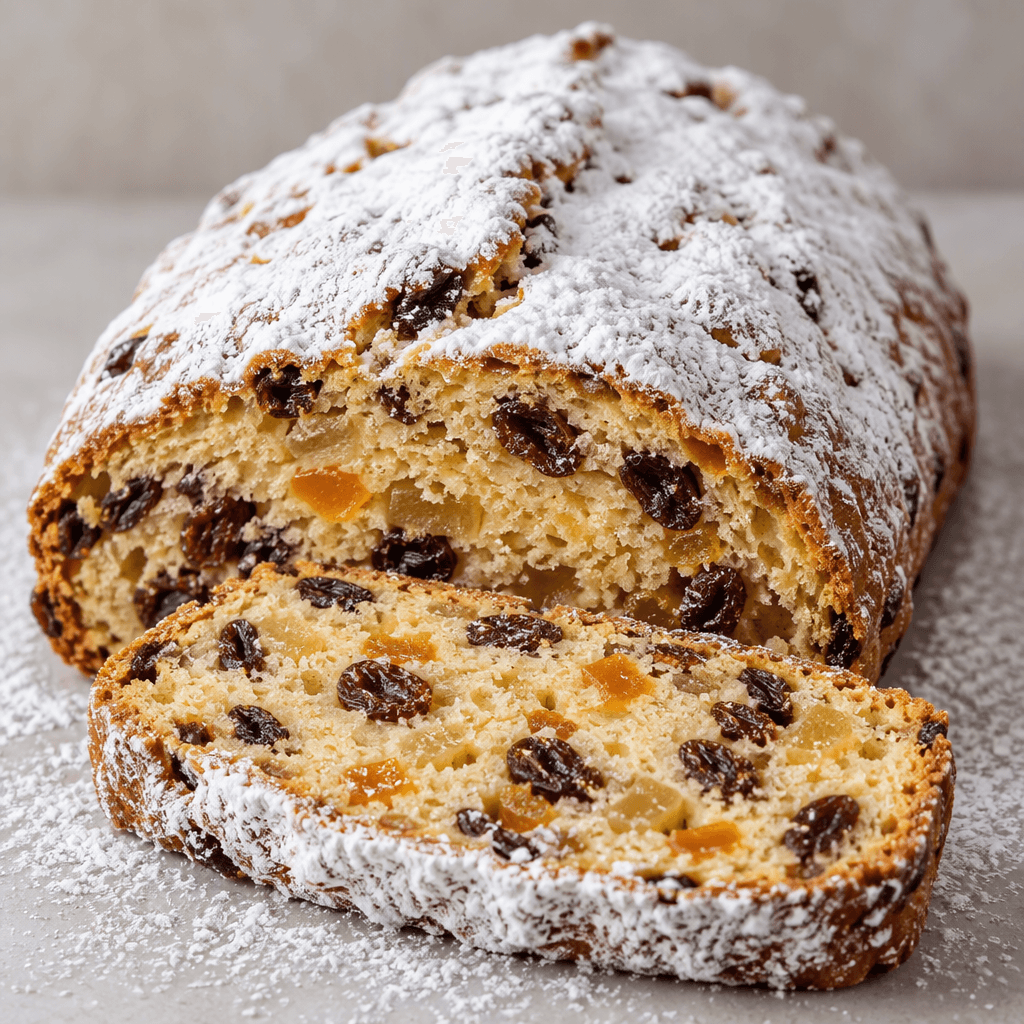
Stollen Calories
German fruit bread rich in dried fruit and butter
In season: Autumn · Winter
CALORIES · 100 G
GI
POTASSIUM · 100 G
FIBER · 100 G
Quick answer
1 slice (thick) of Stollen (60 g) has 222 calories. That works out to 370 calories per 100 g. It contains 34.1 g of carbs, 3.7 g of protein, 8 g of fat and 2.3 g of fiber. Its 9.6 µg of Selenium covers 17% of the Daily Value. Its glycemic index is 65 (medium), so it raises blood sugar at a moderate pace.
Stollen Nutrition Facts
Selected: 1 slice (thick) · 60 g
222
KCAL / 60G
Carbs
34.1g
· 12% DV
Protein
3.7g
· 7% DV
Fat
8g
· 10% DV
Fiber
2.3g
· 8% DV
DV is the share of the daily value covered, on a 2,000 kcal reference diet.
Calories come from: Carbs 61% · Protein 7% · Fat 32%
Stollen nutrition facts table · 1 slice (thick) (60 g)
| Nutrient | Amount | % DV |
|---|---|---|
| Calories | 222 kcal | |
| Total fat | 8 g | 10% |
| Saturated fat | 3.66 g | 18% |
| Trans fat | 0.12 g | |
| Sodium | 192 mg | 8% |
| Total carbohydrate | 34.1 g | 12% |
| Fiber | 2.3 g | 8% |
| Protein | 3.7 g | 7% |
Calories: Calories measure energy. Average daily need is 2,000 kcal. Excess calories are stored as fat, too few cause weight loss.
Carbs: Your body's primary energy source. The brain runs exclusively on carbs. Daily need: 275g.
Protein: Essential for muscle repair and cell growth. Daily need: 50g. Keeps you full and boosts metabolism.
Fat: Needed for hormone production and vitamin absorption. Daily need: 78g. Limit saturated fats, choose unsaturated.
Fiber: Critical for digestive health and satiety. Daily need: 28g. Stabilizes blood sugar, lowers cholesterol.

Log this food in EatBetter
100,000+ people use it
- Get your daily calorie target
- Snap your meal, log it in seconds
- See every vitamin and mineral

📸 Scan the code to get the app free.

How Many Calories in 1 Thick Slice of Stollen?
| Serving | Amount | Calories |
|---|---|---|
| 1 slice (thick) | 60 g | 222 kcal |
| 1 ounce (small) | 28 g | 104 kcal |
| 1 slice (thin) | 35 g | 130 kcal |
| 1 piece (small) | 80 g | 296 kcal |
| 100 g | 100 g | 370 kcal |
| 1 serving (medium) | 100 g | 370 kcal |
| 2 slice (double) | 120 g | 444 kcal |
| 1 piece (medium) | 150 g | 555 kcal |
| 1 piece (large) | 250 g | 925 kcal |
Calculated from 370 calories per 100 g.
Frequently Asked Questions About Stollen
What is Stollen?
Stollen is a rich German yeast bread traditionally eaten at Christmas. It is made with dried fruit and butter, usually shaped as a loaf and finished with a coating of powdered sugar.
What is in Stollen?
Stollen typically contains yeast dough, butter, raisins and candied citrus peel. Recipes may also include almonds, spices or a roll of marzipan in the centre, so the ingredients vary between styles.
Is Stollen the same as fruitcake?
No. Stollen is made from yeast dough and baked as a loaf, while fruitcake is usually a cake batter. Stollen is also known for its buttery crumb and powdered-sugar coating; fruitcake recipes vary widely.
Does Stollen always have marzipan?
No, marzipan is optional. Some Stollen loaves have a strip of almond paste running through the centre, while traditional and regional versions may leave it out. Check the variety name or ingredients if you want one specifically with marzipan.
How do you serve Stollen?
Serve Stollen sliced at room temperature, traditionally with coffee or tea during the Christmas season. Its rich, buttery texture pairs well with a hot drink, and thin slices are customary because the loaf is dense.
Why is Stollen covered in powdered sugar?
The thick powdered-sugar coating is part of Stollen’s traditional finish and gives the loaf its snowy appearance. Bakers often brush the warm loaf with butter before adding the sugar, helping the coating cling to the surface.
How should you store Stollen?
Wrap Stollen tightly and keep it in a cool, dry place. After cutting, cover the exposed end as well to slow drying. Avoid warm, humid storage, which can soften the butter and spoil the loaf sooner.
Can you freeze Stollen?
Yes. Freeze Stollen whole or in slices, wrapped airtight to protect it from freezer odors and drying. Thaw it at room temperature before serving; freezing individual slices makes it easier to take out just what you need.
Why is Stollen folded into a loaf shape?
The traditional folded form of Stollen is commonly said to represent the swaddled Christ child, which connects the bread with its Christmas setting. The shape also gives the loaf its characteristic raised ridge.
What is Dresden Stollen?
Dresden Stollen is a protected regional variety associated with Dresden, Germany. Its name is reserved for Stollen made under specific regional requirements, so a similar Christmas fruit bread baked elsewhere cannot automatically use that designation.
Stollen Vitamins & Minerals
Vitamins
B1
0.11mg · 9% DV
Biotin
2.4µg · 8% DV
B3
1.14mg · 7% DV
Folate
22.8µg · 6% DV
Minerals
Selenium
9.6µg · 17% DV
Manganese
0.25mg · 11% DV
Copper
0.08mg · 9% DV
Sodium
192mg · 8% DV
Potassium ⭐
126mg · 4% DV
Stollen Glycemic Index
GLYCEMIC INDEX
GLYCEMIC LOAD
Accounts for portion size — a more realistic measure than GI alone.
How to Burn Off Stollen
To burn the 222 calories in 1 slice (thick) (60 g):
🚶
Walking (5 km/h)
🏃
Running (8 km/h)
🚴
Cycling
🏊
Swimming
Times are calculated with the MET equation for a 70 kg adult. Actual burn varies with your weight, age and pace.
What is Stollen?
Stollen is a German yeasted fruit bread, traditionally made for Christmas with dried fruit folded into a rich dough. It is usually finished with butter and a coating of icing sugar; some versions have a marzipan centre.
The crumb is soft and close-textured, with sweet, chewy fruit in each slice. In Germany it is a familiar part of the Christmas season, served with coffee or tea; elsewhere, it works just as well as a festive afternoon treat. Dried fruit and butter make stollen energy-dense and largely carbohydrate-led, with some fibre from the fruit. A modest slice alongside unsweetened tea or coffee is an easy way to enjoy its sweetness without making it the whole snack.
How Nutritious Is Stollen?
Nutrient density
Low
How many vitamins, minerals and how much fiber this food carries per calorie. A high score means a lot of nutrition for few calories.
Satiety score
Low
An EatBetter score computed from fiber, protein and calorie density. A high score means staying full longer on the same calories.
Both scores are calculated per 100 g and do not change with the selected portion. The satiety score is EatBetter's own calculation, not a clinical measure.
Is Stollen Processed?
NOVA 3
Processed
1. Unprocessed
2. Minimally Processed
3. Processed
4. Ultra-Processed
NOVA classifies foods into 4 groups by industrial processing. NOVA 1 (unprocessed) is the healthiest.
Does Stollen Contain Allergens?
Contains these allergens:
Which Diets Is Stollen Good For?
Vegan
— Not suitable
Vegetarian
✓ Suitable
Gluten-Free
— Not suitable
Dairy-Free
— Not suitable
Mediterranean
— Not suitable
Paleo
— Not suitable
Whole30
— Not suitable
DASH
— Not suitable
Keto
— Not suitable
Low FODMAP
— Not suitable
Stollen Fat Profile
SATURATED
3.66g
MONOUNSATURATED
2.52g
POLYUNSATURATED
0.78g
Omega 6:3 ratio 17.3:1
Above the ideal 4:1 (17.3:1).
Compare Stollen
Foods Similar to Stollen
Have another question about Stollen?
Ask the AI nutrition coach — calories, portions, alternatives and more, answered in seconds in the app.

Scan calories with your camera
Instant AI nutrition analysis

Nutrition data compiled from USDA FoodData Central and scientific sources.