

Ready & Packaged Foods
All →Vegetables & Legumes
All →Desserts & Confectionery
All →Meat & Protein
All →Grains & Bakery
All →Beverages
All →Milk & Dairy
All →

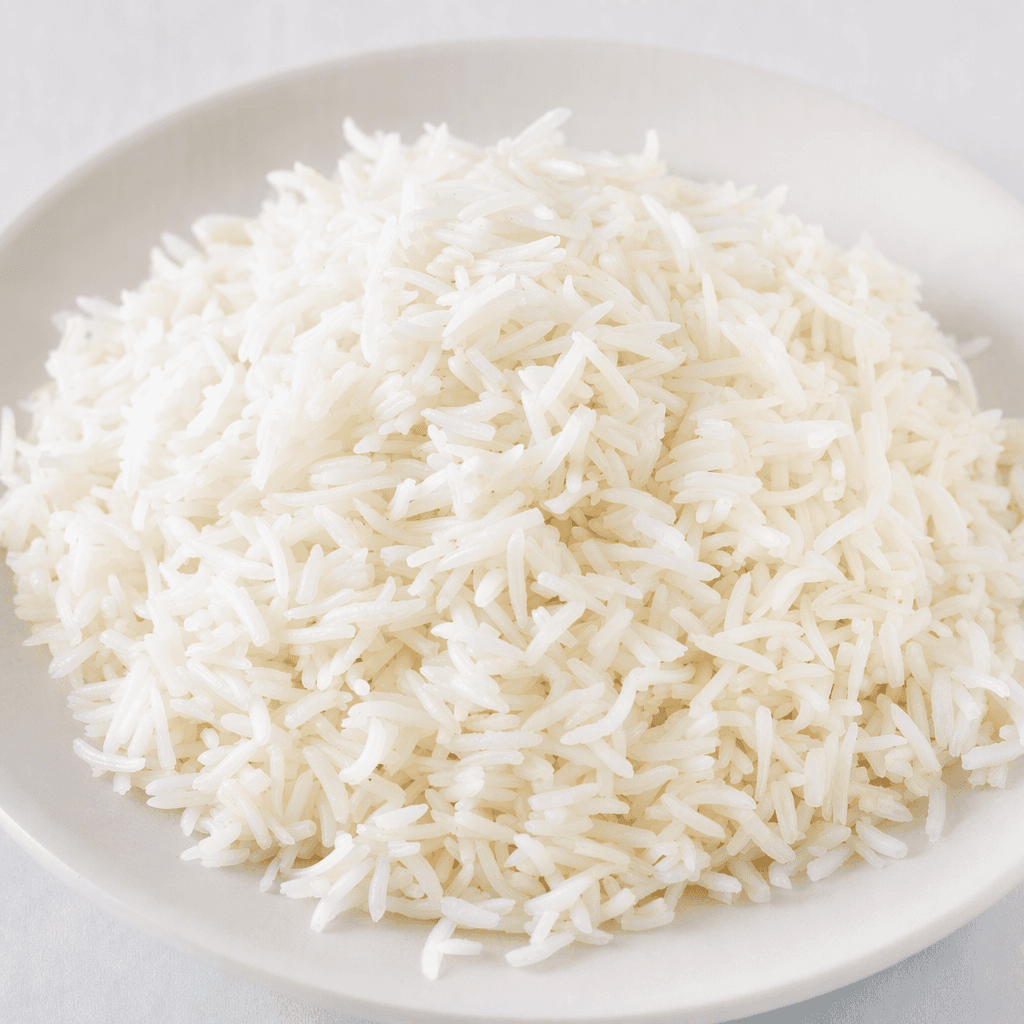
Steamed basmati rice Calories
Low-fat, light, easy-to-digest grain
In season: Spring · Summer · Autumn · Winter
CALORIES
GI
POTASSIUM
FIBER
Quick answer
1 cup (medium) of Steamed basmati rice (158 g) has 191 calories. That works out to 121 calories per 100 g. It contains 39.8 g of carbs, 5.5 g of protein, 0.6 g of fat and 0.6 g of fiber. Its 0.6 mg of Manganese covers 25% of the Daily Value. Its glycemic index is 58 (medium), so it raises blood sugar at a moderate pace.
What is Steamed basmati rice?
Steamed basmati rice is made by cooking the long-grain, aromatic rice associated with the Indian subcontinent—especially India and Pakistan—with steam. The grains lengthen as they cook and, when prepared well, stay light and separate, with a delicate fragrance rather than a sticky texture.
It is served alongside curries, dals, grilled meats and vegetable dishes across South Asia, and works just as easily as a plain side for everyday meals elsewhere. Naturally low in fat and mostly a source of carbohydrates, it takes on the flavour of sauces and seasonings. Pair it with vegetables and a protein-rich main, or add herbs and spices for extra character without making the rice itself heavy.
Steamed basmati rice Nutrition Facts
Selected: 100 g
121
KCAL / 100G
Carbs
25.2g
· 9% DV
Protein
3.5g
· 7% DV
Fat
0.4g
· 1% DV
Fiber
0.4g
· 1% DV
DV is the share of the daily value covered, on a 2,000 kcal reference diet.
Calories come from: Carbs 85% · Protein 12% · Fat 3%
Steamed basmati rice Vitamins & Minerals
Vitamins
B1
0.07mg · 6% DV
B3
1mg · 6% DV
B6
0.09mg · 5% DV
B5
0.15mg · 3% DV
Minerals
Selenium
5µg · 9% DV
Phosphorus
43mg · 6% DV
Magnesium
12mg · 3% DV
Potassium ⭐
35mg · 1% DV
How Nutritious Is Steamed basmati rice?
Nutrient density
Low
How many vitamins, minerals and how much fiber this food carries per calorie. A high score means a lot of nutrition for few calories.
Satiety score
Medium
An EatBetter score computed from fiber, protein and calorie density. A high score means staying full longer on the same calories.
Both scores are calculated per 100 g and do not change with the selected portion. The satiety score is EatBetter's own calculation, not a clinical measure.
Steamed basmati rice Glycemic Index
GLYCEMIC INDEX
GLYCEMIC LOAD
Accounts for portion size — a more realistic measure than GI alone.
How to Burn Off Steamed basmati rice
To burn the 121 calories in 100 g:
🚶
Walking (5 km/h)
🏃
Running (8 km/h)
🚴
Cycling
🏊
Swimming
Times are calculated with the MET equation for a 70 kg adult. Actual burn varies with your weight, age and pace.
Is Steamed basmati rice Processed?
NOVA 2
Minimally Processed
1. Unprocessed
2. Minimally Processed
3. Processed
4. Ultra-Processed
NOVA classifies foods into 4 groups by industrial processing. NOVA 1 (unprocessed) is the healthiest.
Does Steamed basmati rice Contain Allergens?
No known major allergens
Which Diets Is Steamed basmati rice Good For?
Vegan
✓ Suitable
Vegetarian
✓ Suitable
Gluten-Free
✓ Suitable
Dairy-Free
— Not suitable
Mediterranean
✓ Suitable
Paleo
— Not suitable
Whole30
— Not suitable
DASH
— Not suitable
Keto
— Not suitable
Low FODMAP
— Not suitable
Steamed basmati rice Fat Profile
SATURATED
0.11g
MONOUNSATURATED
0.1g
POLYUNSATURATED
0.12g
Omega 6:3 ratio 11:1
Above the ideal 4:1 (11:1).
Compare Steamed basmati rice
Foods Similar to Steamed basmati rice
Frequently Asked Questions About Steamed basmati rice
What is special about steamed basmati rice?
Steamed basmati rice is made from a long-grain rice known for its distinctive aroma and slender grains. When prepared well, the grains stay separate rather than forming a sticky mass, which makes it a popular partner for curries and spiced dishes.
Does steamed basmati rice need to be rinsed before cooking?
Yes, rinsing basmati rice before steaming removes loose surface starch and can help the grains stay separate. Rinse it in cool water until the water looks less cloudy, then drain it well so excess water does not throw off the cooking process.
Should you soak basmati rice before steaming it?
Soaking basmati rice is optional, but it can help the grains cook more evenly and lengthen. Drain it thoroughly after soaking, and remember that soaked rice may cook faster, so check its texture rather than relying on the usual cooking time.
Why does steamed basmati rice sometimes turn sticky?
Steamed basmati rice can turn sticky if it is not rinsed well, is cooked with too much water, or is stirred repeatedly. Rinse and drain the grains, use the water amount recommended for your cooking method, and let the rice rest covered after cooking.
Where does basmati rice come from?
Basmati rice traditionally comes from the Himalayan foothills of the Indian subcontinent, especially India and Pakistan. Its name is associated with its fragrant aroma, and the grain is often aged before sale to develop its characteristic texture and scent.
Can steamed basmati rice be frozen?
Yes, steamed basmati rice freezes well when packed promptly after cooling. Divide it into meal-sized portions in airtight containers, then reheat it until steaming hot throughout; avoid thawing and reheating the same portion more than once.
How should leftover steamed basmati rice be stored?
Cool leftover steamed basmati rice promptly, transfer it to a covered container, and refrigerate it rather than leaving it at room temperature. Use it soon, ideally the next day, and reheat it thoroughly; cooked rice can carry bacteria if handled or stored carelessly.
What dishes go well with steamed basmati rice?
Steamed basmati rice pairs especially well with Indian and South Asian curries, lentil dishes, and spiced vegetables because its fragrance complements bold seasonings. It also works with grilled fish or chicken and can be served as a base for saucy meals.
Is steamed basmati rice a better choice for blood sugar than other white rice?
Basmati rice may affect blood sugar differently from some other white rice varieties, but it still contains digestible carbohydrate. Keeping the serving moderate and eating it with vegetables and protein can help make a meal more balanced; people managing diabetes should follow their care plan.
Can you use steamed basmati rice for fried rice?
Yes, steamed basmati rice works well for fried rice because its long grains can stay distinct. Chilled leftover rice is easier to stir-fry than freshly cooked rice, which tends to be softer; break up any clumps before adding it to a hot pan.
Have another question about Steamed basmati rice?
Ask the AI nutrition coach — calories, portions, alternatives and more, answered in seconds in the app.

Scan calories with your camera
Instant AI nutrition analysis

Nutrition data compiled from USDA FoodData Central and scientific sources.