

Ready & Packaged Foods
All →Vegetables & Legumes
All →Desserts & Confectionery
All →Meat & Protein
All →Grains & Bakery
All →Beverages
All →Milk & Dairy
All →

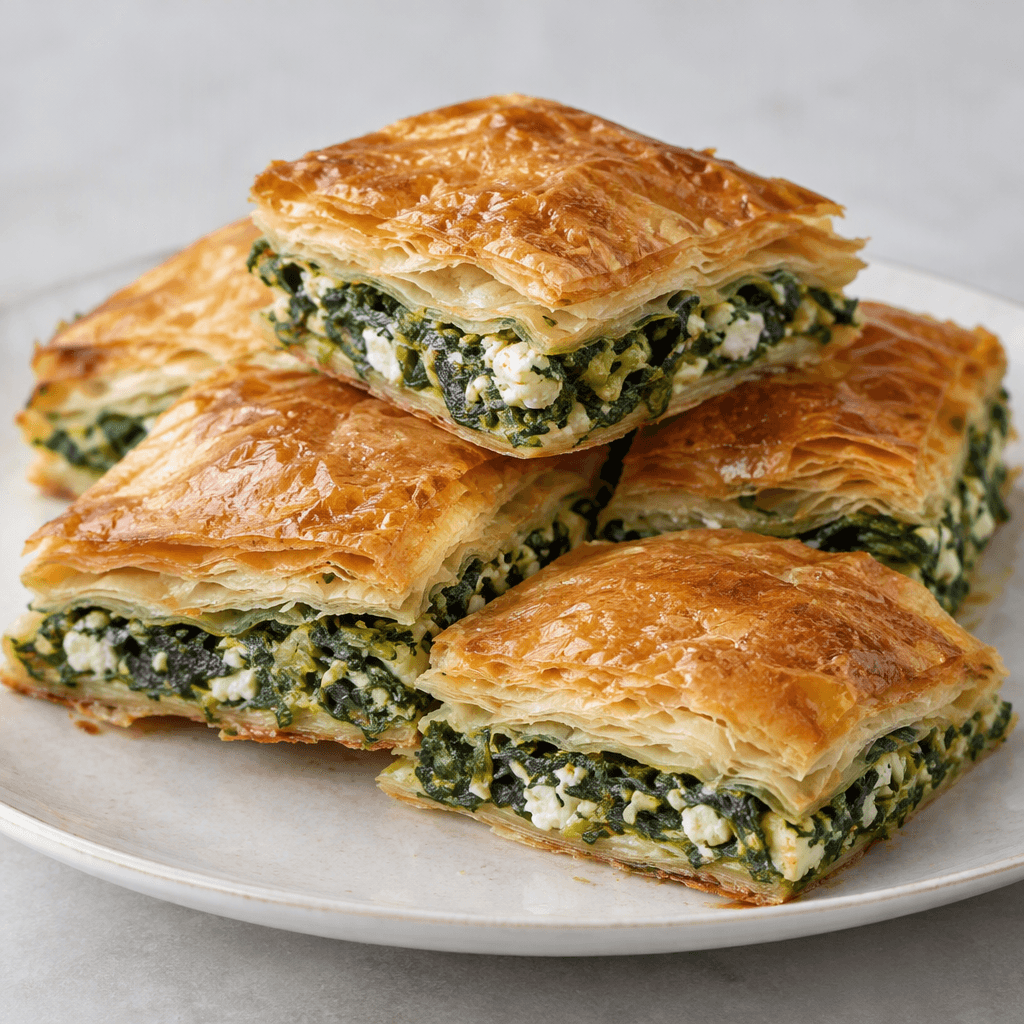
Spinach Cottage Cheese Börek Calories
Traditional Turkish pastry filled with spinach and cottage cheese.
In season: Spring · Summer · Autumn · Winter
CALORIES
GI
POTASSIUM
FIBER
Quick answer
1 piece (medium) of Spinach Cottage Cheese Börek (90 g) has 167 calories. That works out to 185 calories per 100 g. It contains 18.5 g of carbs, 6.5 g of protein, 6.5 g of fat and 2.1 g of fiber. Its 108 µg of Vitamin K covers 90% of the Daily Value. Its glycemic index is 55 (medium), so it raises blood sugar at a moderate pace.
What is Spinach Cottage Cheese Börek?
Spinach Cottage Cheese Börek is a Turkish pastry made by layering thin yufka with spinach and lor, a mild, fresh curd cheese. The filling is often seasoned with onion and pepper, then baked until the pastry is golden and crisp while the centre stays soft. “Cottage cheese” is a loose English rendering of lor; the Turkish cheese is typically a finer, less creamy curd.
In Turkey, it is served at breakfast or with tea, and also makes an easy lunch alongside salad or yogurt. The spinach adds fibre, while lor contributes protein, so a piece can be part of a satisfying meal without needing a heavy accompaniment. For a lighter version, use a modest amount of oil and pair it with fresh vegetables.
Spinach Cottage Cheese Börek Nutrition Facts
Selected: 100 g
185
KCAL / 100G
Carbs
20.5g
· 7% DV
Protein
7.2g
· 14% DV
Fat
7.2g
· 9% DV
Fiber
2.3g
· 8% DV
DV is the share of the daily value covered, on a 2,000 kcal reference diet.
Calories come from: Carbs 47% · Protein 16% · Fat 37%
Spinach Cottage Cheese Börek Vitamins & Minerals
Vitamins
Vitamin K
120µg · 100% DV
Vitamin A
180µg · 20% DV
B2
0.18mg · 14% DV
Biotin
4.2µg · 14% DV
Minerals
Sodium
320mg · 14% DV
Selenium
7.5µg · 14% DV
Phosphorus
95mg · 14% DV
Calcium
110mg · 11% DV
How Nutritious Is Spinach Cottage Cheese Börek?
Nutrient density
Medium
How many vitamins, minerals and how much fiber this food carries per calorie. A high score means a lot of nutrition for few calories.
Satiety score
Medium
An EatBetter score computed from fiber, protein and calorie density. A high score means staying full longer on the same calories.
Both scores are calculated per 100 g and do not change with the selected portion. The satiety score is EatBetter's own calculation, not a clinical measure.
Spinach Cottage Cheese Börek Glycemic Index
GLYCEMIC INDEX
GLYCEMIC LOAD
Accounts for portion size — a more realistic measure than GI alone.
How to Burn Off Spinach Cottage Cheese Börek
To burn the 185 calories in 100 g:
🚶
Walking (5 km/h)
🏃
Running (8 km/h)
🚴
Cycling
🏊
Swimming
Times are calculated with the MET equation for a 70 kg adult. Actual burn varies with your weight, age and pace.
Is Spinach Cottage Cheese Börek Processed?
NOVA 3
Processed
1. Unprocessed
2. Minimally Processed
3. Processed
4. Ultra-Processed
NOVA classifies foods into 4 groups by industrial processing. NOVA 1 (unprocessed) is the healthiest.
Does Spinach Cottage Cheese Börek Contain Allergens?
Contains these allergens:
Which Diets Is Spinach Cottage Cheese Börek Good For?
Vegan
— Not suitable
Vegetarian
✓ Suitable
Gluten-Free
— Not suitable
Dairy-Free
— Not suitable
Mediterranean
✓ Suitable
Paleo
— Not suitable
Whole30
— Not suitable
DASH
— Not suitable
Keto
— Not suitable
Low FODMAP
— Not suitable
Spinach Cottage Cheese Börek Fat Profile
SATURATED
2.5g
MONOUNSATURATED
2.2g
POLYUNSATURATED
1.1g
Omega 6:3 ratio 5.6:1
Above the ideal 4:1 (5.6:1).
Compare Spinach Cottage Cheese Börek
Foods Similar to Spinach Cottage Cheese Börek
Frequently Asked Questions About Spinach Cottage Cheese Börek
What is Spinach Cottage Cheese Börek?
Spinach Cottage Cheese Börek is a Turkish layered pastry filled with spinach and lor, a fresh Turkish curd cheese. The English name can suggest Western-style cottage cheese, but lor is typically drier and less creamy.
How is Spinach Cottage Cheese Börek different from spanakopita?
Spinach Cottage Cheese Börek is a Turkish börek made with yufka and lor, while spanakopita is a Greek spinach pie commonly made with feta and phyllo. Their fillings and pastry styles vary by recipe, although both feature layered pastry and spinach.
Can I make Spinach Cottage Cheese Börek with frozen spinach?
Yes, frozen spinach works in Spinach Cottage Cheese Börek. Thaw it completely and squeeze out as much liquid as possible before mixing it with the lor, or excess moisture can make the pastry soggy.
What pastry is used for Spinach Cottage Cheese Börek?
Spinach Cottage Cheese Börek is traditionally made with thin Turkish yufka. Phyllo can work as a substitute, but it is usually thinner and more delicate, so cover unused sheets while assembling to keep them from drying out.
How do you keep Spinach Cottage Cheese Börek from getting soggy on the bottom?
To keep Spinach Cottage Cheese Börek from getting soggy underneath, remove excess moisture from the spinach and lor before filling the pastry. Bake it on a preheated tray and avoid adding too much liquid between the yufka layers.
Can Spinach Cottage Cheese Börek be assembled ahead of time?
Yes, Spinach Cottage Cheese Börek can be assembled ahead and refrigerated before baking. Cover the unbaked tray so the yufka does not dry out, and bake it while chilled, allowing extra time if the center is still cold.
Is Spinach Cottage Cheese Börek usually served hot or cold?
Spinach Cottage Cheese Börek is most often served warm, when the pastry is crisp and the filling is soft. It can also be eaten at room temperature, making it convenient for picnics, packed lunches, or a buffet.
Can you eat Spinach Cottage Cheese Börek for breakfast?
Yes, Spinach Cottage Cheese Börek is commonly eaten for breakfast in Turkey, often with tea. A smaller piece can be served alongside tomatoes, cucumbers, olives, or other simple breakfast foods.
How long do leftovers of Spinach Cottage Cheese Börek last?
Leftover Spinach Cottage Cheese Börek keeps for a short time in the refrigerator when stored in a covered container. Cool it promptly after serving, and reheat only the portion you plan to eat so the pastry does not become repeatedly soft.
Can Spinach Cottage Cheese Börek be served as a main dish?
Yes, Spinach Cottage Cheese Börek can be a light main dish when served with a salad or yogurt. It is also commonly cut into smaller pieces as a snack, appetizer, or part of a larger spread.
Have another question about Spinach Cottage Cheese Börek?
Ask the AI nutrition coach — calories, portions, alternatives and more, answered in seconds in the app.

Scan calories with your camera
Instant AI nutrition analysis

Nutrition data compiled from USDA FoodData Central and scientific sources.