

Ready & Packaged Foods
All →Vegetables & Legumes
All →Desserts & Confectionery
All →Meat & Protein
All →Grains & Bakery
All →Beverages
All →Milk & Dairy
All →

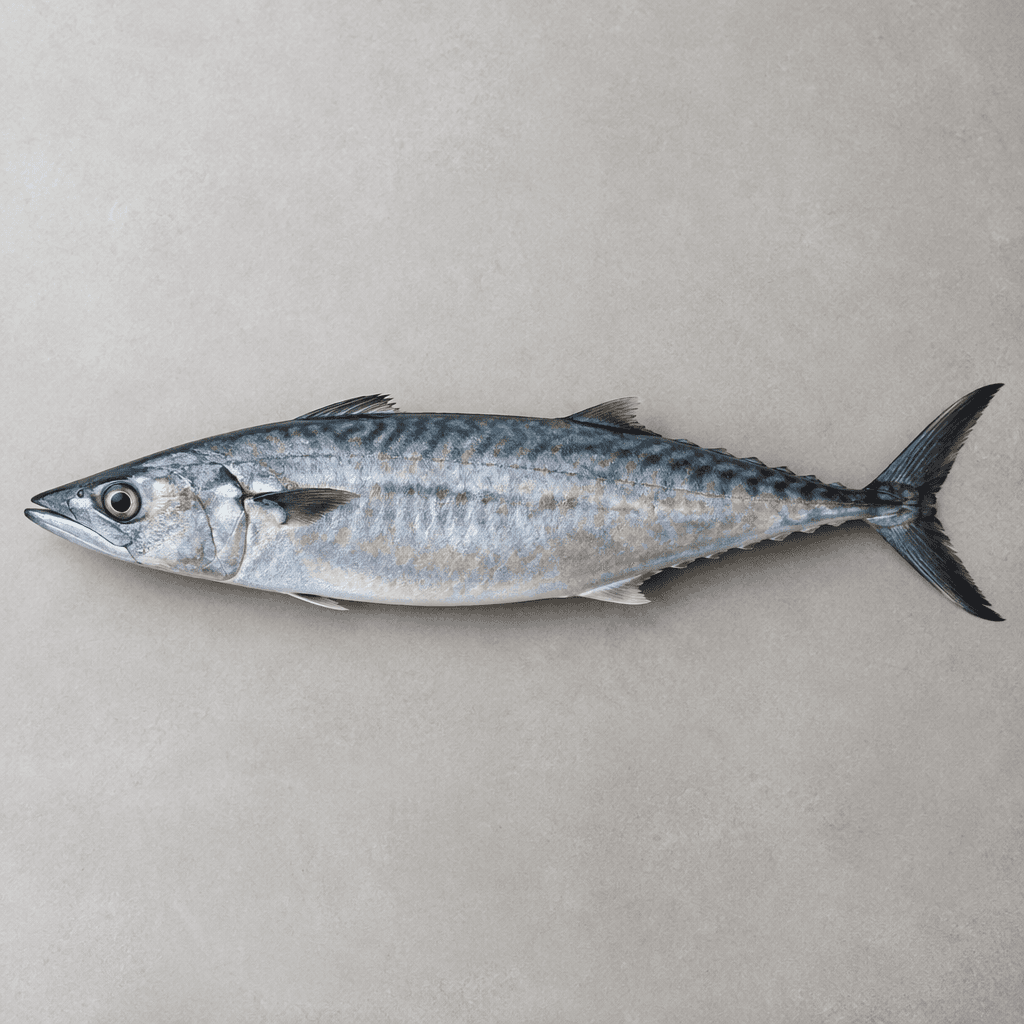
Spanish Mackerel (Raw) Calories
Rich in omega-3, high protein, low carbohydrate
In season: Spring · Summer · Autumn · Winter
CALORIES · 100 G
GI
POTASSIUM · 100 G
FIBER · 100 G
Quick answer
1 piece (medium) of Spanish Mackerel (Raw) (120 g) has 206 calories. That works out to 172 calories per 100 g. It contains 0 g of carbs, 23.2 g of protein, 12.6 g of fat and 0 g of fiber. Its 11.3 µg of B12 covers 470% of the Daily Value. Its glycemic index is 0 (low), so it raises blood sugar slowly.
Spanish Mackerel (Raw) Nutrition Facts
Selected: 1 piece (medium) · 120 g
206
KCAL / 120G
Carbs
0g
· 0% DV
Protein
23.2g
· 46% DV
Fat
12.6g
· 16% DV
Fiber
0g
· 0% DV
DV is the share of the daily value covered, on a 2,000 kcal reference diet.
Calories come from: Carbs 0% · Protein 45% · Fat 55%
Spanish Mackerel (Raw) nutrition facts table · 1 piece (medium) (120 g)
| Nutrient | Amount | % DV |
|---|---|---|
| Calories | 206 kcal | |
| Total fat | 12.6 g | 16% |
| Saturated fat | 3.24 g | 16% |
| Trans fat | 0 g | |
| Sodium | 108 mg | 5% |
| Total carbohydrate | 0 g | 0% |
| Fiber | 0 g | 0% |
| Protein | 23.2 g | 46% |
Calories: Calories measure energy. Average daily need is 2,000 kcal. Excess calories are stored as fat, too few cause weight loss.
Carbs: Your body's primary energy source. The brain runs exclusively on carbs. Daily need: 275g.
Protein: Essential for muscle repair and cell growth. Daily need: 50g. Keeps you full and boosts metabolism.
Fat: Needed for hormone production and vitamin absorption. Daily need: 78g. Limit saturated fats, choose unsaturated.
Fiber: Critical for digestive health and satiety. Daily need: 28g. Stabilizes blood sugar, lowers cholesterol.

Log this food in EatBetter
100,000+ people use it
- Get your daily calorie target
- Snap your meal, log it in seconds
- See every vitamin and mineral

📸 Scan the code to get the app free.

How Many Calories in 1 Medium Spanish Mackerel (Raw)?
| Serving | Amount | Calories |
|---|---|---|
| 1 piece (medium) | 120 g | 206 kcal |
| 1 slice (thin) | 50 g | 86 kcal |
| 1 piece (small) | 80 g | 138 kcal |
| 1 slice (thick) | 80 g | 138 kcal |
| 100 g | 100 g | 172 kcal |
| 1 serving (medium) | 100 g | 172 kcal |
| 1 cup (chopped) | 140 g | 241 kcal |
| 1 serving (large) | 150 g | 258 kcal |
| 1 piece (large) | 180 g | 310 kcal |
Calculated from 172 calories per 100 g.
Frequently Asked Questions About Spanish Mackerel (Raw)
What does Spanish mackerel taste like?
Spanish mackerel has a rich, savory flavor and a firm, oily flesh, but it is generally milder than king mackerel. Its flavor works well with citrus, herbs, and light marinades; avoid overpowering it with long marinating or excessive seasoning.
Can you eat Spanish mackerel raw?
Yes, but only if it has been handled and kept cold for raw consumption. Raw Spanish mackerel can carry parasites and harmful bacteria, so ordinary fresh fish is not automatically safe for sushi or sashimi.
How should you cook Spanish mackerel?
Spanish mackerel is well suited to grilling, pan-searing, or baking. Its oily flesh browns nicely over high heat, but it can dry out if overcooked; take it off the heat once the flesh turns opaque and flakes easily.
Does Spanish mackerel have a lot of bones?
Spanish mackerel has a backbone and fine pin bones along the fillet. Run your fingers over the flesh and pull out any pin bones with tweezers; check again before serving it to children.
How can you tell if Spanish mackerel is fresh?
Fresh Spanish mackerel should smell mild and clean, feel firm, and spring back when pressed. A sour, ammonia-like odor, slimy surface, or soft flesh are warning signs, so do not buy or eat fish with those qualities.
Can Spanish mackerel cause scombroid or histamine poisoning?
Yes, Spanish mackerel can cause histamine poisoning if it is not kept properly chilled after catching. Cooking or freezing does not destroy histamine once it has formed, so prompt refrigeration and careful handling matter.
How is Spanish mackerel different from king mackerel?
Spanish mackerel and king mackerel are different species, and king mackerel generally has much higher mercury levels. Confirm the species when buying, especially when choosing fish for children or during pregnancy.
Can you freeze Spanish mackerel?
Yes, Spanish mackerel freezes well when wrapped airtight while fresh. Thaw it in the refrigerator rather than on the counter. Freezing can control parasites when done under validated conditions, but it does not reverse spoilage or remove histamine.
Do you need to remove the skin from Spanish mackerel?
No, you do not have to remove Spanish mackerel skin. It can help hold the fillet together and crisp up when cooked skin-side down; scale and clean the fish first, and remove the skin if you prefer a softer texture.
How long do Spanish mackerel leftovers keep?
Cooked Spanish mackerel leftovers keep for about three to four days in a refrigerator set to 40°F (4°C) or colder. Refrigerate them promptly in a covered container, and discard them if they were left at room temperature for too long.
Spanish Mackerel (Raw) Vitamins & Minerals
Vitamins
B12
11.28µg · 470% DV
Vitamin D
9.6µg · 48% DV
B3
6.96mg · 44% DV
B6
0.72mg · 42% DV
Minerals
Selenium
43µg · 78% DV
Phosphorus
264mg · 38% DV
Iodine
48µg · 32% DV
Potassium ⭐
408mg · 12% DV
Sodium
108mg · 5% DV
Spanish Mackerel (Raw) Glycemic Index
GLYCEMIC INDEX
GLYCEMIC LOAD
Accounts for portion size — a more realistic measure than GI alone.
How to Burn Off Spanish Mackerel (Raw)
To burn the 206 calories in 1 piece (medium) (120 g):
🚶
Walking (5 km/h)
🏃
Running (8 km/h)
🚴
Cycling
🏊
Swimming
Times are calculated with the MET equation for a 70 kg adult. Actual burn varies with your weight, age and pace.
What is Spanish Mackerel (Raw)?
Spanish mackerel is an oily saltwater fish, and “raw” means the flesh has not been cooked. In many coastal cuisines it is grilled or pan-fried, while raw preparations may appear in dishes such as sashimi when the fish is sourced and handled for that purpose. Its flavour is pronounced and savoury, with a tender texture when fresh; thin slices are often served simply, with citrus or a light dressing.
It provides substantial protein and omega-3 fats, with no carbohydrate listed. For a lighter cooked meal, grill it and pair it with vegetables or a crisp salad. If serving it raw, choose fish specifically intended for raw consumption, keep it properly chilled, and follow local food-safety guidance; citrus juice does not make raw fish safe.
How Nutritious Is Spanish Mackerel (Raw)?
Nutrient density
Very high
How many vitamins, minerals and how much fiber this food carries per calorie. A high score means a lot of nutrition for few calories.
Satiety score
Medium
An EatBetter score computed from fiber, protein and calorie density. A high score means staying full longer on the same calories.
Both scores are calculated per 100 g and do not change with the selected portion. The satiety score is EatBetter's own calculation, not a clinical measure.
Is Spanish Mackerel (Raw) Processed?
NOVA 1
Unprocessed
1. Unprocessed
2. Minimally Processed
3. Processed
4. Ultra-Processed
NOVA classifies foods into 4 groups by industrial processing. NOVA 1 (unprocessed) is the healthiest.
Does Spanish Mackerel (Raw) Contain Allergens?
Contains these allergens:
Which Diets Is Spanish Mackerel (Raw) Good For?
Vegan
— Not suitable
Vegetarian
— Not suitable
Gluten-Free
✓ Suitable
Dairy-Free
— Not suitable
Mediterranean
✓ Suitable
Paleo
✓ Suitable
Whole30
— Not suitable
DASH
— Not suitable
Keto
✓ Suitable
Low FODMAP
— Not suitable
Spanish Mackerel (Raw) Fat Profile
SATURATED
3.24g
MONOUNSATURATED
4.44g
POLYUNSATURATED
2.4g
Omega 6:3 ratio 0.1:1
Below the ideal 4:1 — a good omega balance.
Compare Spanish Mackerel (Raw)
Foods Similar to Spanish Mackerel (Raw)
Have another question about Spanish Mackerel (Raw)?
Ask the AI nutrition coach — calories, portions, alternatives and more, answered in seconds in the app.

Scan calories with your camera
Instant AI nutrition analysis

Nutrition data compiled from USDA FoodData Central and scientific sources.