

Ready & Packaged Foods
All →Vegetables & Legumes
All →Desserts & Confectionery
All →Meat & Protein
All →Grains & Bakery
All →Beverages
All →Milk & Dairy
All →

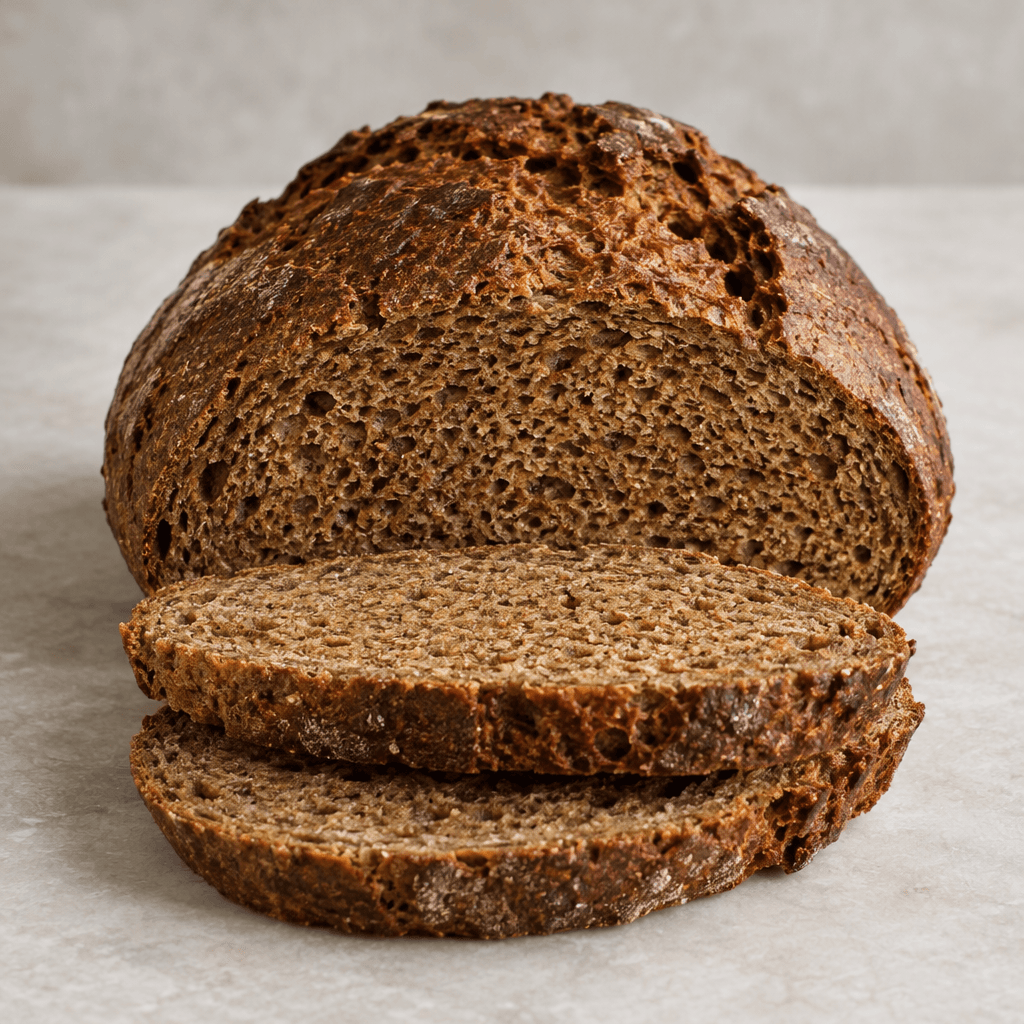
Sourdough rye bread Calories
High fiber, probiotic-rich, low glycemic index bread
In season: Spring · Summer · Autumn · Winter
CALORIES
GI
POTASSIUM
FIBER
Quick answer
1 slice (medium) of Sourdough rye bread (40 g) has 92 calories. That works out to 230 calories per 100 g. It contains 17.6 g of carbs, 2.6 g of protein, 0.9 g of fat and 2.2 g of fiber. Its 0.4 mg of Manganese covers 19% of the Daily Value. Its glycemic index is 48 (medium), so it raises blood sugar at a moderate pace.
What is Sourdough rye bread?
Sourdough rye bread is made with rye flour and a fermented starter, in a style long associated with Northern and Central Europe. Its fermentation gives it a gentle tang, while the loaf’s close, moist crumb and sturdy crust make it denser than many wheat breads.
In its traditional regions, it is often served with cheese, cured fish or hearty soups; elsewhere, it works well for breakfast toast and substantial sandwiches. It is a fibre-rich choice, with 5.5 g of fibre per 100 g. Pair its earthy flavour with crisp vegetables or a fresh, lighter topping if you prefer a less hearty slice.
Sourdough rye bread Nutrition Facts
Selected: 100 g
230
KCAL / 100G
Carbs
44g
· 16% DV
Protein
6.5g
· 13% DV
Fat
2.2g
· 3% DV
Fiber
5.5g
· 20% DV
DV is the share of the daily value covered, on a 2,000 kcal reference diet.
Calories come from: Carbs 79% · Protein 12% · Fat 9%
Sourdough rye bread Vitamins & Minerals
Vitamins
B1
0.22mg · 18% DV
B3
2.1mg · 13% DV
B6
0.19mg · 11% DV
Folate
35µg · 9% DV
Minerals
Manganese
1mg · 43% DV
Sodium
470mg · 20% DV
Selenium
11µg · 20% DV
Phosphorus
95mg · 14% DV
How Nutritious Is Sourdough rye bread?
Nutrient density
Medium
How many vitamins, minerals and how much fiber this food carries per calorie. A high score means a lot of nutrition for few calories.
Satiety score
Medium
An EatBetter score computed from fiber, protein and calorie density. A high score means staying full longer on the same calories.
Both scores are calculated per 100 g and do not change with the selected portion. The satiety score is EatBetter's own calculation, not a clinical measure.
Sourdough rye bread Glycemic Index
GLYCEMIC INDEX
GLYCEMIC LOAD
Accounts for portion size — a more realistic measure than GI alone.
How to Burn Off Sourdough rye bread
To burn the 230 calories in 100 g:
🚶
Walking (5 km/h)
🏃
Running (8 km/h)
🚴
Cycling
🏊
Swimming
Times are calculated with the MET equation for a 70 kg adult. Actual burn varies with your weight, age and pace.
Is Sourdough rye bread Processed?
NOVA 2
Minimally Processed
1. Unprocessed
2. Minimally Processed
3. Processed
4. Ultra-Processed
NOVA classifies foods into 4 groups by industrial processing. NOVA 1 (unprocessed) is the healthiest.
Does Sourdough rye bread Contain Allergens?
Contains these allergens:
Which Diets Is Sourdough rye bread Good For?
Vegan
✓ Suitable
Vegetarian
✓ Suitable
Gluten-Free
— Not suitable
Dairy-Free
— Not suitable
Mediterranean
✓ Suitable
Paleo
— Not suitable
Whole30
— Not suitable
DASH
— Not suitable
Keto
— Not suitable
Low FODMAP
— Not suitable
Sourdough rye bread Fat Profile
SATURATED
0.4g
MONOUNSATURATED
0.5g
POLYUNSATURATED
1.1g
Omega 6:3 ratio 6.4:1
Above the ideal 4:1 (6.4:1).
Compare Sourdough rye bread
Foods Similar to Sourdough rye bread
Frequently Asked Questions About Sourdough rye bread
What is sourdough rye bread?
Sourdough rye bread is bread made with rye flour and a fermented sourdough starter, which gives it a tangy flavor. Many recipes also use wheat flour to help the dough rise, so the name alone does not tell you whether a loaf is made entirely from rye.
Why is sourdough rye bread so dense?
Sourdough rye bread is often dense because rye does not form the same stretchy gluten network as wheat, so it traps less air during rising. A moist, close crumb with small holes is typical of many rye loaves, rather than a sign that the bread is underbaked.
Is sourdough rye bread healthier than white bread?
Sourdough rye bread often provides more fiber and a more filling texture than white bread, particularly when it is made with whole-grain rye. The comparison depends on the recipe: some loaves contain substantial wheat flour or added ingredients, so the name alone does not guarantee a whole-grain bread.
Does sourdough rye bread contain live probiotics?
No, sourdough rye bread is baked, and the heat kills most of the live microorganisms in the starter. Fermentation can still shape its flavor and texture, but eating the finished loaf is not the same as consuming a food with live probiotic cultures.
Can you make sourdough rye bread without wheat flour?
Yes, sourdough rye bread can be made without wheat flour, though a rye-only dough tends to be stickier and produce a denser loaf. Rye itself contains gluten, so replacing wheat flour with rye does not make the bread suitable for a gluten-free diet.
How should you store sourdough rye bread?
Keep sourdough rye bread in a bread box or a breathable bag at room temperature, with the cut side covered. Refrigeration can make bread go stale faster. If you see mold anywhere on the loaf, discard the whole loaf rather than cutting away the visible spot.
Can you freeze sourdough rye bread?
Yes, sourdough rye bread freezes well. Slice it first and seal the slices in a freezer-safe bag so you can take out only what you need. Thaw slices at room temperature or toast them from frozen, and avoid repeatedly thawing and refreezing the loaf.
What is the difference between sourdough rye bread and pumpernickel?
Pumpernickel is a particular style of rye bread, traditionally baked slowly from coarsely ground rye, which gives it a very dark color and distinctive flavor. Sourdough rye bread describes bread fermented with a sourdough starter; it may be lighter and need not be pumpernickel.
Does sourdough fermentation make rye bread easier to digest?
Sourdough fermentation breaks down some compounds in the dough and can change how the bread feels and tastes, but it does not remove rye’s gluten. People with celiac disease must avoid sourdough rye bread; fermentation does not make it safe for them.
How can you serve sourdough rye bread?
Sourdough rye bread pairs well with smoked fish, sharp cheese, eggs, or hearty soups because its tangy flavor stands up to savory toppings. Toasting brings out its aroma, while a thick slice can also be served untoasted alongside stews or salads.
Have another question about Sourdough rye bread?
Ask the AI nutrition coach — calories, portions, alternatives and more, answered in seconds in the app.

Scan calories with your camera
Instant AI nutrition analysis

Nutrition data compiled from USDA FoodData Central and scientific sources.