

Ready & Packaged Foods
All →Vegetables & Legumes
All →Desserts & Confectionery
All →Meat & Protein
All →Grains & Bakery
All →Beverages
All →Milk & Dairy
All →

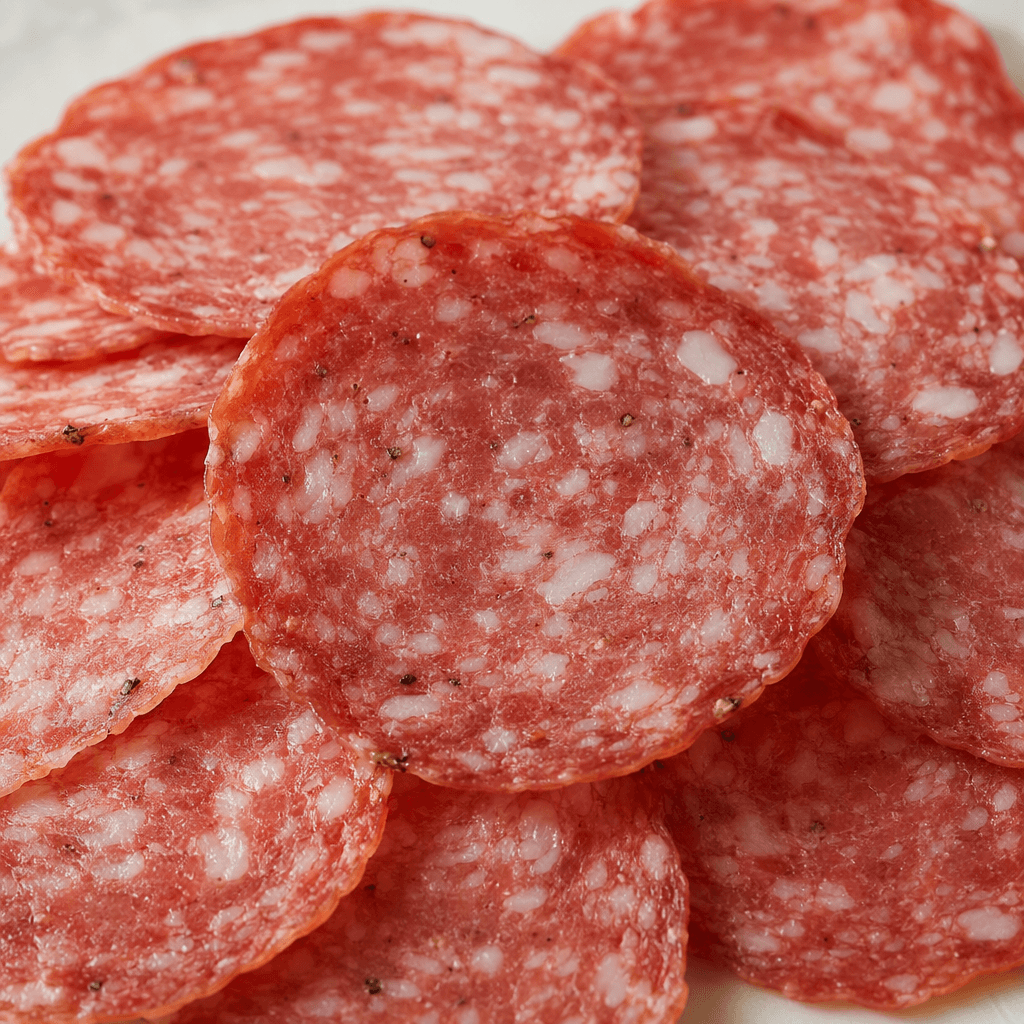
Salami (sliced) Calories
Rich in protein and fat, processed meat product
In season: Spring · Summer · Autumn · Winter
CALORIES
GI
POTASSIUM
FIBER
Quick answer
5 slice (medium) of Salami (sliced) (30 g) has 123 calories. That works out to 410 calories per 100 g. It contains 0.7 g of carbs, 6.6 g of protein, 10.8 g of fat and 0 g of fiber. Its 0.6 µg of B12 covers 26% of the Daily Value. Its glycemic index is 0 (low), so it raises blood sugar slowly.
What is Salami (sliced)?
Sliced salami is made by seasoning meat and fat, forming the mixture into a sausage, and cutting it into thin rounds. Salami comes in many regional styles, with differences in seasoning and texture; these slices are a convenient choice for sandwiches and snack boards.
Its savoury, spiced flavour and firm, slightly yielding texture work well with bread, cheese, olives or crisp vegetables. It is commonly served in sandwiches, as part of an antipasto spread, or as a pizza topping. Salami is rich in both protein and fat, with 36 g of fat per 100 g. For a lighter sandwich, use a few slices and add plenty of salad vegetables.
Salami (sliced) Nutrition Facts
Selected: 100 g
410
KCAL / 100G
Carbs
2.2g
· 1% DV
Protein
22g
· 44% DV
Fat
36g
· 46% DV
Fiber
0g
· 0% DV
DV is the share of the daily value covered, on a 2,000 kcal reference diet.
Calories come from: Carbs 2% · Protein 21% · Fat 77%

Log this food in EatBetter
100,000+ people use it
- Get your daily calorie target
- Snap your meal, log it in seconds
- See every vitamin and mineral

📸 Scan the code to get the app free.

Salami (sliced) Vitamins & Minerals
Vitamins
B12
2.1µg · 88% DV
B1
0.45mg · 38% DV
B3
4.5mg · 28% DV
B5
1.1mg · 22% DV
Minerals
Sodium
1700mg · 74% DV
Phosphorus
180mg · 26% DV
Selenium
13µg · 24% DV
Zinc
2mg · 18% DV
Potassium ⭐
320mg · 9% DV
How Nutritious Is Salami (sliced)?
Nutrient density
Medium
How many vitamins, minerals and how much fiber this food carries per calorie. A high score means a lot of nutrition for few calories.
Satiety score
Low
An EatBetter score computed from fiber, protein and calorie density. A high score means staying full longer on the same calories.
Both scores are calculated per 100 g and do not change with the selected portion. The satiety score is EatBetter's own calculation, not a clinical measure.
Salami (sliced) Glycemic Index
GLYCEMIC INDEX
GLYCEMIC LOAD
Accounts for portion size — a more realistic measure than GI alone.
How to Burn Off Salami (sliced)
To burn the 410 calories in 100 g:
🚶
Walking (5 km/h)
🏃
Running (8 km/h)
🚴
Cycling
🏊
Swimming
Times are calculated with the MET equation for a 70 kg adult. Actual burn varies with your weight, age and pace.
Is Salami (sliced) Processed?
NOVA 3
Processed
1. Unprocessed
2. Minimally Processed
3. Processed
4. Ultra-Processed
NOVA classifies foods into 4 groups by industrial processing. NOVA 1 (unprocessed) is the healthiest.
Does Salami (sliced) Contain Allergens?
No known major allergens
Which Diets Is Salami (sliced) Good For?
Vegan
— Not suitable
Vegetarian
— Not suitable
Gluten-Free
✓ Suitable
Dairy-Free
— Not suitable
Mediterranean
✓ Suitable
Paleo
✓ Suitable
Whole30
— Not suitable
DASH
— Not suitable
Keto
✓ Suitable
Low FODMAP
— Not suitable
Salami (sliced) Fat Profile
SATURATED
13.5g
MONOUNSATURATED
16.2g
POLYUNSATURATED
3.1g
Omega 6:3 ratio 17.5:1
Above the ideal 4:1 (17.5:1).
Compare Salami (sliced)
Foods Similar to Salami (sliced)
Frequently Asked Questions About Salami (sliced)
What is sliced salami made of?
Sliced salami is usually made from seasoned meat and fat, with salt and spices; some varieties also use curing ingredients or cultures. The exact meat and recipe vary, so salami can differ in flavor, texture, and preparation.
Is sliced salami cooked or raw?
Most sliced salami is cured or fermented and may also be heat-treated, rather than being raw fresh meat. Many varieties are ready to eat straight from the package, but follow the package instructions for the specific product.
What is the difference between sliced salami and pepperoni?
Pepperoni is a type of spicy, cured sausage often used as a pizza topping, while salami is a broader family of cured sausages with many seasonings and textures. Pepperoni is typically more strongly seasoned and redder.
How should you store sliced salami before opening it?
Keep unopened sliced salami in the refrigerator unless its package specifically says it is shelf-stable. Store it according to the package directions and avoid leaving it at room temperature for extended periods.
How long does sliced salami last after opening?
Opened sliced salami should be kept refrigerated in a tightly sealed container or wrapper. Follow the package’s after-opening guidance, and discard it if it develops an off smell, a slimy surface, or unusual discoloration.
Can you freeze sliced salami?
Yes, sliced salami can be frozen. Divide it into portions, seal it well to limit freezer burn, and thaw it in the refrigerator; the texture may be softer afterward, so thawed slices work well in cooked dishes.
Why does sliced salami have white spots?
Small white flecks inside sliced salami are often pieces of fat included in the recipe. Fuzzy growth on the surface, sliminess, or an unpleasant smell is different and can signal spoilage; do not eat it.
Can you fry sliced salami?
Yes, sliced salami can be fried briefly in a pan until the edges crisp. It releases fat as it heats, so you usually need little or no added oil; watch it closely because thin slices brown quickly.
Is sliced salami safe to eat during pregnancy?
It is safer to eat sliced salami during pregnancy only after heating it until steaming hot, because refrigerated deli meats can carry listeria. If you have a pregnancy-related health concern, ask your doctor for individual guidance.
Can dogs eat sliced salami?
It is best not to give dogs sliced salami. Its salt and fat content can be unsuitable for them, and seasonings such as garlic may be harmful; offer dog food or a dog-safe treat instead.
Have another question about Salami (sliced)?
Ask the AI nutrition coach — calories, portions, alternatives and more, answered in seconds in the app.

Scan calories with your camera
Instant AI nutrition analysis

Nutrition data compiled from USDA FoodData Central and scientific sources.