

Ready & Packaged Foods
All →Vegetables & Legumes
All →Desserts & Confectionery
All →Meat & Protein
All →Grains & Bakery
All →Beverages
All →Milk & Dairy
All →

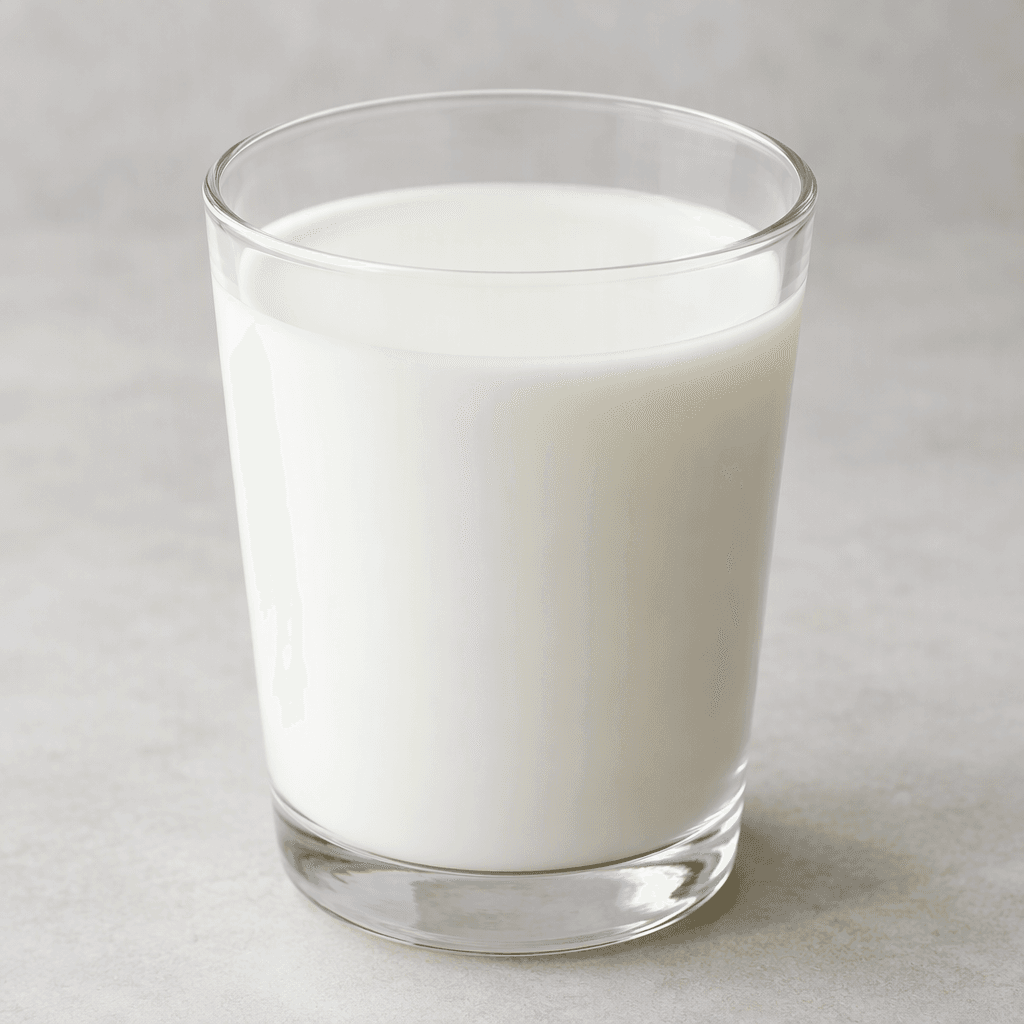
Skim Milk (10g protein) Calories
High-protein, low-fat milk
In season: Spring · Summer · Autumn · Winter
CALORIES
GI
POTASSIUM
FIBER
Quick answer
1 cup (medium) of Skim Milk (10g protein) (200 g) has 90 calories. That works out to 45 calories per 100 g. It contains 9.6 g of carbs, 10 g of protein, 0.4 g of fat and 0 g of fiber. Its 0.9 µg of B12 covers 38% of the Daily Value. Its glycemic index is 32 (low), so it raises blood sugar slowly.
What is Skim Milk (10g protein)?
Skim milk is cow’s milk with most of its fat removed, while retaining its mild dairy flavour and fluid consistency. It is commonly poured over cereal or oats, added to coffee and used in everyday cooking, from sauces to puddings. Compared with whole milk, it feels thinner and less creamy, with a clean, gentle taste; some people prefer it chilled in a glass.
It is low in fat and provides protein: a medium cup of about 200 g contains 10 g according to the serving information provided. It can suit people looking to reduce fat while keeping milk in their routine. Pair it with oats and fruit for a simple, more substantial breakfast.
Skim Milk (10g protein) Nutrition Facts
Selected: 100 g
45
KCAL / 100G
Carbs
4.8g
· 2% DV
Protein
5g
· 10% DV
Fat
0.2g
· 0% DV
Fiber
0g
· 0% DV
DV is the share of the daily value covered, on a 2,000 kcal reference diet.
Calories come from: Carbs 47% · Protein 49% · Fat 4%
Skim Milk (10g protein) Vitamins & Minerals
Vitamins
B12
0.45µg · 19% DV
B2
0.19mg · 15% DV
Biotin
3.5µg · 12% DV
B5
0.36mg · 7% DV
Minerals
Phosphorus
95mg · 14% DV
Calcium
120mg · 12% DV
Iodine
16µg · 11% DV
Selenium
2.5µg · 5% DV
How Nutritious Is Skim Milk (10g protein)?
Nutrient density
High
How many vitamins, minerals and how much fiber this food carries per calorie. A high score means a lot of nutrition for few calories.
Satiety score
Medium
An EatBetter score computed from fiber, protein and calorie density. A high score means staying full longer on the same calories.
Both scores are calculated per 100 g and do not change with the selected portion. The satiety score is EatBetter's own calculation, not a clinical measure.
Skim Milk (10g protein) Glycemic Index
GLYCEMIC INDEX
GLYCEMIC LOAD
Accounts for portion size — a more realistic measure than GI alone.
How to Burn Off Skim Milk (10g protein)
To burn the 45 calories in 100 g:
🚶
Walking (5 km/h)
🏃
Running (8 km/h)
🚴
Cycling
🏊
Swimming
Times are calculated with the MET equation for a 70 kg adult. Actual burn varies with your weight, age and pace.
Is Skim Milk (10g protein) Processed?
NOVA 2
Minimally Processed
1. Unprocessed
2. Minimally Processed
3. Processed
4. Ultra-Processed
NOVA classifies foods into 4 groups by industrial processing. NOVA 1 (unprocessed) is the healthiest.
Does Skim Milk (10g protein) Contain Allergens?
Contains these allergens:
Which Diets Is Skim Milk (10g protein) Good For?
Vegan
— Not suitable
Vegetarian
✓ Suitable
Gluten-Free
— Not suitable
Dairy-Free
— Not suitable
Mediterranean
✓ Suitable
Paleo
— Not suitable
Whole30
— Not suitable
DASH
— Not suitable
Keto
— Not suitable
Low FODMAP
— Not suitable
Skim Milk (10g protein) Fat Profile
SATURATED
0.12g
MONOUNSATURATED
0.04g
POLYUNSATURATED
0.02g
Omega 6:3 ratio 1:1
Below the ideal 4:1 — a good omega balance.
Compare Skim Milk (10g protein)
Foods Similar to Skim Milk (10g protein)
Frequently Asked Questions About Skim Milk (10g protein)
What is skim milk, and how is it made?
Skim milk is cow’s milk with most of its milk fat removed, usually by separating the cream. It still contains milk proteins and lactose. It is also called fat-free or nonfat milk in some countries.
Is skim milk the same as fat-free milk?
Yes, skim milk and fat-free milk are generally names for the same kind of milk: cow’s milk with nearly all its fat removed. Naming and permitted fat thresholds can vary by country, but both refer to a much leaner milk than whole milk.
Is skim milk healthier than whole milk?
Neither is automatically healthier for everyone. Skim milk has less milk fat, while whole milk has a richer taste and texture. Choose based on your needs and preferences; both provide protein and naturally contain lactose.
Does skim milk have as much protein as whole milk?
Yes, skim milk generally has a similar amount of protein to whole milk because removing cream does not remove most of the milk’s protein. The main difference is the amount of fat, not whether the milk is a useful protein source.
Does skim milk froth well for coffee?
Yes, skim milk can make a generous, stable foam for coffee because its proteins help form bubbles. The foam is usually less creamy and rich-tasting than foam made with whole milk. For smoother microfoam, start with cold milk and avoid overheating it.
Can you use skim milk in baking?
Yes, skim milk works in most baking recipes that call for milk. The result may be a little less rich or tender than one made with whole milk, especially in custards and creamy desserts. Use it as a direct substitute in everyday cakes and breads.
Can you make yogurt with skim milk?
Yes, skim milk can be cultured into yogurt, but the result is usually less creamy than yogurt made with whole milk. Heating the milk before adding the starter can help it set more firmly; straining the finished yogurt makes it thicker.
Can you freeze skim milk?
Yes, skim milk can be frozen, but its texture may become grainy or separate after thawing. Leave room in the container for expansion, thaw it in the refrigerator, and shake it well before use. It is often better suited to cooking after thawing.
How should you store skim milk after opening?
Keep opened skim milk tightly closed in the refrigerator, rather than on the door if that area warms often. Follow the package’s storage instructions and use-by guidance. Discard it if it develops an off smell, curdling, or an unusual appearance.
Does skim milk help with weight loss?
Skim milk can help reduce calories from milk compared with whole milk, but it does not cause weight loss by itself. Swapping it into coffee or recipes may be useful if it lowers your overall intake without leaving you less satisfied.
Have another question about Skim Milk (10g protein)?
Ask the AI nutrition coach — calories, portions, alternatives and more, answered in seconds in the app.

Scan calories with your camera
Instant AI nutrition analysis

Nutrition data compiled from USDA FoodData Central and scientific sources.