

Ready & Packaged Foods
All →Vegetables & Legumes
All →Desserts & Confectionery
All →Meat & Protein
All →Grains & Bakery
All →Beverages
All →Milk & Dairy
All →

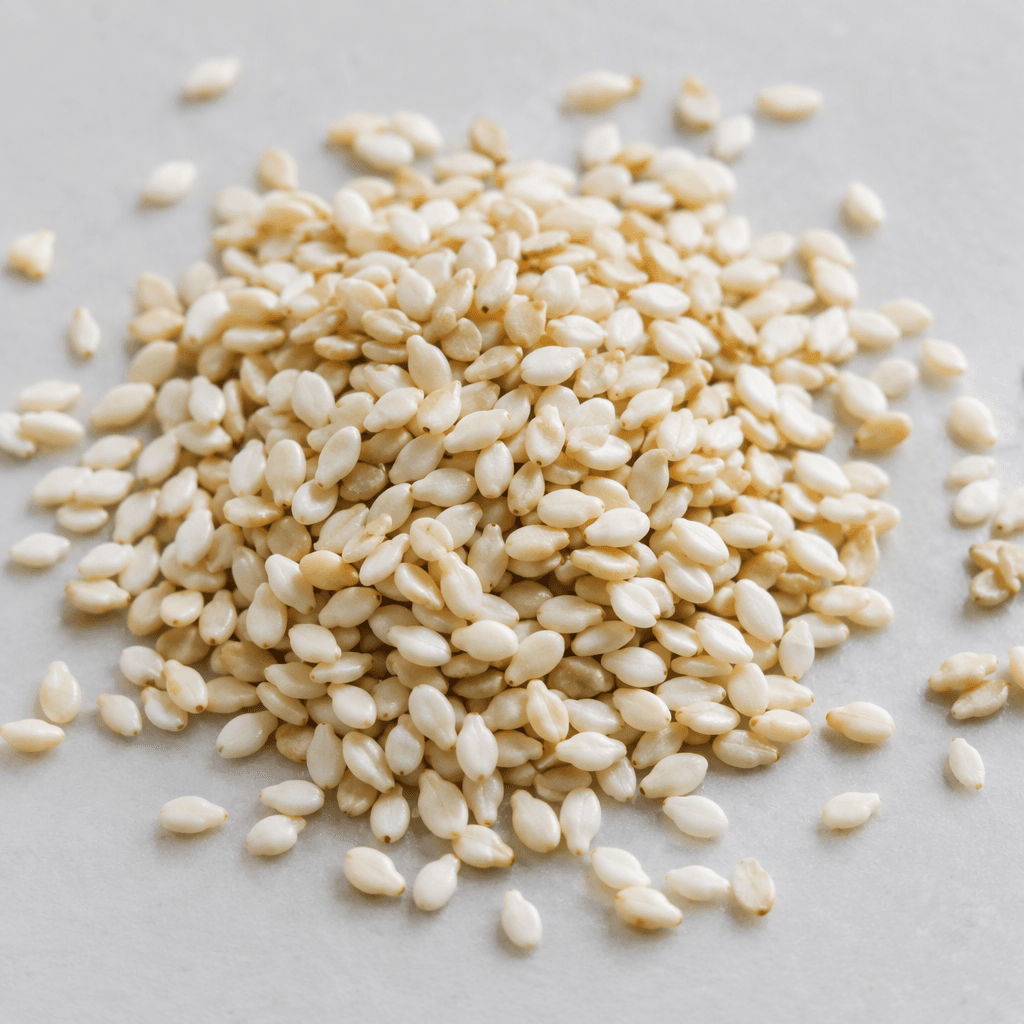
Sesame seeds Calories
High in healthy fats, protein, and calcium
In season: Spring · Summer · Autumn · Winter
CALORIES
GI
POTASSIUM
FIBER
Quick answer
1 tablespoon (medium) of Sesame seeds (9 g) has 52 calories. That works out to 573 calories per 100 g. It contains 2.1 g of carbs, 1.6 g of protein, 4.5 g of fat and 1.1 g of fiber. Its 0.4 mg of Copper covers 41% of the Daily Value. Its glycemic index is 35 (low), so it raises blood sugar slowly.
What is Sesame seeds?
Sesame seeds are the small, flat seeds of the sesame plant, used in cooking across Africa, the Middle East and Asia. They may be white, beige or darker, and are sold whole, toasted or ground into pastes such as tahini. In many cuisines, they add both flavour and texture to everyday dishes.
Toasting brings out their warm, nutty aroma. Sprinkle them over salads, vegetables, noodles or bread, or use them in sauces and sweets; in the US and elsewhere, they are also familiar on burger buns. They are rich in fats and provide protein, fibre and calcium, so a modest spoonful can add a lot of flavour and nourishment. For a lighter meal, use them as a finishing touch rather than the main ingredient.
Sesame seeds Nutrition Facts
Selected: 100 g
573
KCAL / 100G
Carbs
23.5g
· 9% DV
Protein
17.7g
· 35% DV
Fat
49.7g
· 64% DV
Fiber
11.8g
· 42% DV
DV is the share of the daily value covered, on a 2,000 kcal reference diet.
Calories come from: Carbs 15% · Protein 12% · Fat 73%
Sesame seeds Vitamins & Minerals
Vitamins
B1
0.79mg · 66% DV
B6
0.79mg · 46% DV
B3
4.52mg · 28% DV
Biotin
7.5µg · 25% DV
Minerals
Copper
4mg · 444% DV
Calcium
975mg · 98% DV
Phosphorus
629mg · 90% DV
Manganese
2mg · 87% DV
How Nutritious Is Sesame seeds?
Nutrient density
Very high
How many vitamins, minerals and how much fiber this food carries per calorie. A high score means a lot of nutrition for few calories.
Satiety score
Medium
An EatBetter score computed from fiber, protein and calorie density. A high score means staying full longer on the same calories.
Both scores are calculated per 100 g and do not change with the selected portion. The satiety score is EatBetter's own calculation, not a clinical measure.
Sesame seeds Glycemic Index
GLYCEMIC INDEX
GLYCEMIC LOAD
Accounts for portion size — a more realistic measure than GI alone.
How to Burn Off Sesame seeds
To burn the 573 calories in 100 g:
🚶
Walking (5 km/h)
🏃
Running (8 km/h)
🚴
Cycling
🏊
Swimming
Times are calculated with the MET equation for a 70 kg adult. Actual burn varies with your weight, age and pace.
Is Sesame seeds Processed?
NOVA 1
Unprocessed
1. Unprocessed
2. Minimally Processed
3. Processed
4. Ultra-Processed
NOVA classifies foods into 4 groups by industrial processing. NOVA 1 (unprocessed) is the healthiest.
Does Sesame seeds Contain Allergens?
Contains these allergens:
Which Diets Is Sesame seeds Good For?
Vegan
✓ Suitable
Vegetarian
✓ Suitable
Gluten-Free
✓ Suitable
Dairy-Free
— Not suitable
Mediterranean
✓ Suitable
Paleo
✓ Suitable
Whole30
— Not suitable
DASH
— Not suitable
Keto
✓ Suitable
Low FODMAP
— Not suitable
Sesame seeds Fat Profile
SATURATED
6.96g
MONOUNSATURATED
18.8g
POLYUNSATURATED
21.9g
Omega 6:3 ratio 57.1:1
Above the ideal 4:1 (57.1:1).
Compare Sesame seeds
Foods Similar to Sesame seeds
Frequently Asked Questions About Sesame seeds
What are sesame seeds good for?
Sesame seeds provide unsaturated fats, protein, fiber, and minerals, so they can add both flavor and nourishment to meals. They are a useful ingredient, but they do not prevent or treat disease on their own.
How do you eat sesame seeds?
Sprinkle sesame seeds over salads, roasted vegetables, rice, or baked goods, or stir them into sauces and yogurt. You can eat them raw or toasted; toasting gives them a stronger, nuttier flavor.
How do you toast sesame seeds?
Toast sesame seeds in a dry pan over medium-low heat, stirring constantly until fragrant and lightly golden. They can burn quickly, so transfer them to a plate as soon as they are done.
What is the difference between sesame seeds and tahini?
Tahini is a smooth paste made by grinding sesame seeds; sesame seeds are the whole seeds themselves. Tahini works in sauces and spreads, while whole seeds are often used as a topping or garnish.
Are black sesame seeds different from white sesame seeds?
Yes. Black sesame seeds are generally sold with their hull, while white sesame seeds are often hulled, giving them different textures and flavors. Black sesame tends to taste more robust and slightly bitter.
Can you eat sesame seeds raw?
Yes, sesame seeds can be eaten raw. They have a milder flavor than toasted seeds, which develop a nuttier aroma in a dry pan. Keep raw seeds stored airtight so their natural oils stay fresh.
Do sesame seeds need to be washed before eating?
Usually, packaged sesame seeds do not need washing before use. Washing tiny seeds can be awkward and may leave them damp; if you do rinse them, dry them thoroughly before storing or toasting.
How should you store sesame seeds?
Keep sesame seeds in an airtight container away from heat, light, and moisture. Because their oils can turn rancid, refrigerate or freeze them if you need to keep them for a long time; discard seeds with a stale or bitter smell.
Can sesame seeds cause an allergic reaction?
Yes. Sesame is a major food allergen and can cause symptoms ranging from hives or swelling to breathing difficulty. Anyone with a sesame allergy should avoid sesame seeds and foods containing them; breathing problems require emergency care.
Can you substitute sesame seeds for poppy seeds?
Yes, sesame seeds can replace poppy seeds in many toppings and baked goods, but the flavor will be nuttier and more pronounced. Use a similar amount, and toast the sesame lightly if you want a deeper flavor.
Have another question about Sesame seeds?
Ask the AI nutrition coach — calories, portions, alternatives and more, answered in seconds in the app.

Scan calories with your camera
Instant AI nutrition analysis

Nutrition data compiled from USDA FoodData Central and scientific sources.