

Ready & Packaged Foods
All →Vegetables & Legumes
All →Desserts & Confectionery
All →Meat & Protein
All →Grains & Bakery
All →Beverages
All →Milk & Dairy
All →

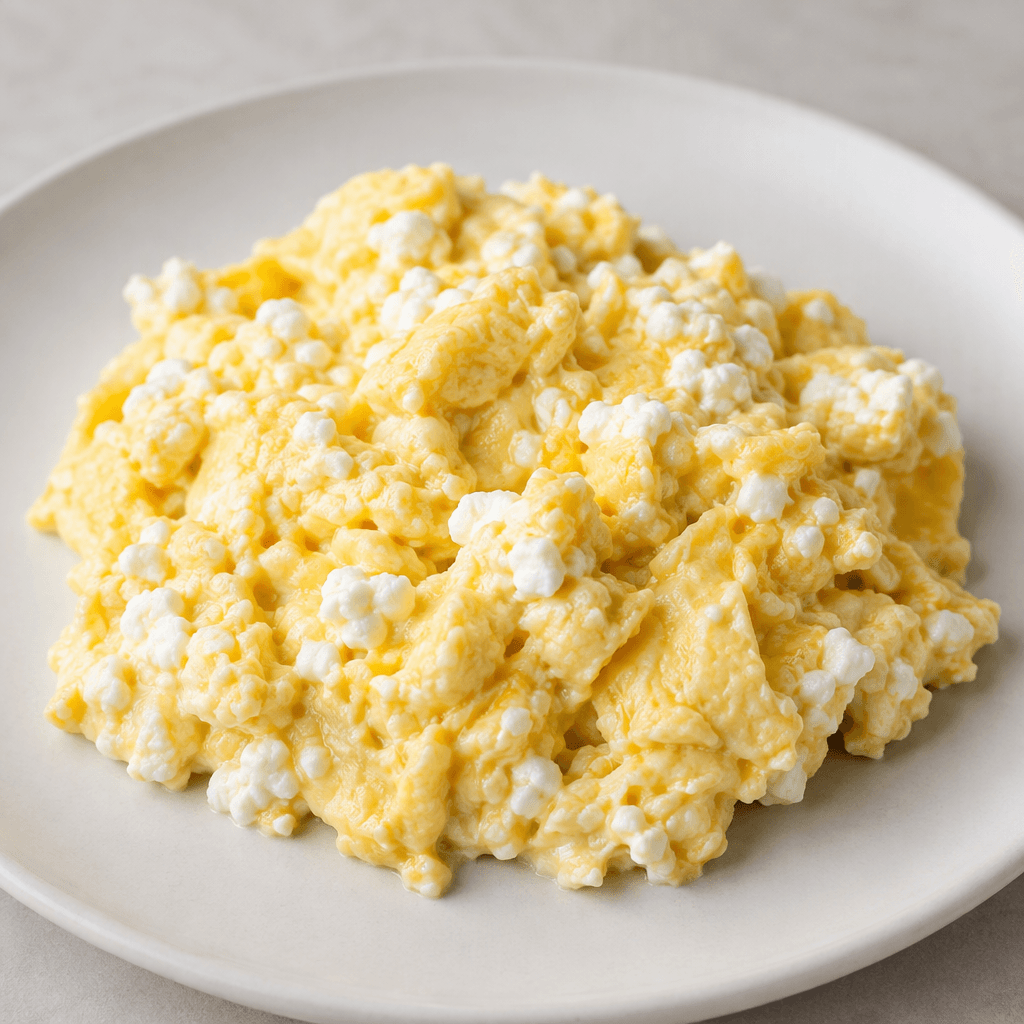
Scrambled eggs with cottage cheese Calories
High in protein, calcium, and vitamin B12
In season: Spring · Summer · Autumn · Winter
CALORIES
GI
POTASSIUM
FIBER
Quick answer
1 serving (medium) of Scrambled eggs with cottage cheese (120 g) has 168 calories. That works out to 140 calories per 100 g. It contains 2.8 g of carbs, 15 g of protein, 10.3 g of fat and 0 g of fiber. Its 21.6 µg of Biotin covers 72% of the Daily Value. Its glycemic index is 0 (low), so it raises blood sugar slowly.
What is Scrambled eggs with cottage cheese?
Lor peynirli yumurta is a Turkish-style scramble made by cooking eggs with lor, a mild, crumbly whey cheese. The curds stay distinct in the soft, moist eggs, giving the dish a gentle, milky flavour rather than a strongly salty or sharp one. In Turkey it is commonly served hot for breakfast, often with bread, tomatoes and olives; it also makes an easy light lunch. It is protein-rich, with calcium and vitamin B12 as well. For a simple, balanced plate, pair it with fresh vegetables, or use a little oil and add herbs such as parsley or chives for extra flavour.
Scrambled eggs with cottage cheese Nutrition Facts
Selected: 100 g
140
KCAL / 100G
Carbs
2.3g
· 1% DV
Protein
12.5g
· 25% DV
Fat
8.6g
· 11% DV
Fiber
0g
· 0% DV
DV is the share of the daily value covered, on a 2,000 kcal reference diet.
Calories come from: Carbs 7% · Protein 37% · Fat 56%
Scrambled eggs with cottage cheese Vitamins & Minerals
Vitamins
Biotin
18µg · 60% DV
B12
1.1µg · 46% DV
B2
0.35mg · 27% DV
B5
1.2mg · 24% DV
Minerals
Selenium
15µg · 27% DV
Phosphorus
180mg · 26% DV
Iodine
22µg · 15% DV
Sodium
320mg · 14% DV
How Nutritious Is Scrambled eggs with cottage cheese?
Nutrient density
High
How many vitamins, minerals and how much fiber this food carries per calorie. A high score means a lot of nutrition for few calories.
Satiety score
Medium
An EatBetter score computed from fiber, protein and calorie density. A high score means staying full longer on the same calories.
Both scores are calculated per 100 g and do not change with the selected portion. The satiety score is EatBetter's own calculation, not a clinical measure.
Scrambled eggs with cottage cheese Glycemic Index
GLYCEMIC INDEX
GLYCEMIC LOAD
Accounts for portion size — a more realistic measure than GI alone.
How to Burn Off Scrambled eggs with cottage cheese
To burn the 140 calories in 100 g:
🚶
Walking (5 km/h)
🏃
Running (8 km/h)
🚴
Cycling
🏊
Swimming
Times are calculated with the MET equation for a 70 kg adult. Actual burn varies with your weight, age and pace.
Is Scrambled eggs with cottage cheese Processed?
NOVA 2
Minimally Processed
1. Unprocessed
2. Minimally Processed
3. Processed
4. Ultra-Processed
NOVA classifies foods into 4 groups by industrial processing. NOVA 1 (unprocessed) is the healthiest.
Does Scrambled eggs with cottage cheese Contain Allergens?
Contains these allergens:
Which Diets Is Scrambled eggs with cottage cheese Good For?
Vegan
— Not suitable
Vegetarian
✓ Suitable
Gluten-Free
✓ Suitable
Dairy-Free
— Not suitable
Mediterranean
✓ Suitable
Paleo
— Not suitable
Whole30
— Not suitable
DASH
— Not suitable
Keto
✓ Suitable
Low FODMAP
— Not suitable
Scrambled eggs with cottage cheese Fat Profile
SATURATED
3.1g
MONOUNSATURATED
2.7g
POLYUNSATURATED
1.1g
Omega 6:3 ratio 7.3:1
Above the ideal 4:1 (7.3:1).
Compare Scrambled eggs with cottage cheese
Foods Similar to Scrambled eggs with cottage cheese
Frequently Asked Questions About Scrambled eggs with cottage cheese
How do you make scrambled eggs with cottage cheese?
Cook beaten eggs gently in a lightly heated pan, then fold in cottage cheese as the eggs begin to set. Take the pan off the heat while the eggs are still slightly moist; residual heat finishes cooking them.
When should you add cottage cheese to scrambled eggs with cottage cheese?
Add the cottage cheese once the eggs have started to form soft curds. This warms the cheese without making it disappear into the eggs, and folding it in gently keeps the curds distinct.
Why are scrambled eggs with cottage cheese watery?
Scrambled eggs with cottage cheese can turn watery if the cheese contains a lot of liquid or the eggs are overcooked. Drain excess liquid from the cottage cheese and cook the eggs gently rather than over high heat.
Does cottage cheese melt in scrambled eggs with cottage cheese?
No, cottage cheese usually does not melt completely in scrambled eggs with cottage cheese. The curds soften and warm through but remain visible; mash them into the eggs during cooking if you prefer a more even texture.
What seasonings go well in scrambled eggs with cottage cheese?
Black pepper, chives, and a little paprika work well in scrambled eggs with cottage cheese. Add fresh herbs near the end of cooking, and taste before adding salt because cottage cheese can already be salty.
How do you keep scrambled eggs with cottage cheese creamy?
Keep scrambled eggs with cottage cheese creamy by cooking them over low to medium-low heat and stirring gently. Remove the pan while the eggs still look a little glossy, since they continue to cook from residual heat.
Can you make scrambled eggs with cottage cheese in the microwave?
Yes, scrambled eggs with cottage cheese can be cooked in a microwave in a microwave-safe bowl. Heat in short bursts, stirring between them, and stop as soon as the eggs are just set to avoid a rubbery texture.
How long do scrambled eggs with cottage cheese last in the fridge?
Store scrambled eggs with cottage cheese in a covered container in the refrigerator and eat them within three days. Refrigerate leftovers promptly rather than leaving them at room temperature, and only reheat the portion you plan to eat.
Can you reheat scrambled eggs with cottage cheese?
Yes, reheat scrambled eggs with cottage cheese gently in the microwave or in a pan over low heat. Stir once or twice and stop when they are hot; prolonged heating can make the eggs tough and the mixture release liquid.
Are scrambled eggs with cottage cheese a filling breakfast?
Yes, scrambled eggs with cottage cheese can make a filling breakfast because the eggs and cheese provide protein. Pair them with vegetables or whole-grain toast for a more varied meal, rather than relying on the eggs alone.
Have another question about Scrambled eggs with cottage cheese?
Ask the AI nutrition coach — calories, portions, alternatives and more, answered in seconds in the app.

Scan calories with your camera
Instant AI nutrition analysis

Nutrition data compiled from USDA FoodData Central and scientific sources.