

Ready & Packaged Foods
All →Vegetables & Legumes
All →Desserts & Confectionery
All →Meat & Protein
All →Grains & Bakery
All →Beverages
All →Milk & Dairy
All →

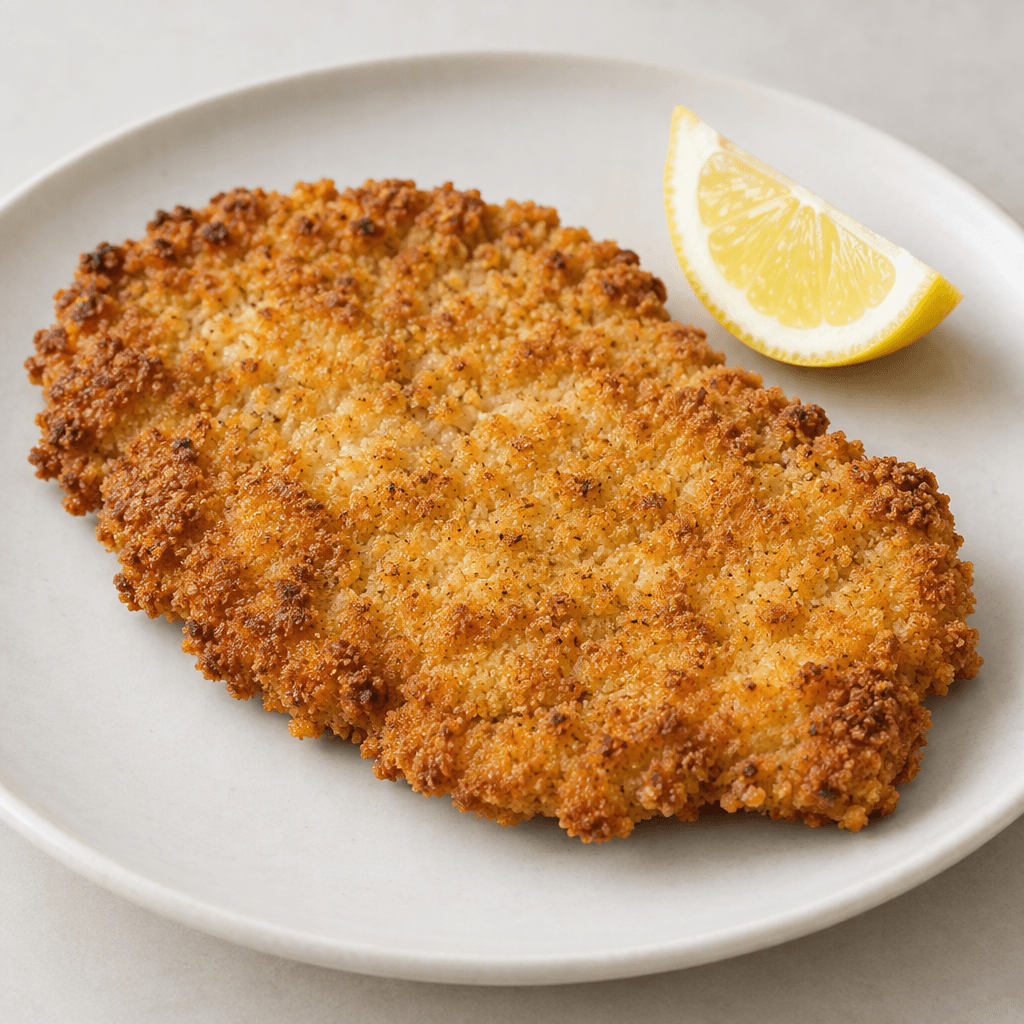
Schnitzel Calories
Breaded and fried meat cutlet
In season: Spring · Summer · Autumn · Winter
CALORIES
GI
POTASSIUM
FIBER
Quick answer
1 piece (medium) of Schnitzel (150 g) has 398 calories. That works out to 265 calories per 100 g. It contains 22.8 g of carbs, 27.8 g of protein, 21.3 g of fat and 1.2 g of fiber. Its 1 µg of B12 covers 44% of the Daily Value. Its glycemic index is 65 (medium), so it raises blood sugar at a moderate pace.
What is Schnitzel?
Schnitzel is a thin, boneless cutlet coated in flour, egg and breadcrumbs, then fried until crisp. It is associated with Central European cooking, especially Austria; veal is traditional for Wiener Schnitzel, while chicken and other meats are common in many places.
The coating should be crunchy and the meat tender. It is often served hot with lemon, potatoes or a simple salad, whether as a pub meal or a home-cooked dinner. Schnitzel provides protein, while the breadcrumb coating contributes carbohydrates and frying adds fat. For a lighter plate, bake it or use an air fryer and pair it with a generous green salad.
Schnitzel Nutrition Facts
Selected: 100 g
265
KCAL / 100G
Carbs
15.2g
· 6% DV
Protein
18.5g
· 37% DV
Fat
14.2g
· 18% DV
Fiber
0.8g
· 3% DV
DV is the share of the daily value covered, on a 2,000 kcal reference diet.
Calories come from: Carbs 23% · Protein 28% · Fat 49%
Schnitzel Vitamins & Minerals
Vitamins
B12
0.7µg · 29% DV
B3
4.2mg · 26% DV
B6
0.32mg · 19% DV
Biotin
4.5µg · 15% DV
Minerals
Phosphorus
185mg · 26% DV
Selenium
13µg · 24% DV
Zinc
2mg · 18% DV
Sodium
420mg · 18% DV
How Nutritious Is Schnitzel?
Nutrient density
Medium
How many vitamins, minerals and how much fiber this food carries per calorie. A high score means a lot of nutrition for few calories.
Satiety score
Medium
An EatBetter score computed from fiber, protein and calorie density. A high score means staying full longer on the same calories.
Both scores are calculated per 100 g and do not change with the selected portion. The satiety score is EatBetter's own calculation, not a clinical measure.
Schnitzel Glycemic Index
GLYCEMIC INDEX
GLYCEMIC LOAD
Accounts for portion size — a more realistic measure than GI alone.
How to Burn Off Schnitzel
To burn the 265 calories in 100 g:
🚶
Walking (5 km/h)
🏃
Running (8 km/h)
🚴
Cycling
🏊
Swimming
Times are calculated with the MET equation for a 70 kg adult. Actual burn varies with your weight, age and pace.
Is Schnitzel Processed?
NOVA 3
Processed
1. Unprocessed
2. Minimally Processed
3. Processed
4. Ultra-Processed
NOVA classifies foods into 4 groups by industrial processing. NOVA 1 (unprocessed) is the healthiest.
Does Schnitzel Contain Allergens?
Contains these allergens:
Which Diets Is Schnitzel Good For?
Vegan
— Not suitable
Vegetarian
— Not suitable
Gluten-Free
— Not suitable
Dairy-Free
— Not suitable
Mediterranean
✓ Suitable
Paleo
— Not suitable
Whole30
— Not suitable
DASH
— Not suitable
Keto
— Not suitable
Low FODMAP
— Not suitable
Schnitzel Fat Profile
SATURATED
3.6g
MONOUNSATURATED
5.2g
POLYUNSATURATED
2.4g
Omega 6:3 ratio 5.3:1
Above the ideal 4:1 (5.3:1).
Compare Schnitzel
Foods Similar to Schnitzel
Frequently Asked Questions About Schnitzel
What does schnitzel mean?
Schnitzel means a thin cutlet, usually pounded, breaded and fried. The name is associated with Central European cooking, and the meat can vary; Wiener schnitzel is the specifically named Austrian veal version.
Is schnitzel always made with veal?
No, schnitzel can be made with chicken, pork, turkey or veal. Veal is required for traditional Wiener schnitzel; menus may use that name loosely, so check which meat the dish contains if it matters to you.
Why does the breading fall off schnitzel?
Schnitzel breading often slips off when the meat is damp or the coating is not firmly applied. Pat the meat dry, coat it in flour, egg and breadcrumbs in that order, then press the crumbs gently onto the surface.
What is the difference between schnitzel and chicken-fried steak?
Schnitzel is a thin breaded cutlet that is usually fried, while chicken-fried steak is typically a tenderized beef steak with a thicker, seasoned coating and is commonly served with creamy gravy. Their meat, coating and usual accompaniments differ.
Is schnitzel Austrian or German?
Schnitzel is popular across German-speaking Central Europe, but Wiener schnitzel is a well-known Austrian dish. Similar breaded cutlets are made in many countries, so the broader dish is not limited to one national cuisine.
What sauce goes with schnitzel?
Lemon is a classic accompaniment for schnitzel, and many versions are served without a heavy sauce so the crust stays crisp. Mushroom cream sauce is also popular, especially with German-style schnitzel; serve it alongside or beneath the cutlet.
How do you keep schnitzel crispy after frying?
To keep schnitzel crispy, place it on a wire rack after frying rather than stacking pieces or leaving them on paper towels. If you need to hold several portions, keep them warm in a low oven with space between them.
Can you cook schnitzel in an air fryer?
Yes, schnitzel can be cooked in an air fryer. Arrange the breaded pieces in a single layer, lightly oil the coating and turn them partway through cooking; crowding the basket can leave the crust uneven.
Can you bake schnitzel instead of frying it?
Yes, you can bake schnitzel on a lightly oiled baking tray. Brush or spray the breadcrumb coating with a little oil and turn the pieces once; baking uses less oil, but the crust may be less crisp than pan-fried schnitzel.
Can you freeze cooked schnitzel?
Yes, cooked schnitzel can be frozen once cooled. Separate pieces with baking paper in an airtight container to prevent sticking, then reheat them in an oven or air fryer so the coating regains some crispness.
Have another question about Schnitzel?
Ask the AI nutrition coach — calories, portions, alternatives and more, answered in seconds in the app.

Scan calories with your camera
Instant AI nutrition analysis

Nutrition data compiled from USDA FoodData Central and scientific sources.