

Ready & Packaged Foods
All →Vegetables & Legumes
All →Desserts & Confectionery
All →Meat & Protein
All →Grains & Bakery
All →Beverages
All →Milk & Dairy
All →

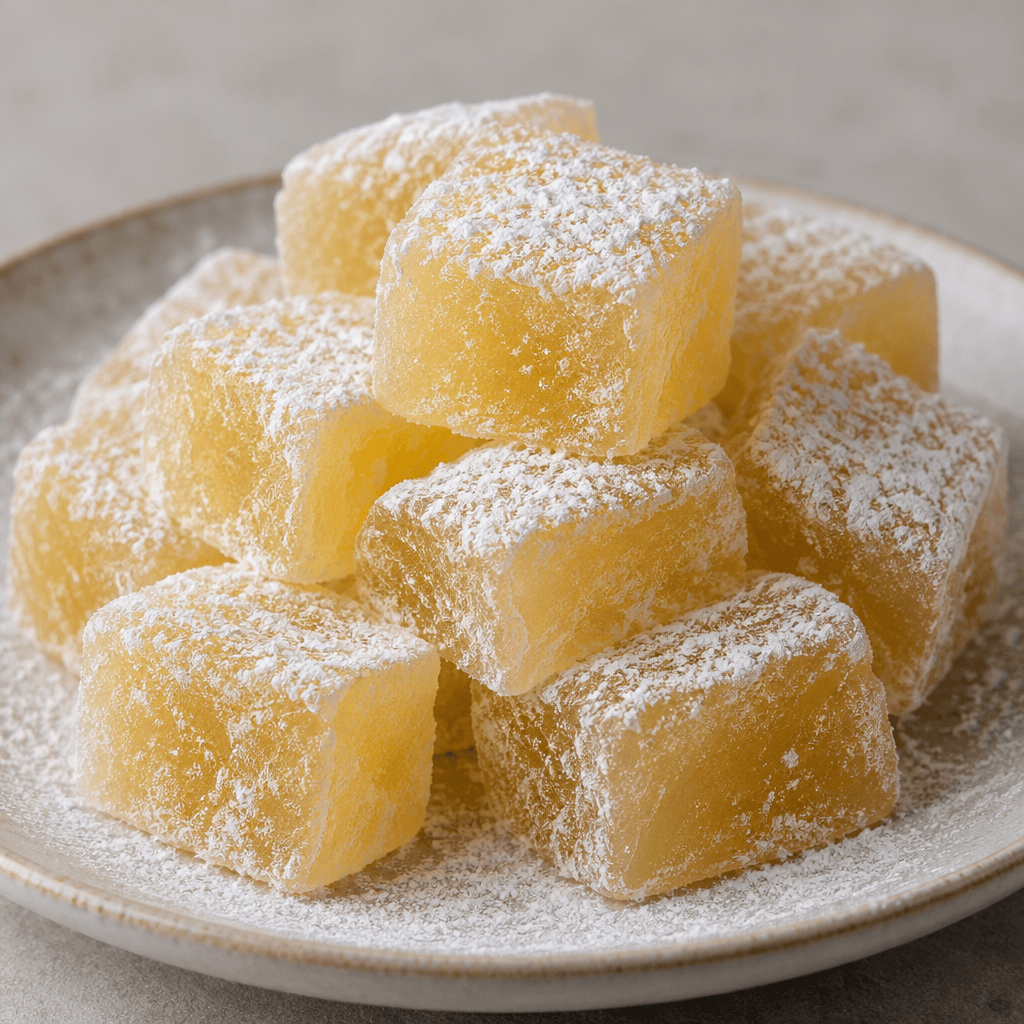
Buttery Turkish delight Calories
High-sugar processed confection with buttery flavor
CALORIES · 100 G
GI
POTASSIUM · 100 G
FIBER · 100 G
Quick answer
2 piece (medium) of Buttery Turkish delight (40 g) has 158 calories. That works out to 395 calories per 100 g. It contains 35.2 g of carbs, 0.2 g of protein, 1.7 g of fat and 0.1 g of fiber. Its glycemic index is 72 (high), so it raises blood sugar quickly.
Buttery Turkish delight Nutrition Facts
Selected: 2 piece (medium) · 40 g
158
KCAL / 40G
Carbs
35.2g
· 13% DV
Protein
0.2g
· 0% DV
Fat
1.7g
· 2% DV
Fiber
0.1g
· 0% DV
DV is the share of the daily value covered, on a 2,000 kcal reference diet.
Calories come from: Carbs 90% · Protein 1% · Fat 9%
Buttery Turkish delight nutrition facts table · 2 piece (medium) (40 g)
| Nutrient | Amount | % DV |
|---|---|---|
| Calories | 158 kcal | |
| Total fat | 1.7 g | 2% |
| Saturated fat | 0.96 g | 5% |
| Trans fat | 0.04 g | |
| Sodium | 22 mg | 1% |
| Total carbohydrate | 35.2 g | 13% |
| Fiber | 0.1 g | 0% |
| Protein | 0.2 g | 0% |
Calories: Calories measure energy. Average daily need is 2,000 kcal. Excess calories are stored as fat, too few cause weight loss.
Carbs: Your body's primary energy source. The brain runs exclusively on carbs. Daily need: 275g.
Protein: Essential for muscle repair and cell growth. Daily need: 50g. Keeps you full and boosts metabolism.
Fat: Needed for hormone production and vitamin absorption. Daily need: 78g. Limit saturated fats, choose unsaturated.
Fiber: Critical for digestive health and satiety. Daily need: 28g. Stabilizes blood sugar, lowers cholesterol.

Log this food in EatBetter
100,000+ people use it
- Get your daily calorie target
- Snap your meal, log it in seconds
- See every vitamin and mineral

📸 Scan the code to get the app free.

How Many Calories in 2 Pieces of Buttery Turkish delight?
| Serving | Amount | Calories |
|---|---|---|
| 2 piece (medium) | 40 g | 158 kcal |
| 1 piece (small) | 20 g | 79 kcal |
| 1 serving (small) | 30 g | 119 kcal |
| 1 serving (medium) | 50 g | 198 kcal |
| 3 piece (large) | 60 g | 237 kcal |
| 1 serving (large) | 75 g | 296 kcal |
| 100 g | 100 g | 395 kcal |
| 5 piece (jumbo) | 100 g | 395 kcal |
| 1 pack (whole) | 150 g | 593 kcal |
Calculated from 395 calories per 100 g.
Frequently Asked Questions About Buttery Turkish delight
What is buttery Turkish delight made of?
Buttery Turkish delight is a lokum variation with a buttery flavor, sometimes from added butter or flavoring. Like other lokum, it is generally made from a cooked sugar-and-starch mixture; the exact ingredients vary by recipe or product.
How is buttery Turkish delight different from regular Turkish delight?
Buttery Turkish delight has a richer, buttery taste that regular lokum does not usually have. Both are soft, chewy sweets, but the flavor and texture of the buttery version depend on how the butter or buttery flavor is incorporated.
How do you make buttery Turkish delight at home?
To make buttery Turkish delight, cook a sugar syrup with starch until thick, then add butter or buttery flavor and continue cooking until the mixture reaches a chewy consistency. Let it set before cutting it into pieces and coating them.
Why does buttery Turkish delight get hard or crystallize?
Buttery Turkish delight can harden when it dries out, while sugar crystals can form if the mixture is cooked or handled incorrectly. Keeping it sealed and away from excessive heat and moisture helps preserve its soft, chewy texture.
How should you store buttery Turkish delight?
Store buttery Turkish delight in an airtight container in a cool, dry place away from sunlight. Humidity and heat can change its texture; discard it if you notice mold, an unusual odor, or an unexpected change in appearance.
What should you serve with buttery Turkish delight?
Serve buttery Turkish delight with unsweetened Turkish coffee or tea, which balances its sweetness. It also works as part of a small dessert plate with other lokum varieties; cutting larger pieces in half makes it easier to share.
How do you stop buttery Turkish delight from sticking together?
Keep the pieces separated in a dry, airtight container to reduce sticking. A light dusting of starch or powdered sugar can help keep buttery Turkish delight pieces apart, though too much coating may change their taste and texture.
Can you use buttery Turkish delight as a gift for Turkish guests?
Yes, buttery Turkish delight can be offered as a small gift or served to guests with coffee or tea. Lokum is a familiar Turkish treat, and a mixed box lets guests choose between the buttery variety and other flavors.
Can people with diabetes eat buttery Turkish delight?
People with diabetes should treat buttery Turkish delight as a sugary sweet that can raise blood glucose. Because suitable portions and glucose management vary from person to person, ask a doctor or dietitian how it fits your individual plan.
What happens if you eat too much buttery Turkish delight?
Eating a lot of buttery Turkish delight may cause discomfort because it is a concentrated sweet, and frequent large portions can add substantially to overall energy intake. Enjoying a small piece rather than grazing on several is a practical way to moderate it.
Buttery Turkish delight Vitamins & Minerals
Vitamins
Vitamin A
14µg · 2% DV
B2
0.01mg · 1% DV
Biotin
0.12µg · 0% DV
B1
0mg · 0% DV
Minerals
Sodium
22mg · 1% DV
Copper
0.01mg · 1% DV
Phosphorus
4mg · 1% DV
Manganese
0.01mg · 0% DV
Potassium ⭐
8.8mg · 0% DV
Buttery Turkish delight Glycemic Index
GLYCEMIC INDEX
GLYCEMIC LOAD
Accounts for portion size — a more realistic measure than GI alone.
How to Burn Off Buttery Turkish delight
To burn the 158 calories in 2 piece (medium) (40 g):
🚶
Walking (5 km/h)
🏃
Running (8 km/h)
🚴
Cycling
🏊
Swimming
Times are calculated with the MET equation for a 70 kg adult. Actual burn varies with your weight, age and pace.
What is Buttery Turkish delight?
Buttery Turkish delight brings a buttery flavour to lokum, the soft, chewy confection traditionally made in Turkey from sugar and starch. Cut into small pieces, it is often offered to guests or enjoyed as a little sweet after a meal. Its texture is tender and slightly springy, with a rich sweetness and a mellow buttery note.
In Turkey, lokum commonly accompanies Turkish coffee or tea and is a familiar treat for visitors and festive gatherings. English-speaking readers may also serve it with coffee or tea, or include it on a small dessert plate. It is mainly a source of sugar and carbohydrate, with very little fibre, so a small piece alongside an unsweetened drink makes a balanced-tasting treat.
How Nutritious Is Buttery Turkish delight?
Nutrient density
Low
How many vitamins, minerals and how much fiber this food carries per calorie. A high score means a lot of nutrition for few calories.
Satiety score
Low
An EatBetter score computed from fiber, protein and calorie density. A high score means staying full longer on the same calories.
Both scores are calculated per 100 g and do not change with the selected portion. The satiety score is EatBetter's own calculation, not a clinical measure.
Is Buttery Turkish delight Processed?
NOVA 4
Ultra-Processed
1. Unprocessed
2. Minimally Processed
3. Processed
4. Ultra-Processed
NOVA classifies foods into 4 groups by industrial processing. NOVA 1 (unprocessed) is the healthiest.
Does Buttery Turkish delight Contain Allergens?
Contains these allergens:
Which Diets Is Buttery Turkish delight Good For?
Vegan
— Not suitable
Vegetarian
✓ Suitable
Gluten-Free
— Not suitable
Dairy-Free
— Not suitable
Mediterranean
— Not suitable
Paleo
— Not suitable
Whole30
— Not suitable
DASH
— Not suitable
Keto
— Not suitable
Low FODMAP
— Not suitable
Buttery Turkish delight Fat Profile
SATURATED
0.96g
MONOUNSATURATED
0.44g
POLYUNSATURATED
0.08g
Omega 6:3 ratio 5:1
Above the ideal 4:1 (5:1).
Compare Buttery Turkish delight
Foods Similar to Buttery Turkish delight
Have another question about Buttery Turkish delight?
Ask the AI nutrition coach — calories, portions, alternatives and more, answered in seconds in the app.

Scan calories with your camera
Instant AI nutrition analysis

Nutrition data compiled from USDA FoodData Central and scientific sources.