

Ready & Packaged Foods
All →Vegetables & Legumes
All →Desserts & Confectionery
All →Meat & Protein
All →Grains & Bakery
All →Beverages
All →Milk & Dairy
All →

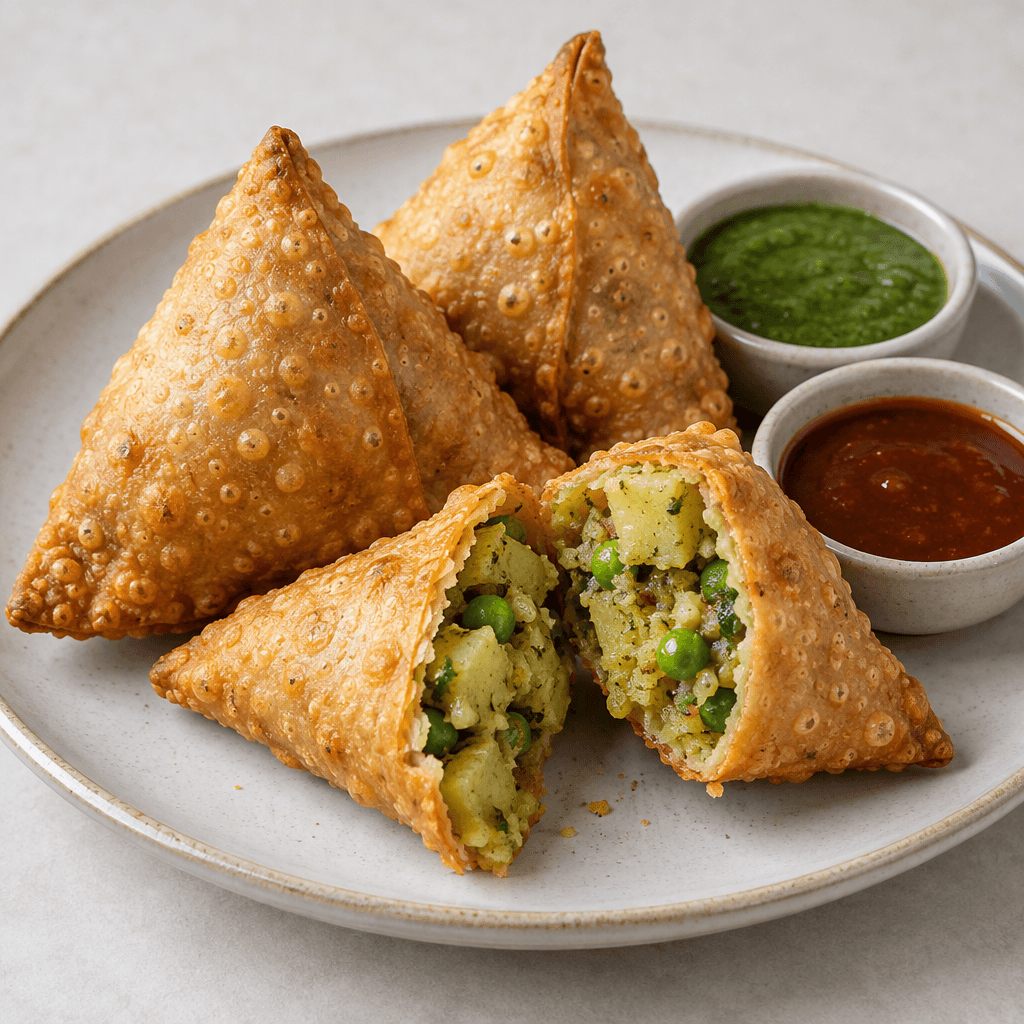
Samosa Calories
Fried pastry with spiced potato filling
In season: Spring · Summer · Autumn · Winter
CALORIES
GI
POTASSIUM
FIBER
Quick answer
1 piece (medium) of Samosa (70 g) has 189 calories. That works out to 270 calories per 100 g. It contains 22.4 g of carbs, 3.9 g of protein, 9.1 g of fat and 2.2 g of fiber. Its 245 mg of Sodium covers 11% of the Daily Value. Its glycemic index is 65 (medium), so it raises blood sugar at a moderate pace.
What is Samosa?
Samosa is a savoury pastry from the Indian subcontinent: a thin wrapper is folded around a spiced filling, often potato and peas, then fried until crisp. The triangular shape is common, though fillings and seasoning vary by region. Its shell is flaky and crunchy, while the centre stays soft and hearty.
Across South Asia it is a familiar street snack, often served hot with mint or tamarind chutney and enjoyed with tea. Elsewhere, including in the UK and North America, you’ll find it at Indian restaurants, cafés and gatherings as a starter or snack. It provides plenty of energy from the pastry and frying, with comparatively modest protein. Pair one with a fresh salad, or share a portion if you want a lighter snack.
Samosa Nutrition Facts
Selected: 100 g
270
KCAL / 100G
Carbs
32g
· 12% DV
Protein
5.5g
· 11% DV
Fat
13g
· 17% DV
Fiber
3.2g
· 11% DV
DV is the share of the daily value covered, on a 2,000 kcal reference diet.
Calories come from: Carbs 48% · Protein 8% · Fat 44%
Samosa Vitamins & Minerals
Vitamins
B6
0.15mg · 9% DV
Biotin
2.5µg · 8% DV
B1
0.08mg · 7% DV
B3
1.1mg · 7% DV
Minerals
Sodium
350mg · 15% DV
Iron
1mg · 6% DV
Phosphorus
45mg · 6% DV
Potassium ⭐
220mg · 6% DV
How Nutritious Is Samosa?
Nutrient density
Medium
How many vitamins, minerals and how much fiber this food carries per calorie. A high score means a lot of nutrition for few calories.
Satiety score
Medium
An EatBetter score computed from fiber, protein and calorie density. A high score means staying full longer on the same calories.
Both scores are calculated per 100 g and do not change with the selected portion. The satiety score is EatBetter's own calculation, not a clinical measure.
Samosa Glycemic Index
GLYCEMIC INDEX
GLYCEMIC LOAD
Accounts for portion size — a more realistic measure than GI alone.
How to Burn Off Samosa
To burn the 270 calories in 100 g:
🚶
Walking (5 km/h)
🏃
Running (8 km/h)
🚴
Cycling
🏊
Swimming
Times are calculated with the MET equation for a 70 kg adult. Actual burn varies with your weight, age and pace.
Is Samosa Processed?
NOVA 3
Processed
1. Unprocessed
2. Minimally Processed
3. Processed
4. Ultra-Processed
NOVA classifies foods into 4 groups by industrial processing. NOVA 1 (unprocessed) is the healthiest.
Does Samosa Contain Allergens?
Contains these allergens:
Which Diets Is Samosa Good For?
Vegan
— Not suitable
Vegetarian
✓ Suitable
Gluten-Free
— Not suitable
Dairy-Free
— Not suitable
Mediterranean
— Not suitable
Paleo
— Not suitable
Whole30
— Not suitable
DASH
— Not suitable
Keto
— Not suitable
Low FODMAP
— Not suitable
Samosa Fat Profile
SATURATED
3.2g
MONOUNSATURATED
4.5g
POLYUNSATURATED
2.1g
Omega 6:3 ratio 36.7:1
Above the ideal 4:1 (36.7:1).
Compare Samosa
Foods Similar to Samosa
Frequently Asked Questions About Samosa
What is a samosa made of?
A classic samosa has a crisp pastry shell filled with spiced potatoes and peas. Recipes vary: some use lentils, vegetables, or minced meat, and the seasoning can range from mild to hot.
Where did samosas originate?
Samosas are most closely associated with South Asian cooking, especially India, though their history is older and their exact origin is debated. They spread across the region, and local versions now differ in shape, pastry, filling, and spices.
How do you make samosas?
To make samosas, place a seasoned filling in pastry, fold it into a triangle, and seal the edges. They are traditionally deep-fried until crisp, but you can also bake them or cook them in an air fryer.
What sauce do you eat with samosas?
Samosas are commonly served with mint-and-coriander chutney or sweet-tangy tamarind chutney. The fresh, sharp or sweet-sour sauces balance the savory filling; some people also serve them with tomato ketchup.
Can you bake samosas instead of frying them?
Yes, you can bake samosas instead of frying them. Brush the pastry lightly with oil so it browns, and bake until crisp; baked samosas are usually less oily but may not have quite the same flaky crunch as fried ones.
Can you freeze samosas?
Yes, samosas freeze well, especially before cooking. Freeze shaped, uncooked samosas separately on a tray, then transfer them to a sealed container; cook them from frozen, allowing extra time for the pastry and filling to heat through.
How do you reheat samosas without making them soggy?
Reheat samosas in an oven or air fryer to bring back their crisp exterior. A microwave warms them quickly but softens the pastry, so use it only when convenience matters more than crunch.
Why do samosas burst while frying?
Samosas often burst when their edges are not sealed firmly or the filling is too wet and creates steam. Let the filling cool, avoid overfilling the pastry, and press the seam closed before frying.
Are samosas healthy to eat?
Samosas can fit into a varied diet, but the usual deep-fried pastry makes them a rich snack rather than an everyday vegetable serving. For a lighter homemade version, bake them and include plenty of vegetables in the filling.
Why is samosa pastry sometimes soggy instead of crispy?
Samosa pastry can turn soggy if the filling is wet, the oil is not hot enough, or cooked pieces are stacked while steaming. Cool and drain the filling well, fry in properly heated oil, and let the samosas rest on a rack.
Have another question about Samosa?
Ask the AI nutrition coach — calories, portions, alternatives and more, answered in seconds in the app.

Scan calories with your camera
Instant AI nutrition analysis

Nutrition data compiled from USDA FoodData Central and scientific sources.