

Ready & Packaged Foods
All →Vegetables & Legumes
All →Desserts & Confectionery
All →Meat & Protein
All →Grains & Bakery
All →Beverages
All →Milk & Dairy
All →

Sambali Calories
Semolina syrup-soaked, traditional Turkish dessert
In season: Spring · Summer · Autumn · Winter
CALORIES
GI
POTASSIUM
FIBER
Quick answer
1 piece (medium) of Sambali (80 g) has 232 calories. That works out to 290 calories per 100 g. It contains 44 g of carbs, 3.6 g of protein, 5.2 g of fat and 1 g of fiber. Its 32 mg of Phosphorus covers 5% of the Daily Value. Its glycemic index is 70 (high), so it raises blood sugar quickly.
What is Sambali?
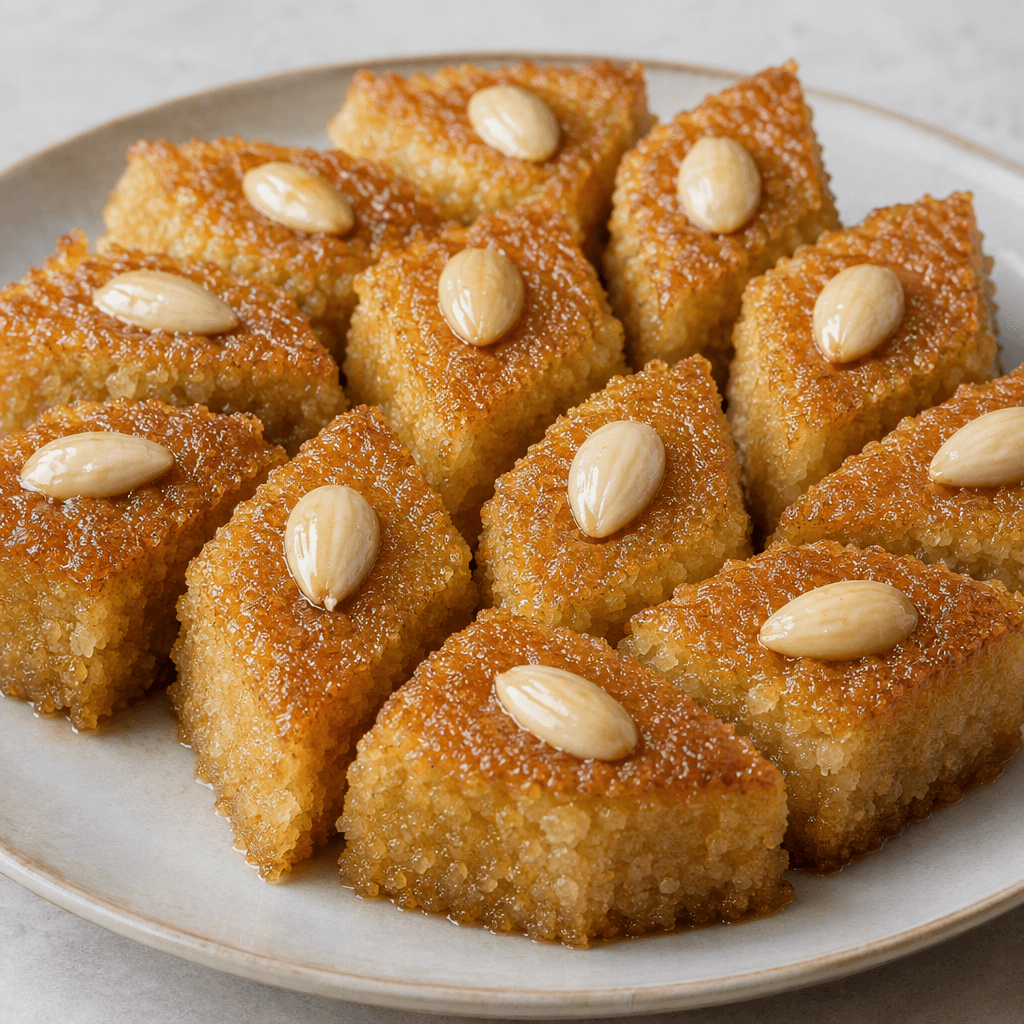
Sambali is a traditional Turkish semolina cake, baked until golden and then soaked in sugar syrup. It is commonly topped with blanched almonds and is especially associated with İzmir, though you’ll find it in sweet shops across Turkey. Its name is linked to Şam (Damascus), but it has become a familiar part of Turkish dessert culture.
The crumb is dense and slightly coarse, with a moist, syrupy finish and a pronounced sweetness. It is usually cut into small pieces and served after a meal or alongside tea. Semolina and syrup make it mainly a carbohydrate-rich sweet, with modest amounts of protein and fat. If you prefer a less sugary-feeling treat, choose a smaller piece and pair it with unsweetened tea or coffee.
Sambali Nutrition Facts
Selected: 100 g
290
KCAL / 100G
Carbs
55g
· 20% DV
Protein
4.5g
· 9% DV
Fat
6.5g
· 8% DV
Fiber
1.2g
· 4% DV
DV is the share of the daily value covered, on a 2,000 kcal reference diet.
Calories come from: Carbs 74% · Protein 6% · Fat 20%

Log this food in EatBetter
100,000+ people use it
- Get your daily calorie target
- Snap your meal, log it in seconds
- See every vitamin and mineral

📸 Scan the code to get the app free.

Sambali Vitamins & Minerals
Vitamins
Biotin
1.5µg · 5% DV
B1
0.05mg · 4% DV
B5
0.2mg · 4% DV
B3
0.6mg · 4% DV
Minerals
Phosphorus
40mg · 6% DV
Iron
1mg · 6% DV
Potassium ⭐
60mg · 2% DV
Copper
0mg · 0% DV
Manganese
0mg · 0% DV
How Nutritious Is Sambali?
Nutrient density
Low
How many vitamins, minerals and how much fiber this food carries per calorie. A high score means a lot of nutrition for few calories.
Satiety score
Low
An EatBetter score computed from fiber, protein and calorie density. A high score means staying full longer on the same calories.
Both scores are calculated per 100 g and do not change with the selected portion. The satiety score is EatBetter's own calculation, not a clinical measure.
Sambali Glycemic Index
GLYCEMIC INDEX
GLYCEMIC LOAD
Accounts for portion size — a more realistic measure than GI alone.
How to Burn Off Sambali
To burn the 290 calories in 100 g:
🚶
Walking (5 km/h)
🏃
Running (8 km/h)
🚴
Cycling
🏊
Swimming
Times are calculated with the MET equation for a 70 kg adult. Actual burn varies with your weight, age and pace.
Is Sambali Processed?
NOVA 3
Processed
1. Unprocessed
2. Minimally Processed
3. Processed
4. Ultra-Processed
NOVA classifies foods into 4 groups by industrial processing. NOVA 1 (unprocessed) is the healthiest.
Does Sambali Contain Allergens?
Contains these allergens:
Which Diets Is Sambali Good For?
Vegan
— Not suitable
Vegetarian
— Not suitable
Gluten-Free
— Not suitable
Dairy-Free
— Not suitable
Mediterranean
✓ Suitable
Paleo
— Not suitable
Whole30
— Not suitable
DASH
— Not suitable
Keto
— Not suitable
Low FODMAP
— Not suitable
Sambali Fat Profile
SATURATED
2.2g
MONOUNSATURATED
2.1g
POLYUNSATURATED
1.1g
Omega 6:3 ratio 30:1
Above the ideal 4:1 (30:1).
Compare Sambali
Foods Similar to Sambali
Frequently Asked Questions About Sambali
What is Sambali?
Sambali is a traditional Turkish semolina cake soaked in sugar syrup. It is baked in a tray, usually cut into diamond-shaped portions, and often topped with almonds or peanuts; its texture is denser than a typical sponge cake.
Is Sambali the same as basbousa?
No, Sambali and basbousa are related syrup-soaked semolina desserts, but they are not exactly the same. Sambali is associated with Turkish baking, especially İzmir, and is typically dense, with a simple semolina-and-yogurt mixture and nuts pressed on top.
What is Sambali made of?
Sambali is usually made with semolina, yogurt, sugar, and a leavening agent, then soaked with sugar syrup after baking. Almonds or peanuts are commonly added on top. Recipes vary, so the exact ingredients can differ between bakeries and home cooks.
How is Sambali traditionally made?
Sambali is traditionally made by spreading a thick semolina mixture in a tray, scoring the surface into portions, and pressing nuts into each piece before baking. Syrup is poured over the baked cake, which is left to absorb it before serving.
Where did Sambali originate?
Sambali is commonly linked to Damascus, as its name suggests, but it became especially well known in Turkey, particularly in İzmir. In İzmir, it is often sold as a street sweet cut into small diamond-shaped pieces.
Why is Sambali denser than cake?
Sambali is denser because semolina forms its main structure, rather than the lighter flour-and-egg batter used in many cakes. The syrup adds moisture and weight, giving Sambali its characteristic compact, chewy texture.
Should Sambali be served warm or cold?
Sambali is usually served at room temperature, after the baked semolina has had time to absorb the syrup. It can be chilled, but letting it sit out briefly before serving brings back a softer texture and makes the syrupy flavor easier to enjoy.
How long does Sambali keep?
Sambali keeps for a few days in a covered container in a cool place. Refrigerate it in warm weather or for longer storage, and let a portion come closer to room temperature before eating for a softer texture.
Can you freeze Sambali?
Yes, you can freeze Sambali in portions in an airtight, freezer-safe container. Thaw it in the refrigerator before serving; the texture may be slightly softer after freezing, but the syrup-soaked cake remains enjoyable.
What is Sambali traditionally served with?
Sambali is often served with Turkish tea, whose unsweetened, slightly brisk taste balances the syrupy dessert. Turkish coffee is another good pairing, and small pieces make it easy to serve as a sweet bite after a meal.
Have another question about Sambali?
Ask the AI nutrition coach — calories, portions, alternatives and more, answered in seconds in the app.

Scan calories with your camera
Instant AI nutrition analysis

Nutrition data compiled from USDA FoodData Central and scientific sources.