

Ready & Packaged Foods
All →Vegetables & Legumes
All →Desserts & Confectionery
All →Meat & Protein
All →Grains & Bakery
All →Beverages
All →Milk & Dairy
All →

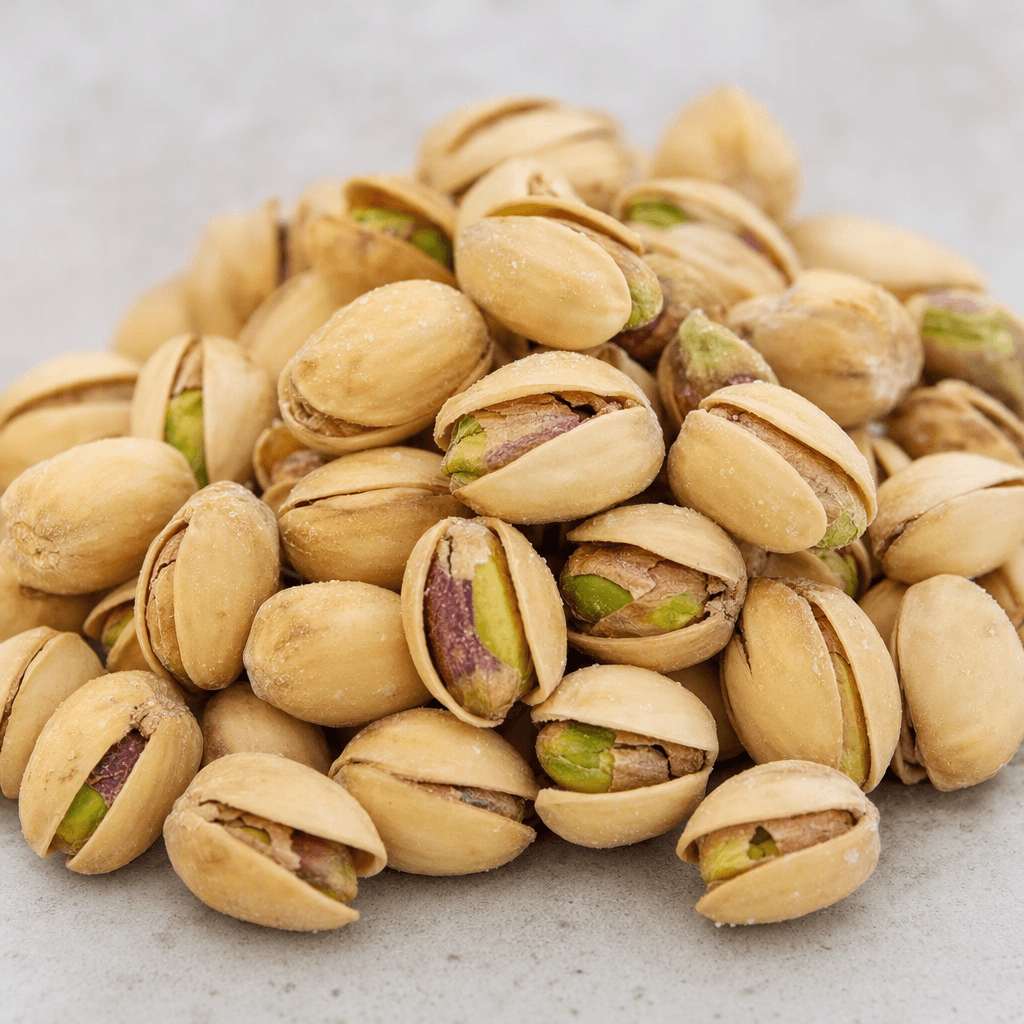
Salted roasted pistachios Calories
Roasted and salted Antep pistachio, specialty of Gaziantep region
In season: Summer · Autumn
CALORIES
GI
POTASSIUM
FIBER
Quick answer
1 serving (medium) of Salted roasted pistachios (30 g) has 171 calories. That works out to 570 calories per 100 g. It contains 8.4 g of carbs, 6.3 g of protein, 13.8 g of fat and 3 g of fiber. Its 0.4 mg of Copper covers 43% of the Daily Value. Its glycemic index is 15 (low), so it raises blood sugar slowly.
What is Salted roasted pistachios?
Salted roasted pistachios are pistachio kernels roasted for a deeper, toastier flavour and seasoned with salt. The Antep variety comes from the Gaziantep region of southeastern Turkey, where pistachios are a local specialty; the shells often split naturally to reveal green and purple-tinged kernels.
They are an easy snack on their own and commonly served in bowls for sharing, alongside drinks or as part of a mixed-nut spread. Their rich, savoury taste and crisp bite make a small handful satisfying. They provide protein, fibre and substantial fat: a 30 g serving has about 6 g of protein. Pair them with fresh fruit, or choose an unsalted version if you want to keep salt lower.
Salted roasted pistachios Nutrition Facts
Selected: 100 g
570
KCAL / 100G
Carbs
28g
· 10% DV
Protein
21g
· 42% DV
Fat
46g
· 59% DV
Fiber
10g
· 36% DV
DV is the share of the daily value covered, on a 2,000 kcal reference diet.
Calories come from: Carbs 18% · Protein 14% · Fat 68%
Salted roasted pistachios Vitamins & Minerals
Vitamins
B6
1.7mg · 100% DV
B1
0.87mg · 73% DV
B2
0.23mg · 18% DV
Biotin
4.5µg · 15% DV
Minerals
Copper
1mg · 111% DV
Phosphorus
490mg · 70% DV
Manganese
1mg · 43% DV
Potassium ⭐
1020mg · 30% DV
How Nutritious Is Salted roasted pistachios?
Nutrient density
Very high
How many vitamins, minerals and how much fiber this food carries per calorie. A high score means a lot of nutrition for few calories.
Satiety score
High
An EatBetter score computed from fiber, protein and calorie density. A high score means staying full longer on the same calories.
Both scores are calculated per 100 g and do not change with the selected portion. The satiety score is EatBetter's own calculation, not a clinical measure.
Salted roasted pistachios Glycemic Index
GLYCEMIC INDEX
GLYCEMIC LOAD
Accounts for portion size — a more realistic measure than GI alone.
How to Burn Off Salted roasted pistachios
To burn the 570 calories in 100 g:
🚶
Walking (5 km/h)
🏃
Running (8 km/h)
🚴
Cycling
🏊
Swimming
Times are calculated with the MET equation for a 70 kg adult. Actual burn varies with your weight, age and pace.
Is Salted roasted pistachios Processed?
NOVA 2
Minimally Processed
1. Unprocessed
2. Minimally Processed
3. Processed
4. Ultra-Processed
NOVA classifies foods into 4 groups by industrial processing. NOVA 1 (unprocessed) is the healthiest.
Does Salted roasted pistachios Contain Allergens?
Contains these allergens:
Which Diets Is Salted roasted pistachios Good For?
Vegan
✓ Suitable
Vegetarian
✓ Suitable
Gluten-Free
✓ Suitable
Dairy-Free
— Not suitable
Mediterranean
✓ Suitable
Paleo
✓ Suitable
Whole30
— Not suitable
DASH
— Not suitable
Keto
— Not suitable
Low FODMAP
— Not suitable
Salted roasted pistachios Fat Profile
SATURATED
5.8g
MONOUNSATURATED
23.5g
POLYUNSATURATED
14.2g
Omega 6:3 ratio 168.8:1
Above the ideal 4:1 (168.8:1).
Compare Salted roasted pistachios
Foods Similar to Salted roasted pistachios
Frequently Asked Questions About Salted roasted pistachios
Are salted roasted pistachios good for you?
Yes, salted roasted pistachios can be a nourishing snack: they provide fiber and unsaturated fats. The main drawback is the added sodium, so the unsalted kind is a better everyday choice if you are limiting salt.
Do salted roasted pistachios cause weight gain?
They do not cause weight gain by themselves, but eating large handfuls can add substantial energy to your day. Their shells slow down snacking, so serve a small amount in a bowl instead of eating straight from the bag.
Why are some pistachio shells already open?
Pistachio shells often split naturally as the kernel matures and expands. A naturally open shell is common, but roasting or mechanical processing can also open shells, so the split alone does not prove where or how the nut was grown.
Can you eat the shells of salted roasted pistachios?
No, the hard outer shells are not meant to be eaten; crack them open and eat the kernel. The thin, papery skin around the kernel is edible, so there is no need to peel it off.
How should you store salted roasted pistachios?
Keep salted roasted pistachios in an airtight container in a cool, dry place, away from sunlight and heat. For longer storage, refrigerate them in a sealed container; discard them if they develop a stale, bitter, or rancid smell.
What is the difference between salted roasted pistachios and raw pistachios?
Salted roasted pistachios are heated and seasoned, giving them a toastier flavor and crunchier texture. Raw pistachios have no roasting flavor or added salt, making them useful when you want to control sodium or use the nuts in recipes.
Why are Antep pistachios associated with Gaziantep?
Antep pistachios come from a pistachio-growing region of southeastern Turkey and are strongly associated with Gaziantep’s food culture. They are used in local sweets such as baklava, while the salted roasted version is commonly eaten as a snack.
Are salted roasted pistachios keto-friendly?
Salted roasted pistachios are not a particularly low-carbohydrate nut, so large portions can use up a substantial share of a strict ketogenic diet’s daily carbohydrate allowance. If you include them, keep the portion small and count the carbohydrates.
Can dogs eat salted roasted pistachios?
It is better not to give dogs salted roasted pistachios. The salt is unnecessary for them, and shells can pose a choking or digestive risk; pistachios are also fatty, which can upset a dog’s stomach.
Does roasting change the taste of Antep pistachios?
Yes, roasting brings out a deeper, nuttier flavor and makes the kernels crisper. Salt intensifies that savory taste, while excessive heat can make pistachios taste bitter, so avoid eating kernels that smell burnt or rancid.
Have another question about Salted roasted pistachios?
Ask the AI nutrition coach — calories, portions, alternatives and more, answered in seconds in the app.

Scan calories with your camera
Instant AI nutrition analysis

Nutrition data compiled from USDA FoodData Central and scientific sources.