

Ready & Packaged Foods
All →Vegetables & Legumes
All →Desserts & Confectionery
All →Meat & Protein
All →Grains & Bakery
All →Beverages
All →Milk & Dairy
All →

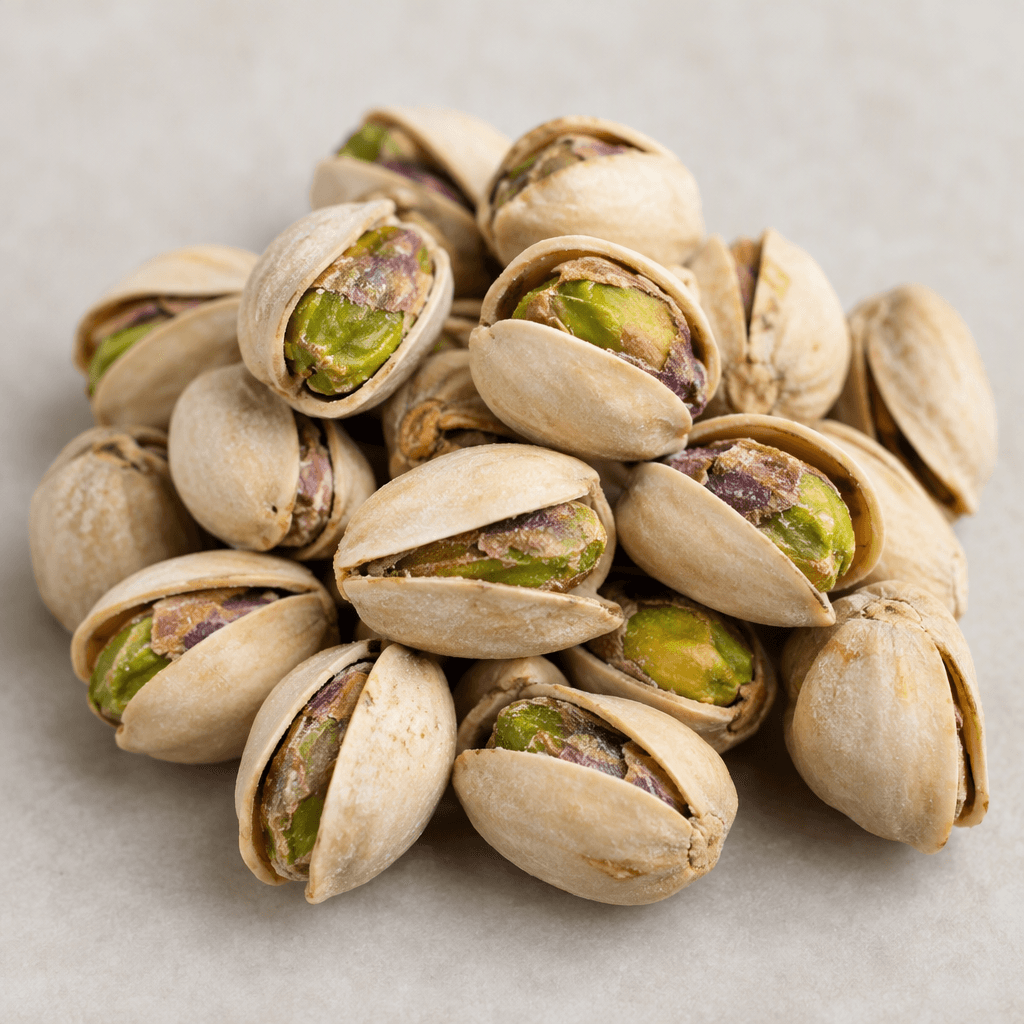
Salted pistachio Calories
Healthy fats, protein, salted snack
In season: Summer · Autumn
CALORIES · 100 G
GI
POTASSIUM · 100 G
FIBER · 100 G
Quick answer
1 serving (medium) of Salted pistachio (30 g) has 177 calories. That works out to 590 calories per 100 g. It contains 8.4 g of carbs, 6.3 g of protein, 13.8 g of fat and 3 g of fiber. Its 0.4 mg of Copper covers 43% of the Daily Value. Its glycemic index is 15 (low), so it raises blood sugar slowly.
Salted pistachio Nutrition Facts
Selected: 1 serving (medium) · 30 g
177
KCAL / 30G
Carbs
8.4g
· 3% DV
Protein
6.3g
· 13% DV
Fat
13.8g
· 18% DV
Fiber
3g
· 11% DV
DV is the share of the daily value covered, on a 2,000 kcal reference diet.
Calories come from: Carbs 18% · Protein 14% · Fat 68%
Salted pistachio nutrition facts table · 1 serving (medium) (30 g)
| Nutrient | Amount | % DV |
|---|---|---|
| Calories | 177 kcal | |
| Total fat | 13.8 g | 18% |
| Saturated fat | 1.71 g | 9% |
| Trans fat | 0 g | |
| Sodium | 144 mg | 6% |
| Total carbohydrate | 8.4 g | 3% |
| Fiber | 3 g | 11% |
| Protein | 6.3 g | 13% |
Calories: Calories measure energy. Average daily need is 2,000 kcal. Excess calories are stored as fat, too few cause weight loss.
Carbs: Your body's primary energy source. The brain runs exclusively on carbs. Daily need: 275g.
Protein: Essential for muscle repair and cell growth. Daily need: 50g. Keeps you full and boosts metabolism.
Fat: Needed for hormone production and vitamin absorption. Daily need: 78g. Limit saturated fats, choose unsaturated.
Fiber: Critical for digestive health and satiety. Daily need: 28g. Stabilizes blood sugar, lowers cholesterol.

Log this food in EatBetter
100,000+ people use it
- Get your daily calorie target
- Snap your meal, log it in seconds
- See every vitamin and mineral

📸 Scan the code to get the app free.

How Many Calories in 1 Serving of Salted pistachio?
| Serving | Amount | Calories |
|---|---|---|
| 1 serving (medium) | 30 g | 177 kcal |
| 1 piece (small) | 2 g | 12 kcal |
| 1 tablespoon (small) | 10 g | 59 kcal |
| 10 piece (small) | 20 g | 118 kcal |
| 1 ounce (medium) | 28 g | 165 kcal |
| 1 pack (medium) | 40 g | 236 kcal |
| 1 serving (large) | 50 g | 295 kcal |
| 100 g | 100 g | 590 kcal |
| 1 pack (large) | 100 g | 590 kcal |
| 1 cup (large) | 120 g | 708 kcal |
Calculated from 590 calories per 100 g.
Frequently Asked Questions About Salted pistachio
Are salted pistachios healthy?
Yes, salted pistachios provide protein, fibre and mostly unsaturated fats, but their added salt makes them a less suitable everyday choice than unsalted pistachios if you are limiting sodium. A small portion makes a more balanced snack.
How many salted pistachios should you eat a day?
About 30 grams of salted pistachios is a moderate snack portion. Because they are easy to keep eating straight from the bag, serving out a portion can help you avoid taking in excess salt.
Can you eat the shells of salted pistachios?
No, the hard outer shells of salted pistachios are not meant to be eaten; eat the kernel inside. The shells are tough and can be uncomfortable to chew or swallow.
Are salted pistachios bad for high blood pressure?
They can make it harder to limit sodium, since salted pistachios contain added salt. If you have been advised to reduce sodium for blood pressure, choose unsalted pistachios instead.
How do you remove salt from salted pistachios?
To reduce surface salt on salted pistachios, remove the shells and briefly rinse the kernels, then dry them thoroughly. Rinsing can soften the kernels and will not remove salt that has already penetrated their surface.
Do salted pistachios make you gain weight?
Salted pistachios do not cause weight gain by themselves, but large portions can add substantially to your daily energy intake. Measure out a serving rather than snacking from the package.
How should you store salted pistachios?
Store salted pistachios in an airtight container in a cool, dry place to protect them from moisture and staleness. Discard them if they develop an unpleasant or rancid smell.
Are salted pistachios roasted or raw?
Salted pistachios can be either roasted or raw; salt alone does not tell you how they were prepared. Roasted kernels are usually crunchier, while raw ones tend to be softer.
Why do pistachio shells split open?
Pistachio shells split naturally as the kernel grows inside the fruit and pushes the shell apart. The salt does not cause the split; the opening simply makes the kernel easier to reach.
Can dogs eat salted pistachios?
No, do not give dogs salted pistachios. The added salt and rich kernels are unsuitable as a treat, and hard shells can pose a choking or digestive risk.
Salted pistachio Vitamins & Minerals
Vitamins
B6
0.51mg · 30% DV
B1
0.26mg · 22% DV
Vitamin E
0.69mg · 5% DV
Folate
15.3µg · 4% DV
Minerals
Copper
0.39mg · 43% DV
Phosphorus
147mg · 21% DV
Manganese
0.36mg · 16% DV
Potassium ⭐
306mg · 9% DV
Sodium
144mg · 6% DV
Salted pistachio Glycemic Index
GLYCEMIC INDEX
GLYCEMIC LOAD
Accounts for portion size — a more realistic measure than GI alone.
How to Burn Off Salted pistachio
To burn the 177 calories in 1 serving (medium) (30 g):
🚶
Walking (5 km/h)
🏃
Running (8 km/h)
🚴
Cycling
🏊
Swimming
Times are calculated with the MET equation for a 70 kg adult. Actual burn varies with your weight, age and pace.
What is Salted pistachio?
Salted pistachio is made from pistachio nuts, usually roasted with salt and sold in their naturally split shells. Pistachios have long been grown across parts of the Middle East and Mediterranean, including Turkey, and are enjoyed both as a snack and in sweets and savoury dishes.
The kernels taste gently sweet and earthy, with salt bringing out their rich flavour; cracking the shells is part of the casual snacking ritual. Serve them in a bowl for sharing, or add shelled kernels to salads and grain dishes. They provide protein, fibre and mostly unsaturated fats, so a small handful can be satisfying. If you prefer less salt, choose unsalted pistachios or mix the two.
How Nutritious Is Salted pistachio?
Nutrient density
Very high
How many vitamins, minerals and how much fiber this food carries per calorie. A high score means a lot of nutrition for few calories.
Satiety score
High
An EatBetter score computed from fiber, protein and calorie density. A high score means staying full longer on the same calories.
Both scores are calculated per 100 g and do not change with the selected portion. The satiety score is EatBetter's own calculation, not a clinical measure.
Is Salted pistachio Processed?
NOVA 2
Minimally Processed
1. Unprocessed
2. Minimally Processed
3. Processed
4. Ultra-Processed
NOVA classifies foods into 4 groups by industrial processing. NOVA 1 (unprocessed) is the healthiest.
Does Salted pistachio Contain Allergens?
Contains these allergens:
Which Diets Is Salted pistachio Good For?
Vegan
✓ Suitable
Vegetarian
✓ Suitable
Gluten-Free
✓ Suitable
Dairy-Free
— Not suitable
Mediterranean
✓ Suitable
Paleo
✓ Suitable
Whole30
— Not suitable
DASH
— Not suitable
Keto
✓ Suitable
Low FODMAP
— Not suitable
Salted pistachio Fat Profile
SATURATED
1.71g
MONOUNSATURATED
6.99g
POLYUNSATURATED
4.23g
Omega 6:3 ratio 50.6:1
Above the ideal 4:1 (50.6:1).
Compare Salted pistachio
Foods Similar to Salted pistachio
Have another question about Salted pistachio?
Ask the AI nutrition coach — calories, portions, alternatives and more, answered in seconds in the app.

Scan calories with your camera
Instant AI nutrition analysis

Nutrition data compiled from USDA FoodData Central and scientific sources.