

Ready & Packaged Foods
All →Vegetables & Legumes
All →Desserts & Confectionery
All →Meat & Protein
All →Grains & Bakery
All →Beverages
All →Milk & Dairy
All →

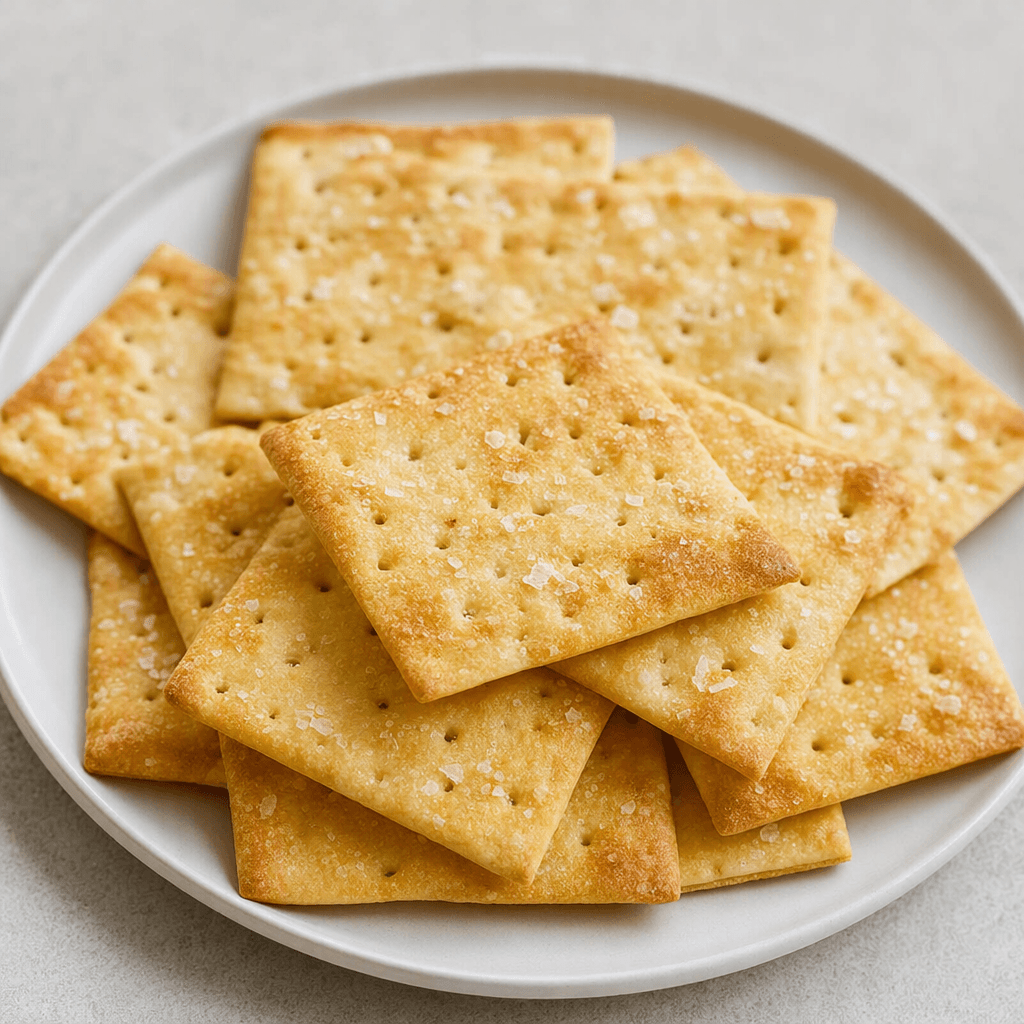
Salted cracker Calories
Salty, crisp, processed snack cracker
CALORIES
GI
POTASSIUM
FIBER
Quick answer
1 serving (medium) of Salted cracker (30 g) has 129 calories. That works out to 430 calories per 100 g. It contains 21.6 g of carbs, 2.7 g of protein, 3.3 g of fat and 0.9 g of fiber. Its 285 mg of Sodium covers 12% of the Daily Value. Its glycemic index is 72 (high), so it raises blood sugar quickly.
What is Salted cracker?
Salted cracker is a thin, baked savoury biscuit with a crisp texture and a sprinkling of salt. It is a familiar packaged snack in many places, valued for its long-lasting crunch and convenience rather than as a meal in itself.
Its dry, mildly savoury bite works well with cheese, hummus, or sliced vegetables, and it is often served alongside soup or a cup of tea. The crackers are mainly a source of carbohydrates, with some fat and a little fibre. For a more balanced snack, pair a modest portion with a protein-rich topping or fresh produce; they also make an easy addition to a lunchbox or travel snack.
Salted cracker Nutrition Facts
Selected: 100 g
430
KCAL / 100G
Carbs
72g
· 26% DV
Protein
9g
· 18% DV
Fat
11g
· 14% DV
Fiber
3g
· 11% DV
DV is the share of the daily value covered, on a 2,000 kcal reference diet.
Calories come from: Carbs 68% · Protein 9% · Fat 23%
Salted cracker Vitamins & Minerals
Vitamins
B1
0.45mg · 38% DV
B3
4.8mg · 30% DV
Folate
95µg · 24% DV
B2
0.22mg · 17% DV
Minerals
Sodium
950mg · 41% DV
Selenium
22µg · 40% DV
Iron
3mg · 17% DV
Phosphorus
110mg · 16% DV
How Nutritious Is Salted cracker?
Nutrient density
Low
How many vitamins, minerals and how much fiber this food carries per calorie. A high score means a lot of nutrition for few calories.
Satiety score
Low
An EatBetter score computed from fiber, protein and calorie density. A high score means staying full longer on the same calories.
Both scores are calculated per 100 g and do not change with the selected portion. The satiety score is EatBetter's own calculation, not a clinical measure.
Salted cracker Glycemic Index
GLYCEMIC INDEX
GLYCEMIC LOAD
Accounts for portion size — a more realistic measure than GI alone.
How to Burn Off Salted cracker
To burn the 430 calories in 100 g:
🚶
Walking (5 km/h)
🏃
Running (8 km/h)
🚴
Cycling
🏊
Swimming
Times are calculated with the MET equation for a 70 kg adult. Actual burn varies with your weight, age and pace.
Is Salted cracker Processed?
NOVA 4
Ultra-Processed
1. Unprocessed
2. Minimally Processed
3. Processed
4. Ultra-Processed
NOVA classifies foods into 4 groups by industrial processing. NOVA 1 (unprocessed) is the healthiest.
Does Salted cracker Contain Allergens?
Contains these allergens:
Which Diets Is Salted cracker Good For?
Vegan
— Not suitable
Vegetarian
✓ Suitable
Gluten-Free
— Not suitable
Dairy-Free
— Not suitable
Mediterranean
— Not suitable
Paleo
— Not suitable
Whole30
— Not suitable
DASH
— Not suitable
Keto
— Not suitable
Low FODMAP
— Not suitable
Salted cracker Fat Profile
SATURATED
1.8g
MONOUNSATURATED
2.4g
POLYUNSATURATED
3.4g
Omega 6:3 ratio 64:1
Above the ideal 4:1 (64:1).
Compare Salted cracker
Foods Similar to Salted cracker
Frequently Asked Questions About Salted cracker
What is a salted cracker made of?
A salted cracker is typically made with wheat flour, oil, salt and raising agents. Commercial versions are ultra-processed foods: the dough is mixed, shaped and baked in a factory, and the exact recipe varies by product.
Do salted crackers help with nausea?
Salted crackers do not treat nausea, but their dry, plain texture may be easier for some people to tolerate when they feel queasy. Their saltiness can make you thirsty, and they are not a remedy for persistent or severe symptoms.
What goes well with salted crackers?
Salted crackers pair well with cheese, hummus, soup or a mild dip. Adding a protein-rich topping such as cheese can make the snack more filling than eating the crackers on their own.
Why do salted crackers have holes?
The small holes let steam escape as salted crackers bake. This helps prevent large air bubbles from forming and gives the crackers their even, crisp texture.
How should you store salted crackers after opening the packet?
Keep salted crackers in an airtight container in a cool, dry place. Exposure to air and moisture makes them lose their crispness; discard them if you notice mold, an unusual smell or other signs of spoilage.
Can you make stale salted crackers crispy again?
Yes, if they have only gone soft from moisture, briefly warming salted crackers in a low oven and letting them cool can restore some crispness. Do not try to salvage crackers that are moldy or smell off.
Can salted crackers be used instead of breadcrumbs?
Yes, crushed salted crackers can replace breadcrumbs as a coating or binder in many recipes. They add extra salt, so reduce the salt elsewhere in the recipe and crush them to the texture you need.
Do salted crackers cause weight gain?
Salted crackers do not cause weight gain on their own, but they are easy to snack on in larger amounts than intended. Keeping a serving in a bowl instead of eating from the packet can help you manage how much you eat.
Do salted crackers raise blood sugar?
Yes, the refined flour and starch in salted crackers can raise blood sugar. Eating them with a source of protein or fiber may slow the rise compared with eating the crackers alone.
Are salted crackers a healthy snack?
Salted crackers can fit as an occasional snack, but they are not especially nourishing on their own: they are salty and made from refined flour. Pair them with a more substantial topping rather than relying on them as a regular meal.
Have another question about Salted cracker?
Ask the AI nutrition coach — calories, portions, alternatives and more, answered in seconds in the app.

Scan calories with your camera
Instant AI nutrition analysis

Nutrition data compiled from USDA FoodData Central and scientific sources.