

Ready & Packaged Foods
All →Vegetables & Legumes
All →Desserts & Confectionery
All →Meat & Protein
All →Grains & Bakery
All →Beverages
All →Milk & Dairy
All →

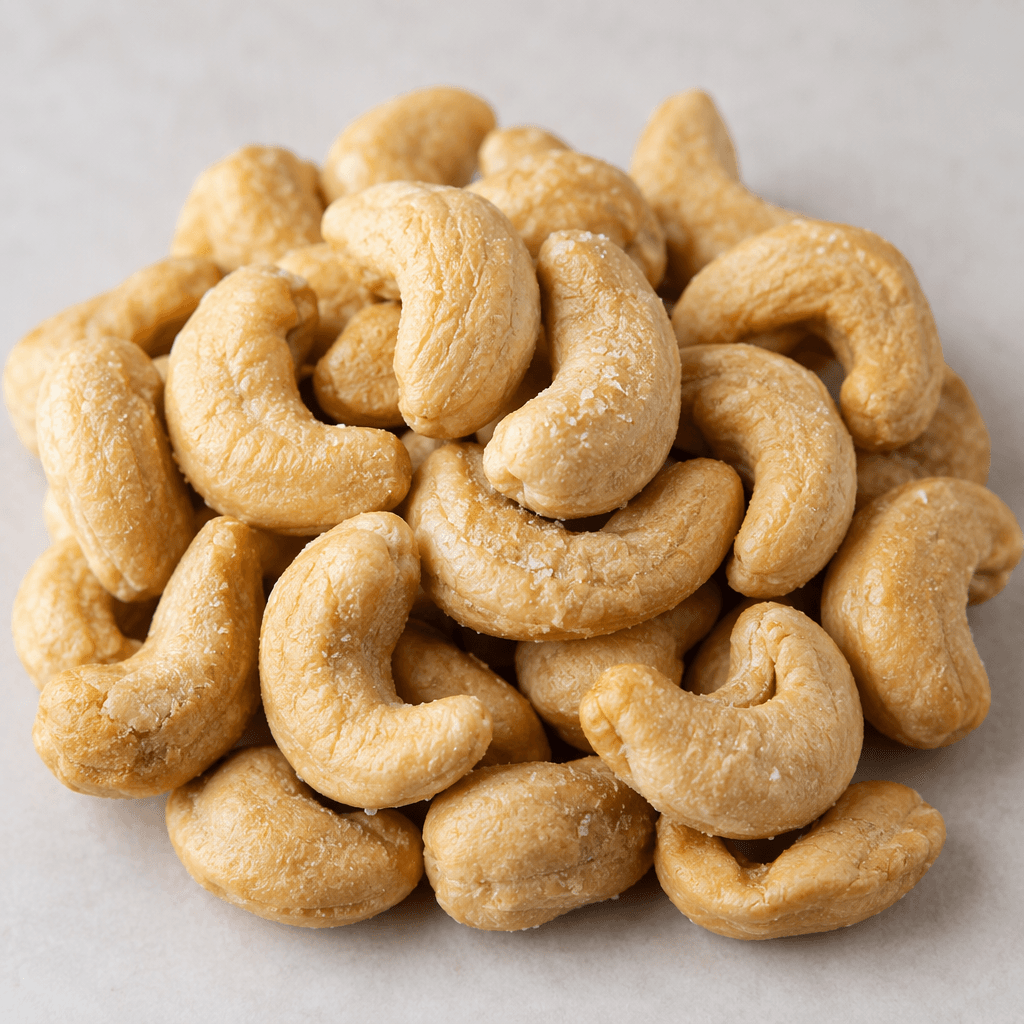
Salted cashews Calories
Source of protein and healthy fats, salty snack
In season: Spring · Summer · Autumn · Winter
CALORIES
GI
POTASSIUM
FIBER
Quick answer
1 serving (medium) of Salted cashews (30 g) has 174 calories. That works out to 580 calories per 100 g. It contains 8.3 g of carbs, 5 g of protein, 14.3 g of fat and 1 g of fiber. Its 0.7 mg of Copper covers 73% of the Daily Value. Its glycemic index is 22 (low), so it raises blood sugar slowly.
What is Salted cashews?
Salted cashews are the edible kernels of the cashew tree, lightly salted after being removed from their shells. The tree is native to South America and is now grown across tropical regions. In many places, these crunchy nuts are sold ready to eat as a simple snack.
Their buttery, gently sweet flavour works well on its own, with a drink, or tossed into salads and rice dishes. They provide protein and unsaturated fats, so a small handful can make a satisfying snack; 100 g contains 16.5 g of protein. For a less salty mix, combine them with unsalted nuts or pair a modest portion with fresh fruit.
Salted cashews Nutrition Facts
Selected: 100 g
580
KCAL / 100G
Carbs
27.5g
· 10% DV
Protein
16.5g
· 33% DV
Fat
47.5g
· 61% DV
Fiber
3.3g
· 12% DV
DV is the share of the daily value covered, on a 2,000 kcal reference diet.
Calories come from: Carbs 18% · Protein 11% · Fat 71%
Salted cashews Vitamins & Minerals
Vitamins
B1
0.42mg · 35% DV
Vitamin K
34µg · 28% DV
B6
0.42mg · 25% DV
Biotin
7µg · 23% DV
Minerals
Copper
2mg · 222% DV
Manganese
2mg · 87% DV
Phosphorus
490mg · 70% DV
Magnesium
260mg · 62% DV
How Nutritious Is Salted cashews?
Nutrient density
High
How many vitamins, minerals and how much fiber this food carries per calorie. A high score means a lot of nutrition for few calories.
Satiety score
Medium
An EatBetter score computed from fiber, protein and calorie density. A high score means staying full longer on the same calories.
Both scores are calculated per 100 g and do not change with the selected portion. The satiety score is EatBetter's own calculation, not a clinical measure.
Salted cashews Glycemic Index
GLYCEMIC INDEX
GLYCEMIC LOAD
Accounts for portion size — a more realistic measure than GI alone.
How to Burn Off Salted cashews
To burn the 580 calories in 100 g:
🚶
Walking (5 km/h)
🏃
Running (8 km/h)
🚴
Cycling
🏊
Swimming
Times are calculated with the MET equation for a 70 kg adult. Actual burn varies with your weight, age and pace.
Is Salted cashews Processed?
NOVA 2
Minimally Processed
1. Unprocessed
2. Minimally Processed
3. Processed
4. Ultra-Processed
NOVA classifies foods into 4 groups by industrial processing. NOVA 1 (unprocessed) is the healthiest.
Does Salted cashews Contain Allergens?
Contains these allergens:
Which Diets Is Salted cashews Good For?
Vegan
✓ Suitable
Vegetarian
✓ Suitable
Gluten-Free
✓ Suitable
Dairy-Free
— Not suitable
Mediterranean
✓ Suitable
Paleo
✓ Suitable
Whole30
— Not suitable
DASH
— Not suitable
Keto
— Not suitable
Low FODMAP
— Not suitable
Salted cashews Fat Profile
SATURATED
9.2g
MONOUNSATURATED
27g
POLYUNSATURATED
8g
Omega 6:3 ratio 110:1
Above the ideal 4:1 (110:1).
Compare Salted cashews
Foods Similar to Salted cashews
Frequently Asked Questions About Salted cashews
Are salted cashews healthy?
Yes, salted cashews provide protein and unsaturated fats, making them a nourishing snack. The added salt increases their sodium content, though, so unsalted cashews are a better choice if you are limiting sodium.
Do salted cashews raise blood pressure?
They can contribute to higher blood pressure because salted cashews contain added sodium. If you have high blood pressure or have been told to restrict salt, choose unsalted cashews and ask your clinician what sodium limit is appropriate for you.
Do salted cashews cause weight gain?
Salted cashews do not cause weight gain on their own, but they are energy-dense and easy to overeat. Pouring a portion into a bowl instead of snacking from the packet can help you keep track of how much you eat.
Are salted cashews roasted?
Usually, salted cashews are roasted before or during salting, but the exact method varies by product. Salted cashews are not automatically oil-roasted; some are dry-roasted, so check the package if the roasting method matters to you.
Can you remove salt from salted cashews?
You can wipe salted cashews with a clean, dry cloth to remove some surface salt. Rinsing may remove more, but it can make them soft; if you rinse them, eat them soon or dry them thoroughly before storing.
How should you store salted cashews?
Store salted cashews in an airtight container in a cool, dry place. Exposure to air, heat, and moisture can make their natural oils turn rancid or soften the kernels, so reseal an opened bag promptly.
Can you freeze salted cashews?
Yes, salted cashews freeze well when kept in an airtight container or freezer bag. Let the sealed container come to room temperature before opening it; this helps prevent condensation from making the cashews damp.
How can you tell if salted cashews have gone bad?
Rancid salted cashews may smell like old oil or paint and taste bitter or stale. Discard them if you see mold, moisture, or insects, and do not taste cashews that show signs of spoilage.
Can dogs eat salted cashews?
Salted cashews are not a good dog treat because added salt is unnecessary, and too many cashews can upset a dog’s stomach. If a dog eats a large amount or seems unwell, contact a veterinarian.
Are salted cashews keto-friendly?
Salted cashews are less suited to strict keto diets than many other nuts because they contain more carbohydrates. A small amount may fit some personal carb limits, but check your daily allowance rather than treating them as a low-carb nut.
Have another question about Salted cashews?
Ask the AI nutrition coach — calories, portions, alternatives and more, answered in seconds in the app.

Scan calories with your camera
Instant AI nutrition analysis

Nutrition data compiled from USDA FoodData Central and scientific sources.