

Ready & Packaged Foods
All →Vegetables & Legumes
All →Desserts & Confectionery
All →Meat & Protein
All →Grains & Bakery
All →Beverages
All →Milk & Dairy
All →

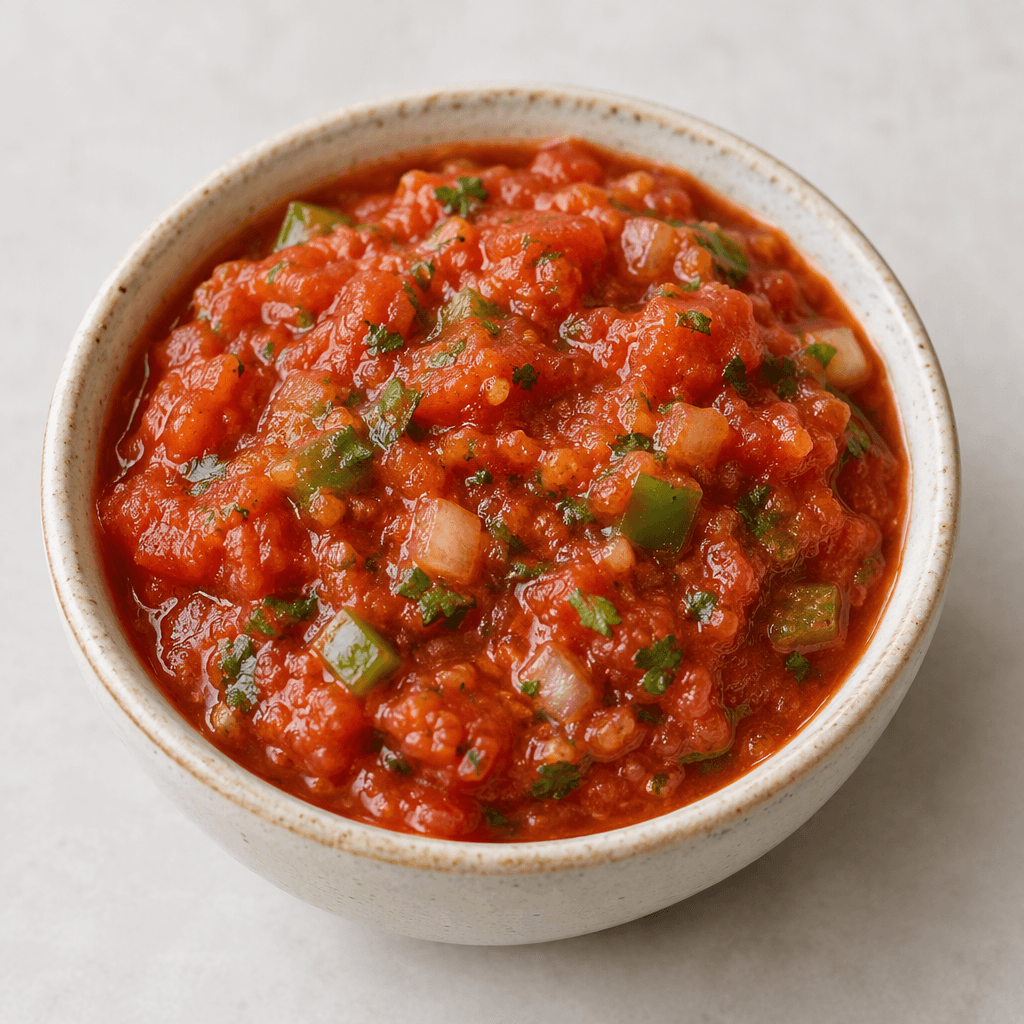
Salsa Sauce Calories
Fresh sauce made with tomatoes, onions, peppers, spices
In season: Summer · Autumn
CALORIES
GI
POTASSIUM
FIBER
Quick answer
2 tablespoon (medium) of Salsa Sauce (30 g) has 10 calories. That works out to 32 calories per 100 g. It contains 2.1 g of carbs, 0.4 g of protein, 0.1 g of fat and 0.5 g of fiber. Its 105 mg of Sodium covers 5% of the Daily Value. Its glycemic index is 30 (low), so it raises blood sugar slowly.
What is Salsa Sauce?
Salsa sauce is a Mexican-style condiment, commonly made with chopped tomatoes, onion, peppers, herbs and spices. It can be finely blended or left chunky, with the tomato bringing a fresh tang and the peppers adding anything from mild sweetness to heat.
Serve it with tortilla chips, spoon it into tacos and wraps, or use it alongside grilled foods. It is mostly vegetables and very low in fat; a 100 g serving has 32 calories. For a lighter plate, use it in place of a creamy dip, or add it to beans and vegetables for a bright, punchy finish.
Salsa Sauce Nutrition Facts
Selected: 100 g
32
KCAL / 100G
Carbs
7g
· 3% DV
Protein
1.3g
· 3% DV
Fat
0.2g
· 0% DV
Fiber
1.8g
· 6% DV
DV is the share of the daily value covered, on a 2,000 kcal reference diet.
Calories come from: Carbs 80% · Protein 15% · Fat 5%

Log this food in EatBetter
100,000+ people use it
- Get your daily calorie target
- Snap your meal, log it in seconds
- See every vitamin and mineral

📸 Scan the code to get the app free.

Salsa Sauce Vitamins & Minerals
Vitamins
Vitamin C
7.5mg · 8% DV
B6
0.09mg · 5% DV
Vitamin K
6.2µg · 5% DV
Vitamin A
42µg · 5% DV
Minerals
Sodium
350mg · 15% DV
Potassium ⭐
210mg · 6% DV
Copper
0mg · 0% DV
Manganese
0mg · 0% DV
How Nutritious Is Salsa Sauce?
Nutrient density
Medium
How many vitamins, minerals and how much fiber this food carries per calorie. A high score means a lot of nutrition for few calories.
Satiety score
Medium
An EatBetter score computed from fiber, protein and calorie density. A high score means staying full longer on the same calories.
Both scores are calculated per 100 g and do not change with the selected portion. The satiety score is EatBetter's own calculation, not a clinical measure.
Salsa Sauce Glycemic Index
GLYCEMIC INDEX
GLYCEMIC LOAD
Accounts for portion size — a more realistic measure than GI alone.
How to Burn Off Salsa Sauce
To burn the 32 calories in 100 g:
🚶
Walking (5 km/h)
🏃
Running (8 km/h)
🚴
Cycling
🏊
Swimming
Times are calculated with the MET equation for a 70 kg adult. Actual burn varies with your weight, age and pace.
Is Salsa Sauce Processed?
NOVA 3
Processed
1. Unprocessed
2. Minimally Processed
3. Processed
4. Ultra-Processed
NOVA classifies foods into 4 groups by industrial processing. NOVA 1 (unprocessed) is the healthiest.
Does Salsa Sauce Contain Allergens?
No known major allergens
Which Diets Is Salsa Sauce Good For?
Vegan
✓ Suitable
Vegetarian
✓ Suitable
Gluten-Free
✓ Suitable
Dairy-Free
— Not suitable
Mediterranean
✓ Suitable
Paleo
✓ Suitable
Whole30
— Not suitable
DASH
— Not suitable
Keto
— Not suitable
Low FODMAP
— Not suitable
Salsa Sauce Fat Profile
SATURATED
0.03g
MONOUNSATURATED
0.04g
POLYUNSATURATED
0.05g
Omega 6:3 ratio 3:1
Below the ideal 4:1 — a good omega balance.
Compare Salsa Sauce
Foods Similar to Salsa Sauce
Frequently Asked Questions About Salsa Sauce
What is Salsa Sauce made of?
Salsa Sauce is usually made with tomatoes, onions, peppers, herbs, and seasonings. Some versions are chopped and fresh, while others are blended or cooked; ingredients and texture vary by recipe and regional style.
How do you make Salsa Sauce at home?
For a fresh Salsa Sauce, finely chop ripe tomatoes, onion, and pepper, then mix with lime juice, cilantro, and salt. Leave it chunky or pulse it briefly for a smoother texture; letting it rest helps the flavors mingle.
Is Salsa Sauce the same as pico de gallo?
Not always. Pico de gallo is a fresh, uncooked salsa made from chopped ingredients and is usually chunky with little liquid. Salsa Sauce can also be blended, smoother, or cooked, although people sometimes use “salsa” for both.
What do you eat Salsa Sauce with?
Salsa Sauce is commonly served with tortilla chips, tacos, burritos, and quesadillas. It also works as a topping for grilled chicken, fish, eggs, rice, or roasted vegetables, adding a bright, tangy flavor.
Does Salsa Sauce need to be refrigerated after opening?
Yes, refrigerate Salsa Sauce after opening, especially fresh salsa or a jar that has been kept chilled. Put it back in the refrigerator promptly and use a clean utensil to avoid introducing food residue into the container.
How long does Salsa Sauce last in the fridge?
Fresh homemade Salsa Sauce generally keeps for about 3–4 days in a sealed container in the refrigerator. Commercial jarred salsa can have a different storage life after opening, so follow the product’s stated storage instructions.
Can you freeze Salsa Sauce?
Yes, you can freeze Salsa Sauce, but thawed tomatoes and onions often become softer and release liquid. Frozen salsa is usually better stirred into cooked dishes, soups, or stews than served as a chunky dip.
Is Salsa Sauce supposed to be cooked?
No, Salsa Sauce does not have to be cooked. Fresh salsa is served raw, while cooked salsa is simmered or roasted for a deeper, softer flavor; either style can be eaten as a dip or used in meals.
What is the difference between red and green Salsa Sauce?
Red Salsa Sauce is typically tomato-based, while green salsa often gets its color and tart flavor from tomatillos and green chilies. Recipes vary, and color alone does not determine how hot the sauce is.
How can you make Salsa Sauce less spicy?
To make Salsa Sauce milder, use fewer hot peppers and remove their seeds and inner membranes before chopping. Add more tomato or onion to soften the heat, then taste and adjust the seasoning before serving.
Have another question about Salsa Sauce?
Ask the AI nutrition coach — calories, portions, alternatives and more, answered in seconds in the app.

Scan calories with your camera
Instant AI nutrition analysis

Nutrition data compiled from USDA FoodData Central and scientific sources.