

Ready & Packaged Foods
All →Vegetables & Legumes
All →Desserts & Confectionery
All →Meat & Protein
All →Grains & Bakery
All →Beverages
All →Milk & Dairy
All →

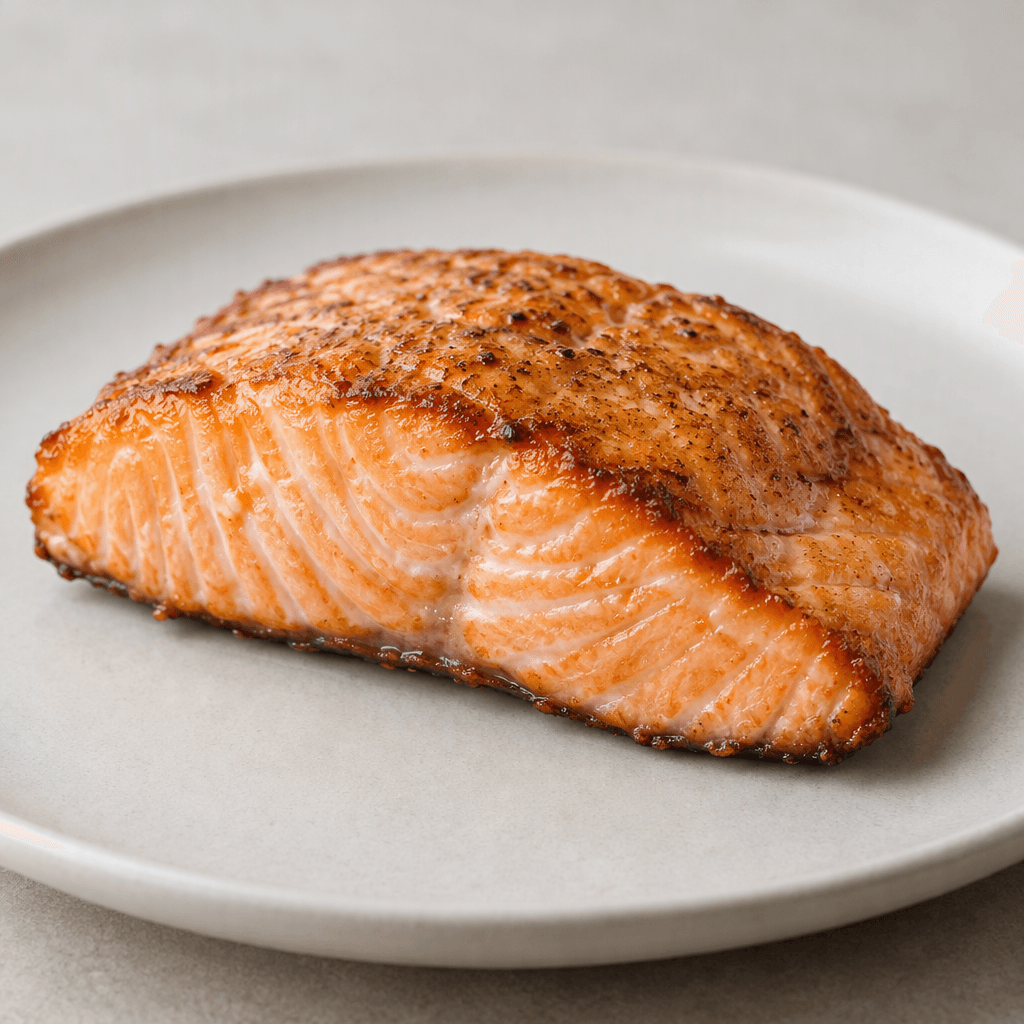
Sauteed salmon Calories
High protein, rich in omega-3
CALORIES · 100 G
GI
POTASSIUM · 100 G
FIBER · 100 G
Quick answer
1 piece (medium) of Sauteed salmon (120 g) has 250 calories. That works out to 208 calories per 100 g. It contains 0 g of carbs, 29.5 g of protein, 14.9 g of fat and 0 g of fiber. Its 3.8 µg of B12 covers 160% of the Daily Value. Its glycemic index is 0 (low), so it raises blood sugar slowly.
Sauteed salmon Nutrition Facts
Selected: 1 piece (medium) · 120 g
250
KCAL / 120G
Carbs
0g
· 0% DV
Protein
29.5g
· 59% DV
Fat
14.9g
· 19% DV
Fiber
0g
· 0% DV
DV is the share of the daily value covered, on a 2,000 kcal reference diet.
Calories come from: Carbs 0% · Protein 47% · Fat 53%
Sauteed salmon nutrition facts table · 1 piece (medium) (120 g)
| Nutrient | Amount | % DV |
|---|---|---|
| Calories | 250 kcal | |
| Total fat | 14.9 g | 19% |
| Saturated fat | 3.24 g | 16% |
| Trans fat | 0.06 g | |
| Sodium | 71 mg | 3% |
| Total carbohydrate | 0 g | 0% |
| Fiber | 0 g | 0% |
| Protein | 29.5 g | 59% |
Calories: Calories measure energy. Average daily need is 2,000 kcal. Excess calories are stored as fat, too few cause weight loss.
Carbs: Your body's primary energy source. The brain runs exclusively on carbs. Daily need: 275g.
Protein: Essential for muscle repair and cell growth. Daily need: 50g. Keeps you full and boosts metabolism.
Fat: Needed for hormone production and vitamin absorption. Daily need: 78g. Limit saturated fats, choose unsaturated.
Fiber: Critical for digestive health and satiety. Daily need: 28g. Stabilizes blood sugar, lowers cholesterol.

Log this food in EatBetter
100,000+ people use it
- Get your daily calorie target
- Snap your meal, log it in seconds
- See every vitamin and mineral

📸 Scan the code to get the app free.

How Many Calories in 1 Medium Sauteed salmon?
| Serving | Amount | Calories |
|---|---|---|
| 1 piece (medium) | 120 g | 250 kcal |
| ½ piece (half) | 60 g | 125 kcal |
| 1 piece (small) | 80 g | 166 kcal |
| 100 g | 100 g | 208 kcal |
| 1 cup (diced) | 140 g | 291 kcal |
| 1 serving (medium) | 150 g | 312 kcal |
| 1 piece (large) | 180 g | 374 kcal |
| 1 serving (large) | 220 g | 458 kcal |
Calculated from 208 calories per 100 g.
Frequently Asked Questions About Sauteed salmon
How do you make sauteed salmon?
To make sauteed salmon, pat the fillet dry, season it, and place it in a preheated skillet with a little oil. Let the first side brown before turning it, then cook until the thickest part is opaque and flakes easily.
How long should you cook sauteed salmon?
Sauteed salmon usually takes a few minutes per side, but the exact time depends on the fillet’s thickness and your pan’s heat. Start checking thin pieces early; thicker fillets need more time to cook through without scorching the outside.
How do you keep sauteed salmon from sticking to the pan?
To keep sauteed salmon from sticking, dry the fish thoroughly, preheat the pan, and add a thin layer of oil. Leave the fillet undisturbed until its surface has browned; it should release more easily when it is ready to turn.
How do you get crispy skin on sauteed salmon?
For crispy-skinned sauteed salmon, dry the skin well and start cooking with the skin facing down in a hot pan. Press gently with a spatula for a few seconds so the skin makes even contact, then let it cook without moving it.
How can you tell when sauteed salmon is done?
Sauteed salmon is done when the center turns opaque and the flakes separate easily with a fork. For a precise check, use a food thermometer in the thickest part; the FDA recommends an internal temperature of 145°F (63°C).
Why does sauteed salmon have white stuff on it?
The white substance on sauteed salmon is albumin, a protein that can seep out as the fish cooks; it is safe to eat. Cooking the salmon more gently and taking it off the heat as soon as it is done can reduce how much appears.
What should you season sauteed salmon with?
Salt, black pepper, lemon, and garlic are simple seasonings for sauteed salmon. Add fresh herbs such as dill or parsley at the end so their flavor stays bright, and avoid adding lemon juice too early if you want the fish to brown well.
What goes well with sauteed salmon?
Sauteed salmon pairs well with roasted vegetables, a crisp salad, or potatoes. For a more filling meal, serve it with rice or couscous; a lemony sauce or fresh herbs can bring the plate together without overpowering the fish.
How long does leftover sauteed salmon last in the fridge?
Leftover sauteed salmon keeps for up to 3 days in the refrigerator when stored promptly in a covered container. Refrigerate it within 2 hours of cooking, and discard it if it has been left out longer.
Can you saute frozen salmon?
It is better to thaw salmon in the refrigerator before sauteing it. A frozen fillet can brown unevenly and release extra water in the pan; thaw it in a covered container, then pat it dry before cooking.
Sauteed salmon Vitamins & Minerals
Vitamins
B12
3.84µg · 160% DV
B3
10.2mg · 64% DV
Vitamin D
12µg · 60% DV
B6
0.96mg · 56% DV
Minerals
Selenium
43µg · 78% DV
Phosphorus
302mg · 43% DV
Iodine
36µg · 24% DV
Potassium ⭐
461mg · 14% DV
Sodium
71mg · 3% DV
Sauteed salmon Glycemic Index
GLYCEMIC INDEX
GLYCEMIC LOAD
Accounts for portion size — a more realistic measure than GI alone.
How to Burn Off Sauteed salmon
To burn the 250 calories in 1 piece (medium) (120 g):
🚶
Walking (5 km/h)
🏃
Running (8 km/h)
🚴
Cycling
🏊
Swimming
Times are calculated with the MET equation for a 70 kg adult. Actual burn varies with your weight, age and pace.
What is Sauteed salmon?
Sauteed salmon is a salmon fillet cooked quickly in a hot pan, often with a little oil. The surface turns golden while the inside stays moist and tender, with flaky layers and a rich, distinct flavour. It’s a straightforward preparation found in home kitchens and restaurants around the world.
Serve it with lemon, vegetables or a fresh salad; potatoes or rice make it a heartier meal. It provides plenty of protein—24.6 g per 100 g—and is naturally rich in omega-3 fats. For a lighter plate, use just enough oil to coat the pan and pair the fish with vegetables.
How Nutritious Is Sauteed salmon?
Nutrient density
Very high
How many vitamins, minerals and how much fiber this food carries per calorie. A high score means a lot of nutrition for few calories.
Satiety score
Medium
An EatBetter score computed from fiber, protein and calorie density. A high score means staying full longer on the same calories.
Both scores are calculated per 100 g and do not change with the selected portion. The satiety score is EatBetter's own calculation, not a clinical measure.
Is Sauteed salmon Processed?
NOVA 2
Minimally Processed
1. Unprocessed
2. Minimally Processed
3. Processed
4. Ultra-Processed
NOVA classifies foods into 4 groups by industrial processing. NOVA 1 (unprocessed) is the healthiest.
Does Sauteed salmon Contain Allergens?
Contains these allergens:
Which Diets Is Sauteed salmon Good For?
Vegan
— Not suitable
Vegetarian
— Not suitable
Gluten-Free
✓ Suitable
Dairy-Free
— Not suitable
Mediterranean
✓ Suitable
Paleo
✓ Suitable
Whole30
— Not suitable
DASH
— Not suitable
Keto
✓ Suitable
Low FODMAP
— Not suitable
Sauteed salmon Fat Profile
SATURATED
3.24g
MONOUNSATURATED
4.92g
POLYUNSATURATED
3.6g
Omega 6:3 ratio 0.2:1
Below the ideal 4:1 — a good omega balance.
Compare Sauteed salmon
Foods Similar to Sauteed salmon
Have another question about Sauteed salmon?
Ask the AI nutrition coach — calories, portions, alternatives and more, answered in seconds in the app.

Scan calories with your camera
Instant AI nutrition analysis

Nutrition data compiled from USDA FoodData Central and scientific sources.