

Ready & Packaged Foods
All →Vegetables & Legumes
All →Desserts & Confectionery
All →Meat & Protein
All →Grains & Bakery
All →Beverages
All →Milk & Dairy
All →

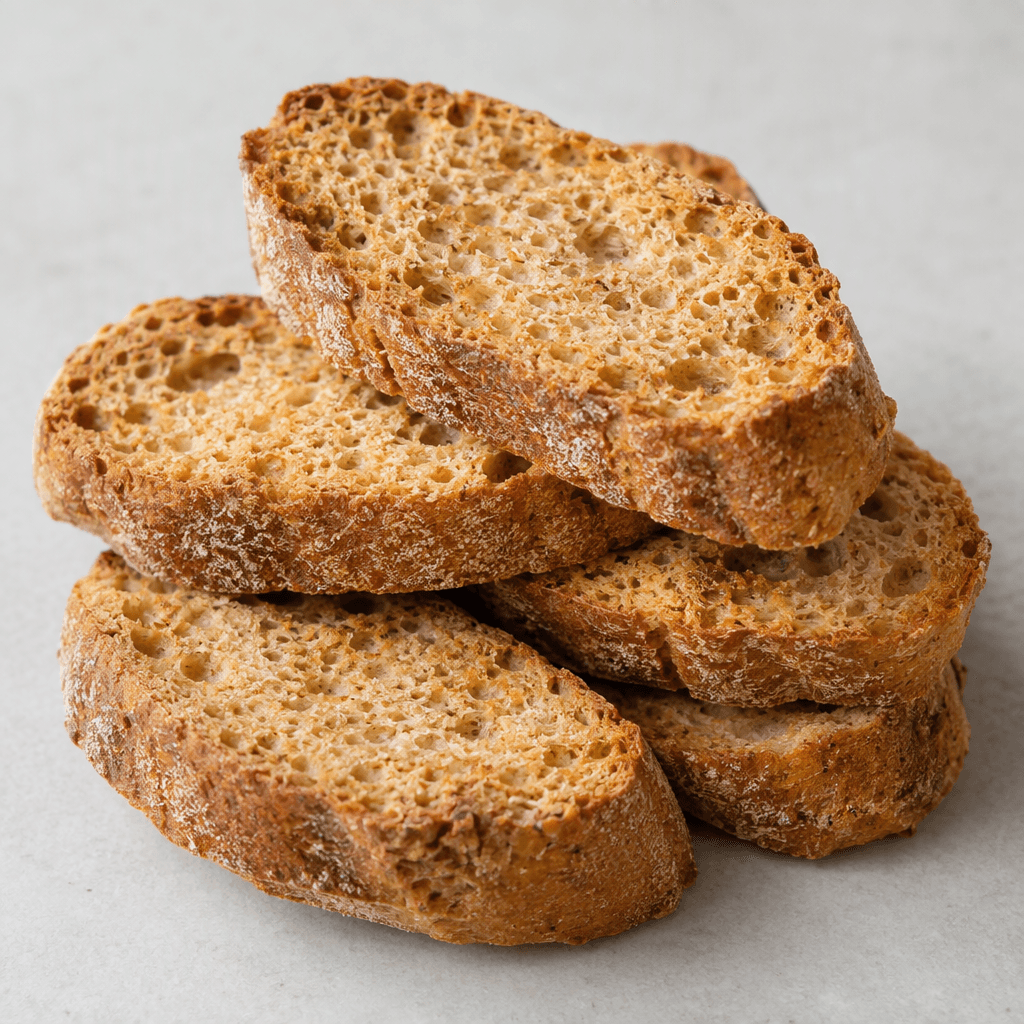
Rusks Calories
Dry, crisp bread slice. Long shelf life, used for breakfast or desserts.
In season: Spring · Summer · Autumn · Winter
CALORIES
GI
POTASSIUM
FIBER
Quick answer
1 piece (medium) of Rusks (18 g) has 70 calories. That works out to 390 calories per 100 g. It contains 14 g of carbs, 2 g of protein, 0.6 g of fat and 0.8 g of fiber. Its 0.1 mg of B1 covers 5% of the Daily Value. Its glycemic index is 70 (high), so it raises blood sugar quickly.
What is Rusks?
Rusks are slices of bread baked again to remove moisture, giving them a crisp texture and a long shelf life. They are enjoyed in many places as a simple breakfast or snack, often spread with butter, jam or soft cheese and served with tea or coffee. In Turkey, etimek is also a familiar base for layered desserts, where the dry slices soften as they absorb syrup or cream.
Their flavor is mild and toasty, making them easy to pair with both sweet and savory toppings. They are mainly a source of carbohydrates, with some protein and fibre. For a lighter dessert, use a modest amount of syrup and layer the rusks with fresh fruit and plain yoghurt.
Rusks Nutrition Facts
Selected: 100 g
390
KCAL / 100G
Carbs
78g
· 28% DV
Protein
11g
· 22% DV
Fat
3.5g
· 4% DV
Fiber
4.5g
· 16% DV
DV is the share of the daily value covered, on a 2,000 kcal reference diet.
Calories come from: Carbs 81% · Protein 11% · Fat 8%
Rusks Vitamins & Minerals
Vitamins
B1
0.35mg · 29% DV
B3
3.7mg · 23% DV
B2
0.18mg · 14% DV
B5
0.5mg · 10% DV
Minerals
Selenium
12µg · 22% DV
Sodium
420mg · 18% DV
Phosphorus
95mg · 14% DV
Iron
2mg · 11% DV
How Nutritious Is Rusks?
Nutrient density
Low
How many vitamins, minerals and how much fiber this food carries per calorie. A high score means a lot of nutrition for few calories.
Satiety score
Medium
An EatBetter score computed from fiber, protein and calorie density. A high score means staying full longer on the same calories.
Both scores are calculated per 100 g and do not change with the selected portion. The satiety score is EatBetter's own calculation, not a clinical measure.
Rusks Glycemic Index
GLYCEMIC INDEX
GLYCEMIC LOAD
Accounts for portion size — a more realistic measure than GI alone.
How to Burn Off Rusks
To burn the 390 calories in 100 g:
🚶
Walking (5 km/h)
🏃
Running (8 km/h)
🚴
Cycling
🏊
Swimming
Times are calculated with the MET equation for a 70 kg adult. Actual burn varies with your weight, age and pace.
Is Rusks Processed?
NOVA 3
Processed
1. Unprocessed
2. Minimally Processed
3. Processed
4. Ultra-Processed
NOVA classifies foods into 4 groups by industrial processing. NOVA 1 (unprocessed) is the healthiest.
Does Rusks Contain Allergens?
Contains these allergens:
Which Diets Is Rusks Good For?
Vegan
— Not suitable
Vegetarian
✓ Suitable
Gluten-Free
— Not suitable
Dairy-Free
— Not suitable
Mediterranean
— Not suitable
Paleo
— Not suitable
Whole30
— Not suitable
DASH
— Not suitable
Keto
— Not suitable
Low FODMAP
— Not suitable
Rusks Fat Profile
SATURATED
0.8g
MONOUNSATURATED
1.1g
POLYUNSATURATED
1.2g
Omega 6:3 ratio 13:1
Above the ideal 4:1 (13:1).
Compare Rusks
Foods Similar to Rusks
Frequently Asked Questions About Rusks
What are rusks?
Rusks are dry, crisp slices of bread that have been baked again to remove moisture. They are eaten plain or with toppings, dipped into drinks, or used as a base in layered desserts and other recipes.
How do you eat rusks?
Rusks can be eaten plain, topped with butter, cheese, jam, or other spreads, or briefly dipped in tea or coffee. Add moist toppings shortly before eating if you want them to stay crisp.
Are rusks the same as biscotti?
No, rusks and biscotti are not always the same. Both may be baked twice and have a dry, crisp texture, but biscotti are typically sweet Italian biscuits made with additions such as nuts, while rusks can be plain bread slices.
How do you soften rusks?
Soften rusks by briefly dipping or pouring a little liquid over them. Tea, coffee, milk, syrup, or broth can work, depending on the dish. Add liquid gradually so the rusk becomes tender without turning soggy.
How should you store rusks after opening?
Keep opened rusks in an airtight container in a cool, dry place. Moisture makes them lose their crispness, so avoid storing them near steam or in a damp cupboard; follow the package date for unopened rusks.
Can you use rusks in desserts?
Yes, rusks work well in layered desserts because they absorb syrup or custard while keeping some structure. Arrange them in a dish, moisten them with the recipe’s liquid, and add pudding or cream; avoid soaking them until they fall apart.
Can you use rusks instead of breadcrumbs?
Yes, plain rusks can replace breadcrumbs if you crush them finely. They may make a coating or filling crunchier, so adjust the amount to the texture you want and season the crumbs if the rusks are unsalted.
Are rusks suitable for babies?
Some rusks are made specifically for babies, but ordinary rusks can be very hard and may pose a choking risk. Choose an age-appropriate product and supervise closely; do not give a baby a hard rusk to chew unattended.
Why are rusks baked twice?
Rusks are baked twice to dry them out and create their characteristic crisp texture. Removing moisture also helps them keep longer than soft bread, provided they are protected from damp air after baking.
Can rusks go stale?
Yes, rusks can lose their crispness if they absorb moisture, even though they are drier than ordinary bread. Seal them promptly after opening and discard any that develop an unusual smell, visible mold, or an unpleasant taste.
Have another question about Rusks?
Ask the AI nutrition coach — calories, portions, alternatives and more, answered in seconds in the app.

Scan calories with your camera
Instant AI nutrition analysis

Nutrition data compiled from USDA FoodData Central and scientific sources.