

Ready & Packaged Foods
All →Vegetables & Legumes
All →Desserts & Confectionery
All →Meat & Protein
All →Grains & Bakery
All →Beverages
All →Milk & Dairy
All →

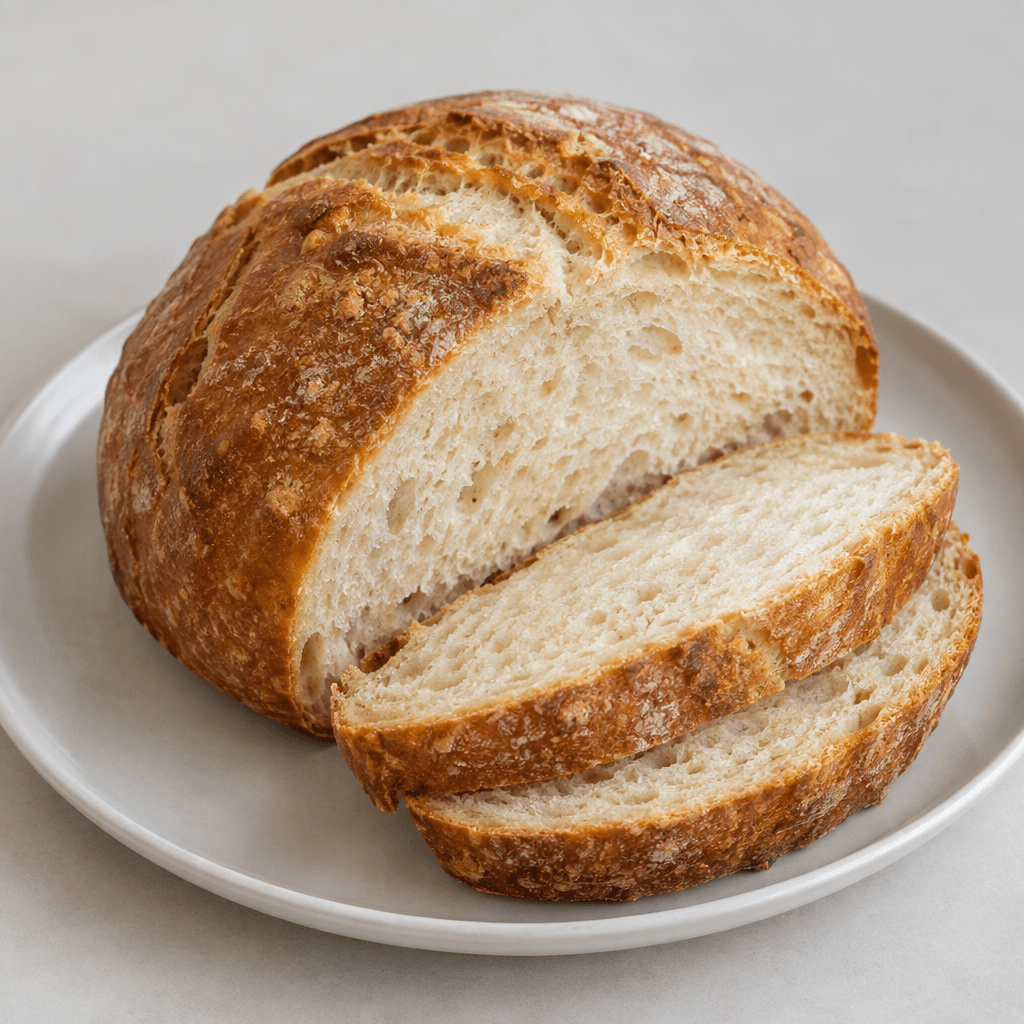
Round Bread Calories
Traditional round bread, usually made with wheat flour.
In season: Spring · Summer · Autumn · Winter
CALORIES
GI
POTASSIUM
FIBER
Quick answer
1 piece (medium) of Round Bread (60 g) has 150 calories. That works out to 250 calories per 100 g. It contains 29.4 g of carbs, 5.1 g of protein, 1.5 g of fat and 1.6 g of fiber. Its 7.8 µg of Selenium covers 14% of the Daily Value. Its glycemic index is 70 (high), so it raises blood sugar quickly.
What is Round Bread?
Round Bread is a loaf shaped into a circle, usually made with wheat flour and baked until its crust is golden and its inside soft and airy. The exact size and crust vary from bakery to bakery; the name describes its shape rather than one specific recipe.
In Turkey, it may be served at breakfast with cheese, olives and tomatoes, or alongside soup and main dishes. Thick slices also work well for sandwiches or toast. It is mostly a source of carbohydrates, with 8.5 g of protein per 100 g. For a more filling meal, pair it with eggs, beans or another protein-rich topping, plus vegetables.
Round Bread Nutrition Facts
Selected: 100 g
250
KCAL / 100G
Carbs
49g
· 18% DV
Protein
8.5g
· 17% DV
Fat
2.5g
· 3% DV
Fiber
2.7g
· 10% DV
DV is the share of the daily value covered, on a 2,000 kcal reference diet.
Calories come from: Carbs 78% · Protein 13% · Fat 9%
Round Bread Vitamins & Minerals
Vitamins
B1
0.25mg · 21% DV
B3
2.2mg · 14% DV
B2
0.12mg · 9% DV
Folate
30µg · 8% DV
Minerals
Selenium
13µg · 24% DV
Sodium
450mg · 20% DV
Iron
2mg · 11% DV
Phosphorus
75mg · 11% DV
How Nutritious Is Round Bread?
Nutrient density
Low
How many vitamins, minerals and how much fiber this food carries per calorie. A high score means a lot of nutrition for few calories.
Satiety score
Medium
An EatBetter score computed from fiber, protein and calorie density. A high score means staying full longer on the same calories.
Both scores are calculated per 100 g and do not change with the selected portion. The satiety score is EatBetter's own calculation, not a clinical measure.
Round Bread Glycemic Index
GLYCEMIC INDEX
GLYCEMIC LOAD
Accounts for portion size — a more realistic measure than GI alone.
How to Burn Off Round Bread
To burn the 250 calories in 100 g:
🚶
Walking (5 km/h)
🏃
Running (8 km/h)
🚴
Cycling
🏊
Swimming
Times are calculated with the MET equation for a 70 kg adult. Actual burn varies with your weight, age and pace.
Is Round Bread Processed?
NOVA 3
Processed
1. Unprocessed
2. Minimally Processed
3. Processed
4. Ultra-Processed
NOVA classifies foods into 4 groups by industrial processing. NOVA 1 (unprocessed) is the healthiest.
Does Round Bread Contain Allergens?
Contains these allergens:
Which Diets Is Round Bread Good For?
Vegan
— Not suitable
Vegetarian
✓ Suitable
Gluten-Free
— Not suitable
Dairy-Free
— Not suitable
Mediterranean
✓ Suitable
Paleo
— Not suitable
Whole30
— Not suitable
DASH
— Not suitable
Keto
— Not suitable
Low FODMAP
— Not suitable
Round Bread Fat Profile
SATURATED
0.5g
MONOUNSATURATED
0.3g
POLYUNSATURATED
0.5g
Omega 6:3 ratio 11.3:1
Above the ideal 4:1 (11.3:1).
Compare Round Bread
Foods Similar to Round Bread
Frequently Asked Questions About Round Bread
What is round bread?
Round bread is a loaf shaped into a round, usually domed form before baking. It commonly has a firm crust and a soft, airy crumb, and is served whole or cut into slices.
How do you make round bread at home?
To make round bread, knead flour, water, yeast, and salt into a dough and let it rise. Shape it into a tight ball, allow it to rise again, then bake in a preheated oven until the crust is golden.
Why does round bread crack on top while baking?
Round bread often cracks when the dough expands in the oven but its surface cannot stretch enough to keep up. Cutting a shallow slash across the top before baking gives the loaf a planned place to open.
Why is my round bread dense in the middle?
Round bread can turn out dense if the dough has not risen enough, or if too much flour was added during kneading. Let the shaped loaf become visibly puffy before baking, and keep the dough soft rather than stiff.
Why does round bread spread out instead of rising upward?
Round bread spreads when its dough is too slack, overproofed, or not shaped tightly enough to hold its form. Create surface tension while shaping the dough into a ball, and bake it before it loses that structure.
How do you score round bread before baking?
Score round bread with a sharp blade just before it goes into the oven, making one or more shallow cuts across the dome. The cuts let steam escape in a controlled way and help the loaf expand without splitting unpredictably.
How do you slice a round loaf evenly?
Let round bread cool fully, then use a serrated bread knife on a stable cutting board. Saw gently rather than pressing down; this keeps the soft crumb from compressing and makes slices more even.
How should you store round bread to keep its crust crisp?
Store round bread at room temperature in a bread box or paper bag, with the cut side facing down. A sealed plastic bag traps moisture and softens the crust, while refrigeration can make the crumb stale faster.
Can you freeze round bread?
Yes, round bread freezes well. Cool it completely, then wrap the whole loaf tightly or slice it first and freeze the slices in an airtight bag. Slicing beforehand lets you take out only what you need.
What can you serve with round bread?
Round bread works well with soups, stews, and bean dishes because its sturdy slices can be used for dipping. For breakfast, serve it with eggs, cheese, or jam; thicker slices also make good toast.
Have another question about Round Bread?
Ask the AI nutrition coach — calories, portions, alternatives and more, answered in seconds in the app.

Scan calories with your camera
Instant AI nutrition analysis

Nutrition data compiled from USDA FoodData Central and scientific sources.