

Ready & Packaged Foods
All →Vegetables & Legumes
All →Desserts & Confectionery
All →Meat & Protein
All →Grains & Bakery
All →Beverages
All →Milk & Dairy
All →

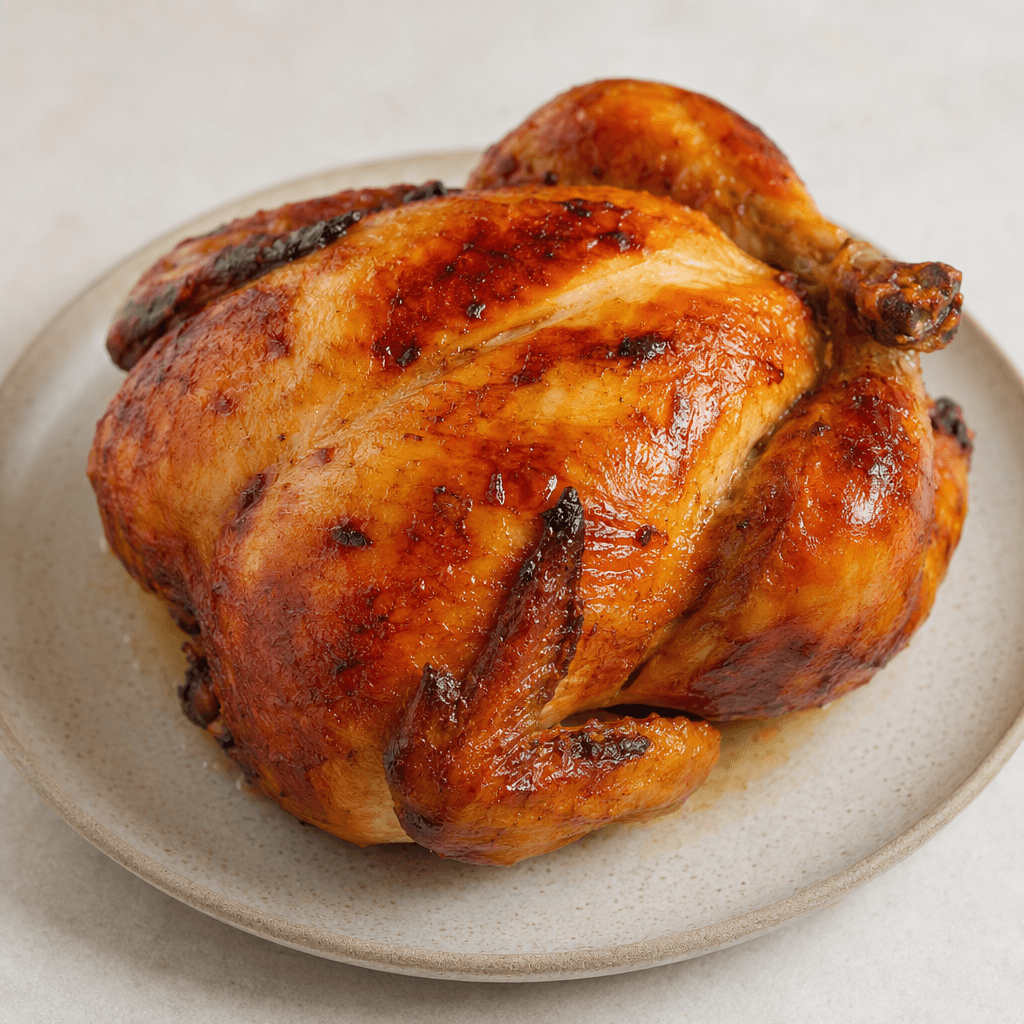
Rotisserie Chicken Calories
Low carb, good protein source, contains minerals and vitamins
In season: Spring · Summer · Autumn · Winter
CALORIES
GI
POTASSIUM
FIBER
Quick answer
1 piece (medium) of Rotisserie Chicken (150 g) has 255 calories. That works out to 170 calories per 100 g. It contains 0 g of carbs, 37.5 g of protein, 10.5 g of fat and 0 g of fiber. Its 13.5 mg of B3 covers 84% of the Daily Value. Its glycemic index is 0 (low), so it raises blood sugar slowly.
What is Rotisserie Chicken?
Rotisserie chicken is chicken cooked slowly on a rotating spit, valued for its substantial protein content and savory flavor. A 100 g serving provides 170 calories, 25 g of protein, and 7 g of fat, with no carbohydrates or fiber. Its glycemic index is 0.
As a minimally processed meat option, rotisserie chicken can fit into balanced meals alongside vegetables and whole-grain sides. It is compatible with omnivore, keto, paleo, Mediterranean, flexitarian, and gluten-free eating patterns.
Rotisserie Chicken Nutrition Facts
Selected: 100 g
170
KCAL / 100G
Carbs
0g
· 0% DV
Protein
25g
· 50% DV
Fat
7g
· 9% DV
Fiber
0g
· 0% DV
DV is the share of the daily value covered, on a 2,000 kcal reference diet.
Calories come from: Carbs 0% · Protein 61% · Fat 39%
Rotisserie Chicken Vitamins & Minerals
Vitamins
B3
9mg · 56% DV
B6
0.5mg · 29% DV
B5
1mg · 20% DV
Biotin
5µg · 17% DV
Minerals
Selenium
18µg · 33% DV
Phosphorus
210mg · 30% DV
Sodium
400mg · 17% DV
Zinc
1mg · 9% DV
How Nutritious Is Rotisserie Chicken?
Nutrient density
High
How many vitamins, minerals and how much fiber this food carries per calorie. A high score means a lot of nutrition for few calories.
Satiety score
Medium
An EatBetter score computed from fiber, protein and calorie density. A high score means staying full longer on the same calories.
Both scores are calculated per 100 g and do not change with the selected portion. The satiety score is EatBetter's own calculation, not a clinical measure.
Rotisserie Chicken Glycemic Index
GLYCEMIC INDEX
GLYCEMIC LOAD
Accounts for portion size — a more realistic measure than GI alone.
How to Burn Off Rotisserie Chicken
To burn the 170 calories in 100 g:
🚶
Walking (5 km/h)
🏃
Running (8 km/h)
🚴
Cycling
🏊
Swimming
Times are calculated with the MET equation for a 70 kg adult. Actual burn varies with your weight, age and pace.
Is Rotisserie Chicken Processed?
NOVA 2
Minimally Processed
1. Unprocessed
2. Minimally Processed
3. Processed
4. Ultra-Processed
NOVA classifies foods into 4 groups by industrial processing. NOVA 1 (unprocessed) is the healthiest.
Does Rotisserie Chicken Contain Allergens?
No known major allergens
Which Diets Is Rotisserie Chicken Good For?
Vegan
— Not suitable
Vegetarian
— Not suitable
Gluten-Free
✓ Suitable
Dairy-Free
— Not suitable
Mediterranean
✓ Suitable
Paleo
✓ Suitable
Whole30
— Not suitable
DASH
— Not suitable
Keto
✓ Suitable
Low FODMAP
— Not suitable
Rotisserie Chicken Fat Profile
SATURATED
2g
MONOUNSATURATED
2.5g
POLYUNSATURATED
1.5g
Omega 6:3 ratio 7.1:1
Above the ideal 4:1 (7.1:1).
Compare Rotisserie Chicken
Foods Similar to Rotisserie Chicken
Frequently Asked Questions About Rotisserie Chicken
Is rotisserie chicken healthy?
Rotisserie chicken can be a practical protein-rich meal, especially when served with vegetables. Its skin, seasoning, and salty sides can add more fat or sodium, so remove the skin or choose simple sides if you want a lighter meal.
How long does rotisserie chicken last in the fridge?
Rotisserie chicken usually keeps for 3–4 days in the refrigerator when chilled within two hours of cooking or purchase. Store it in a covered container and reheat portions until steaming hot before eating.
Can you freeze rotisserie chicken?
Yes, rotisserie chicken freezes well. Remove the meat from the bones, pack it in airtight freezer-safe containers, and thaw it in the refrigerator. Use thawed chicken promptly and do not refreeze it.
How do you reheat rotisserie chicken without drying it out?
Reheat rotisserie chicken covered in the oven with a splash of water or broth to help retain moisture. You can also use a microwave, turning the pieces partway through; heat until the center is steaming hot.
Is rotisserie chicken the same as roast chicken?
They are similar, but not always cooked the same way. Rotisserie chicken is cooked while turning on a spit, whereas roast chicken is usually stationary in an oven; the rotating spit helps brown the skin evenly.
Why is rotisserie chicken so moist?
Rotisserie chicken often stays moist because it cooks gradually while rotating, and its skin helps retain juices. The bird also bastes as fat and juices run over its surface during cooking.
Can you eat rotisserie chicken cold?
Yes, you can eat rotisserie chicken cold if it was refrigerated promptly and kept chilled. It works well in sandwiches and salads; discard it if it sat at room temperature for more than two hours.
What can you make with leftover rotisserie chicken?
Leftover rotisserie chicken works in soup, tacos, sandwiches, salads, and pasta. Remove the meat from the bones, refrigerate it promptly, and add it near the end of cooking so it does not become dry.
Can dogs eat rotisserie chicken?
Dogs can have a little plain rotisserie chicken meat, but remove all bones and skin first. Avoid seasoned pieces, especially those with garlic, onion, or excess salt, and do not give dogs cooked chicken bones.
How do you shred rotisserie chicken?
Let the rotisserie chicken cool enough to handle, remove the skin and bones, then pull the meat apart with two forks. For a larger batch, a stand mixer on low speed can shred the meat quickly.
Have another question about Rotisserie Chicken?
Ask the AI nutrition coach — calories, portions, alternatives and more, answered in seconds in the app.

Scan calories with your camera
Instant AI nutrition analysis

Nutrition data compiled from USDA FoodData Central and scientific sources.