

Ready & Packaged Foods
All →Vegetables & Legumes
All →Desserts & Confectionery
All →Meat & Protein
All →Grains & Bakery
All →Beverages
All →Milk & Dairy
All →

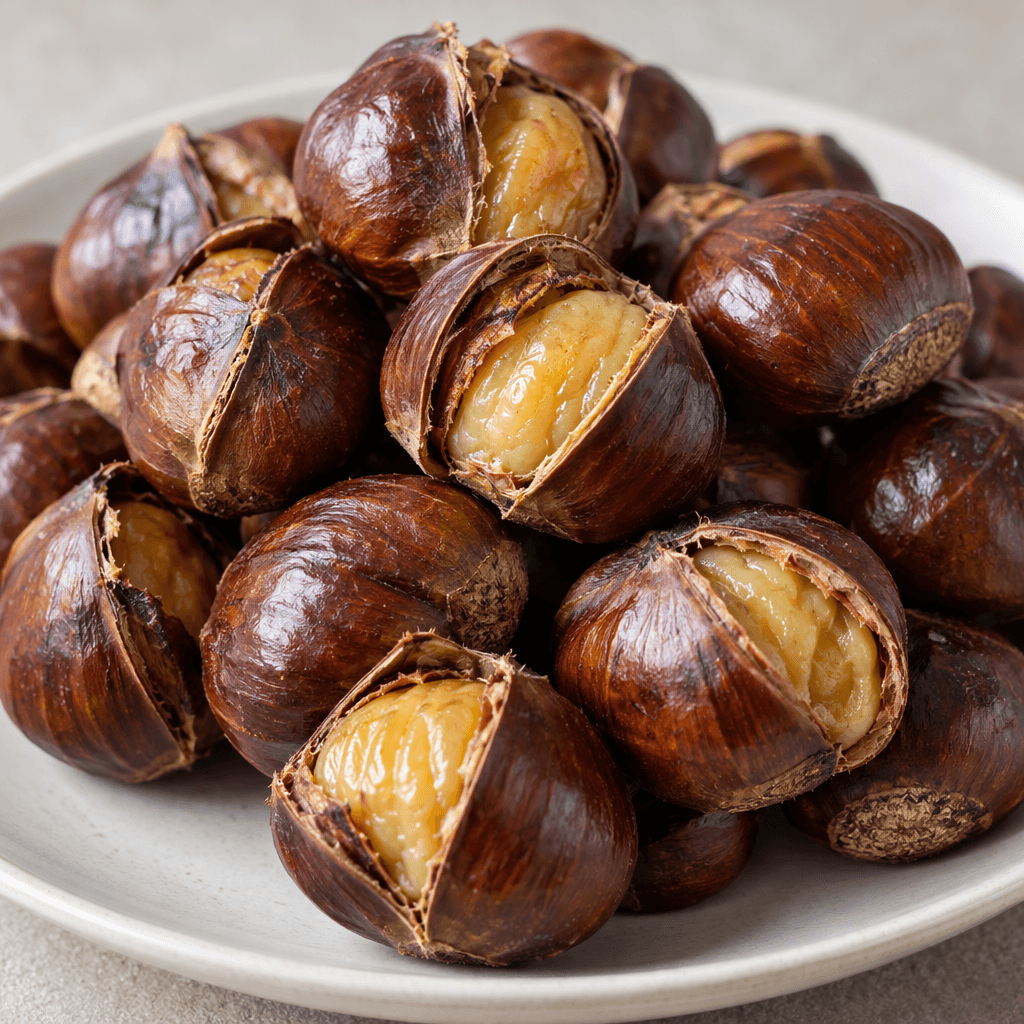
Roasted chestnut Calories
Roasted chestnut: fiber-rich, good source of vitamin C and potassium, low in fat.
In season: Autumn · Winter
CALORIES
GI
POTASSIUM
FIBER
Quick answer
5 piece (medium) of Roasted chestnut (60 g) has 126 calories. That works out to 210 calories per 100 g. It contains 27.3 g of carbs, 1.6 g of protein, 0.8 g of fat and 3.1 g of fiber. Its 0.7 mg of Manganese covers 31% of the Daily Value. Its glycemic index is 54 (medium), so it raises blood sugar at a moderate pace.
What is Roasted chestnut?
Roasted chestnut is made by scoring the shells and cooking the nuts over a fire, on a hot pan or in an oven. In Turkey, vendors often sell them hot from street-side braziers during the colder months; roasting chestnuts is also a seasonal custom in many parts of Europe and East Asia.
Peel them while warm and eat them plain as a snack, or serve them alongside a winter meal. Their flesh is soft, gently sweet and slightly floury, with a smoky edge when cooked over coals. Unlike many nuts, roasted chestnut is low in fat and supplies mainly carbohydrates, along with fibre. For a simple, lighter serving, enjoy it without added butter or sugar.
Roasted chestnut Nutrition Facts
Selected: 100 g
210
KCAL / 100G
Carbs
45.5g
· 17% DV
Protein
2.7g
· 5% DV
Fat
1.3g
· 2% DV
Fiber
5.1g
· 18% DV
DV is the share of the daily value covered, on a 2,000 kcal reference diet.
Calories come from: Carbs 89% · Protein 5% · Fat 6%
Roasted chestnut Vitamins & Minerals
Vitamins
Vitamin C
26mg · 29% DV
B6
0.35mg · 21% DV
B1
0.24mg · 20% DV
Folate
62µg · 16% DV
Minerals
Manganese
1mg · 43% DV
Potassium ⭐
715mg · 21% DV
Phosphorus
70mg · 10% DV
Zinc
1mg · 9% DV
How Nutritious Is Roasted chestnut?
Nutrient density
High
How many vitamins, minerals and how much fiber this food carries per calorie. A high score means a lot of nutrition for few calories.
Satiety score
Medium
An EatBetter score computed from fiber, protein and calorie density. A high score means staying full longer on the same calories.
Both scores are calculated per 100 g and do not change with the selected portion. The satiety score is EatBetter's own calculation, not a clinical measure.
Roasted chestnut Glycemic Index
GLYCEMIC INDEX
GLYCEMIC LOAD
Accounts for portion size — a more realistic measure than GI alone.
How to Burn Off Roasted chestnut
To burn the 210 calories in 100 g:
🚶
Walking (5 km/h)
🏃
Running (8 km/h)
🚴
Cycling
🏊
Swimming
Times are calculated with the MET equation for a 70 kg adult. Actual burn varies with your weight, age and pace.
Is Roasted chestnut Processed?
NOVA 2
Minimally Processed
1. Unprocessed
2. Minimally Processed
3. Processed
4. Ultra-Processed
NOVA classifies foods into 4 groups by industrial processing. NOVA 1 (unprocessed) is the healthiest.
Does Roasted chestnut Contain Allergens?
No known major allergens
Which Diets Is Roasted chestnut Good For?
Vegan
✓ Suitable
Vegetarian
✓ Suitable
Gluten-Free
✓ Suitable
Dairy-Free
— Not suitable
Mediterranean
✓ Suitable
Paleo
✓ Suitable
Whole30
— Not suitable
DASH
— Not suitable
Keto
— Not suitable
Low FODMAP
— Not suitable
Roasted chestnut Fat Profile
SATURATED
0.3g
MONOUNSATURATED
0.5g
POLYUNSATURATED
0.15g
Omega 6:3 ratio 4:1
Below the ideal 4:1 — a good omega balance.
Compare Roasted chestnut
Foods Similar to Roasted chestnut
Frequently Asked Questions About Roasted chestnut
How do you roast chestnuts at home?
Roasted chestnuts are easy to make in an oven: cut an X through each shell, arrange them on a baking tray, and roast until the shells open and the flesh is tender. Serve them warm, when they are easiest to peel.
Do you have to cut roasted chestnuts before cooking them?
Yes, score each chestnut before roasting. The cut lets steam escape and reduces the chance of the shell bursting from pressure; it also makes the cooked chestnuts easier to peel.
How long do roasted chestnuts take in the oven?
Roasted chestnuts usually take about 20–30 minutes in a preheated 200°C (400°F) oven. They are ready when the scored shells curl back and the flesh feels tender; smaller chestnuts may cook sooner.
How do you peel roasted chestnuts easily?
Peel roasted chestnuts while they are still warm. Wrap them in a clean kitchen towel for a few minutes after cooking; the trapped steam loosens both the hard shell and the thin inner skin.
Can you roast chestnuts in a pan?
Yes, chestnuts can be roasted in a covered, heavy-based skillet. Score them first, cook over medium-low heat, and turn them from time to time so they roast evenly without scorching.
How can you tell when roasted chestnuts are done?
Roasted chestnuts are done when their scored shells have opened and the flesh is tender when pierced. If the center is still firm, return them to the heat and check again shortly.
How should you store roasted chestnuts?
Store roasted chestnuts in a covered container in the refrigerator once they have cooled. Keeping them sealed helps prevent them from drying out; reheat them in a pan or oven before serving if you prefer them warm.
Can you freeze roasted chestnuts?
Yes, roasted chestnuts can be frozen. Let them cool, peel them, and seal them in a freezer-safe container; thaw them before adding to recipes or warming them to eat.
Are roasted chestnuts healthy?
Roasted chestnuts provide fiber and are lower in fat than many other nuts. They are also rich in carbohydrates, so people managing blood sugar should consider their portion as part of their meal.
Are roasted chestnuts the same as horse chestnuts?
No, roasted chestnuts come from edible sweet chestnut trees, while horse chestnuts are a different tree’s seeds and are toxic if eaten. Never roast or eat a horse chestnut.
Have another question about Roasted chestnut?
Ask the AI nutrition coach — calories, portions, alternatives and more, answered in seconds in the app.

Scan calories with your camera
Instant AI nutrition analysis

Nutrition data compiled from USDA FoodData Central and scientific sources.