

Ready & Packaged Foods
All →Vegetables & Legumes
All →Desserts & Confectionery
All →Meat & Protein
All →Grains & Bakery
All →Beverages
All →Milk & Dairy
All →

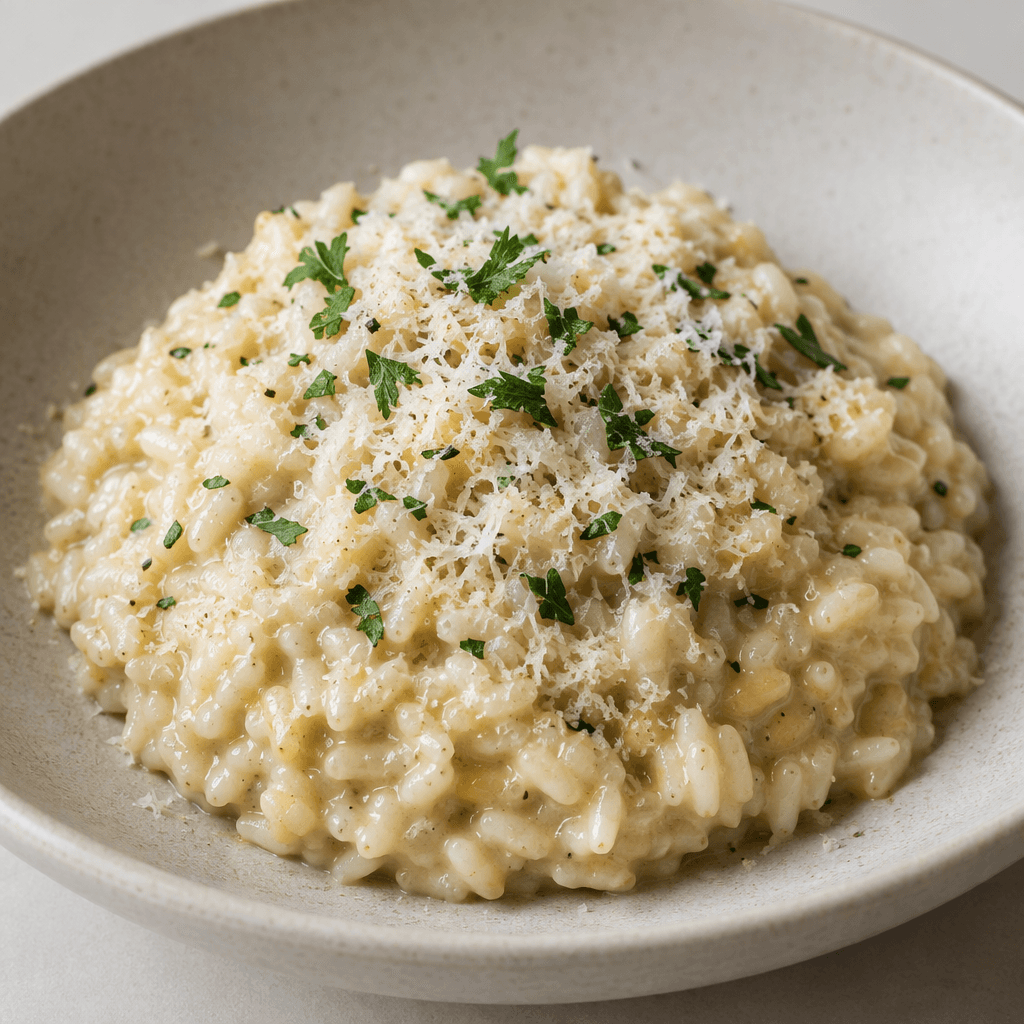
Risotto Calories
Creamy Italian rice dish, source of carbs and energy
In season: Spring · Summer · Autumn · Winter
CALORIES
GI
POTASSIUM
FIBER
Quick answer
1 cup (medium) of Risotto (200 g) has 260 calories. That works out to 130 calories per 100 g. It contains 45 g of carbs, 5 g of protein, 6.4 g of fat and 1.2 g of fiber. Its 320 mg of Sodium covers 14% of the Daily Value. Its glycemic index is 72 (high), so it raises blood sugar quickly.
What is Risotto?
Risotto is a northern Italian rice dish, traditionally made by slowly cooking short-grain rice with warm stock, added a little at a time. Frequent stirring helps release the rice’s starch, giving the dish its characteristic creamy texture while the grains remain distinct. Butter and grated cheese are often stirred in at the end.
Serve it hot as a main course or as a first course, with ingredients such as mushrooms, seasonal vegetables, seafood or saffron. It is chiefly a carbohydrate-rich source of energy, with relatively little fibre. For a lighter version, use less butter and cheese and add extra vegetables; a crisp green salad makes a fresh accompaniment.
Risotto Nutrition Facts
Selected: 100 g
130
KCAL / 100G
Carbs
22.5g
· 8% DV
Protein
2.5g
· 5% DV
Fat
3.2g
· 4% DV
Fiber
0.6g
· 2% DV
DV is the share of the daily value covered, on a 2,000 kcal reference diet.
Calories come from: Carbs 70% · Protein 8% · Fat 22%
Risotto Vitamins & Minerals
Vitamins
B3
0.6mg · 4% DV
Biotin
1.2µg · 4% DV
B1
0.04mg · 3% DV
B5
0.15mg · 3% DV
Minerals
Sodium
160mg · 7% DV
Selenium
2.5µg · 5% DV
Phosphorus
32mg · 5% DV
Calcium
18mg · 2% DV
How Nutritious Is Risotto?
Nutrient density
Low
How many vitamins, minerals and how much fiber this food carries per calorie. A high score means a lot of nutrition for few calories.
Satiety score
Low
An EatBetter score computed from fiber, protein and calorie density. A high score means staying full longer on the same calories.
Both scores are calculated per 100 g and do not change with the selected portion. The satiety score is EatBetter's own calculation, not a clinical measure.
Risotto Glycemic Index
GLYCEMIC INDEX
GLYCEMIC LOAD
Accounts for portion size — a more realistic measure than GI alone.
How to Burn Off Risotto
To burn the 130 calories in 100 g:
🚶
Walking (5 km/h)
🏃
Running (8 km/h)
🚴
Cycling
🏊
Swimming
Times are calculated with the MET equation for a 70 kg adult. Actual burn varies with your weight, age and pace.
Is Risotto Processed?
NOVA 3
Processed
1. Unprocessed
2. Minimally Processed
3. Processed
4. Ultra-Processed
NOVA classifies foods into 4 groups by industrial processing. NOVA 1 (unprocessed) is the healthiest.
Does Risotto Contain Allergens?
Contains these allergens:
Which Diets Is Risotto Good For?
Vegan
— Not suitable
Vegetarian
✓ Suitable
Gluten-Free
— Not suitable
Dairy-Free
— Not suitable
Mediterranean
✓ Suitable
Paleo
— Not suitable
Whole30
— Not suitable
DASH
— Not suitable
Keto
— Not suitable
Low FODMAP
— Not suitable
Risotto Fat Profile
SATURATED
1.8g
MONOUNSATURATED
0.9g
POLYUNSATURATED
0.15g
Omega 6:3 ratio 13:1
Above the ideal 4:1 (13:1).
Compare Risotto
Foods Similar to Risotto
Frequently Asked Questions About Risotto
What is risotto?
Risotto is an Italian rice dish cooked gradually with hot stock until the grains release starch and form a creamy sauce. The rice should remain distinct and slightly firm, rather than turning into a smooth porridge.
How do you make risotto?
To make risotto, toast the rice briefly in oil or butter, then add warm stock a little at a time, stirring often. Add more stock as each addition is absorbed, and stop cooking when the rice is creamy but still slightly firm.
Can you make risotto without cream?
Yes, traditional risotto is creamy without cream. The starch released as short-grain rice cooks thickens the stock; finishing with butter and grated Parmesan adds richness, but neither cream nor a cream substitute is necessary.
What is the best rice for risotto?
Arborio is the easiest risotto rice to find, while carnaroli and vialone nano are also classic choices. Their short, starchy grains make a creamy sauce while holding their shape; long-grain rice usually will not give the same texture.
Why do you add stock to risotto a little at a time?
Adding warm stock gradually lets the rice absorb liquid and release starch while it cooks, creating risotto’s characteristic texture. Keep the pan at a gentle simmer and add another ladle when the previous addition is mostly absorbed.
Does risotto need wine?
No, wine is optional in risotto. It adds acidity and aroma after the rice is toasted, but you can skip it and continue with warm stock; the dish will still develop its creamy texture from the rice.
How do you keep risotto from becoming mushy?
Keep risotto slightly firm at the center and take it off the heat before the grains split or lose their shape. Add stock gradually, taste as it cooks, and serve promptly because risotto continues to thicken as it stands.
Can you make risotto ahead of time?
Risotto is best served just after cooking, so it is not ideal to prepare fully in advance. For a dinner party, cook the rice partway, spread it out to cool, then finish it with hot stock shortly before serving.
How do you reheat leftover risotto?
Reheat leftover risotto in a saucepan over low heat, stirring in a splash of stock or water to loosen it. Heat it until steaming throughout; the rice will be softer than freshly made risotto but should still hold together.
What can you serve with risotto?
Serve risotto as a main dish with a crisp green salad, or as a side alongside roasted vegetables, fish, or chicken. Match the accompaniment to the risotto: for example, a simple salad complements rich mushroom or cheese versions.
Have another question about Risotto?
Ask the AI nutrition coach — calories, portions, alternatives and more, answered in seconds in the app.

Scan calories with your camera
Instant AI nutrition analysis

Nutrition data compiled from USDA FoodData Central and scientific sources.