

Ready & Packaged Foods
All →Vegetables & Legumes
All →Desserts & Confectionery
All →Meat & Protein
All →Grains & Bakery
All →Beverages
All →Milk & Dairy
All →

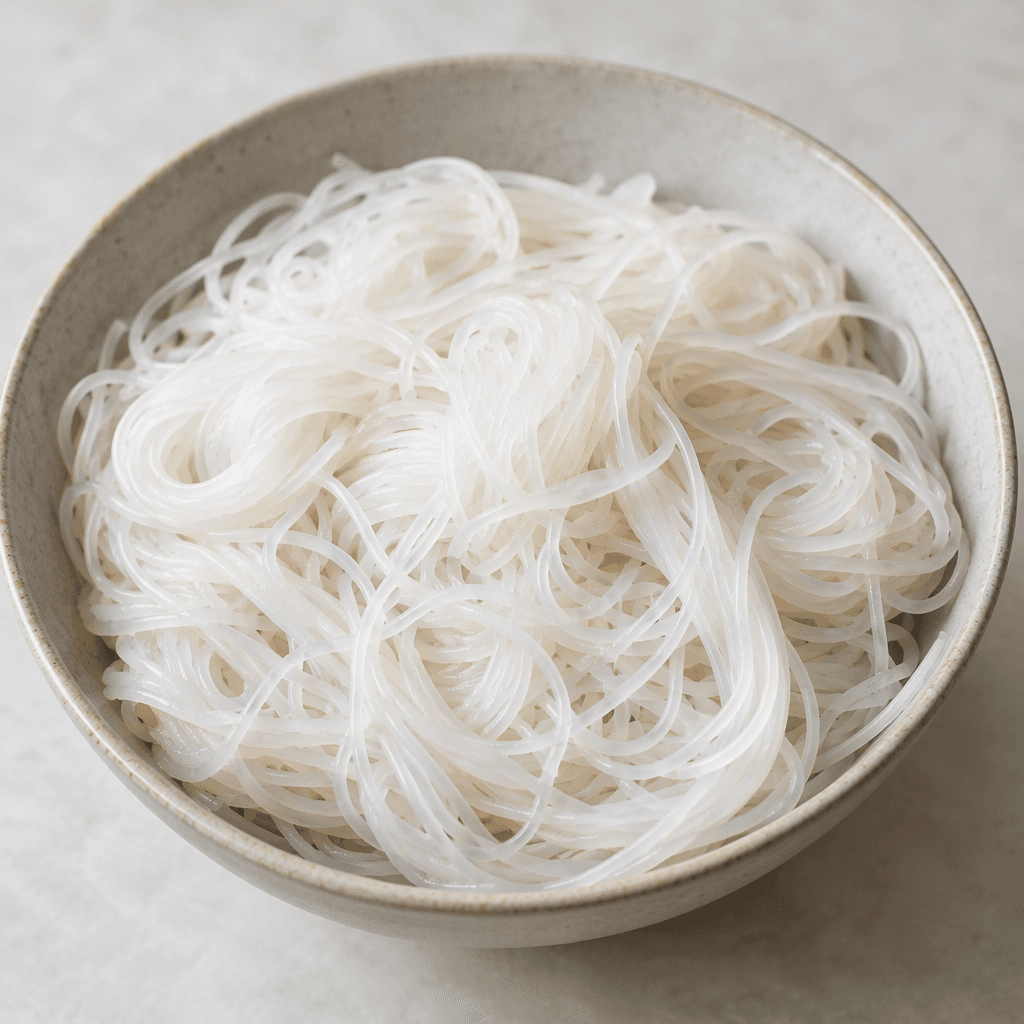
Rice noodles Calories
Gluten-free, light, common in Asian cuisine
In season: Spring · Summer · Autumn · Winter
CALORIES
GI
POTASSIUM
FIBER
Quick answer
1 cup (medium) of Rice noodles (150 g) has 162 calories. That works out to 108 calories per 100 g. It contains 37.3 g of carbs, 2.7 g of protein, 0.3 g of fat and 1.4 g of fiber. Its 0.1 mg of Manganese covers 6% of the Daily Value. Its glycemic index is 61 (medium), so it raises blood sugar at a moderate pace.
What is Rice noodles?
Rice noodles are made mainly from rice flour and water, and come in many widths across East and Southeast Asian cuisines. Thin varieties turn soft and slightly slippery when cooked, while some remain pleasantly springy. They are a familiar base for noodle soups and stir-fries, and are also served chilled in salads.
Depending on the region, you might find them in dishes such as pho or pad thai; elsewhere, they work well with vegetables, herbs, tofu, egg or seafood. Their energy comes mostly from carbohydrates, with little protein or fibre, so pair them with protein-rich ingredients and plenty of vegetables for a more balanced meal. A light broth or modest amount of sauce keeps the dish from feeling heavy.
Rice noodles Nutrition Facts
Selected: 100 g
108
KCAL / 100G
Carbs
24.9g
· 9% DV
Protein
1.8g
· 4% DV
Fat
0.2g
· 0% DV
Fiber
0.9g
· 3% DV
DV is the share of the daily value covered, on a 2,000 kcal reference diet.
Calories come from: Carbs 92% · Protein 7% · Fat 1%
Rice noodles Vitamins & Minerals
Vitamins
B1
0.01mg · 1% DV
B2
0.01mg · 1% DV
B3
0.2mg · 1% DV
B5
0.03mg · 1% DV
Minerals
Phosphorus
18mg · 3% DV
Selenium
1.2µg · 2% DV
Calcium
6mg · 1% DV
Magnesium
3mg · 1% DV
How Nutritious Is Rice noodles?
Nutrient density
Low
How many vitamins, minerals and how much fiber this food carries per calorie. A high score means a lot of nutrition for few calories.
Satiety score
Medium
An EatBetter score computed from fiber, protein and calorie density. A high score means staying full longer on the same calories.
Both scores are calculated per 100 g and do not change with the selected portion. The satiety score is EatBetter's own calculation, not a clinical measure.
Rice noodles Glycemic Index
GLYCEMIC INDEX
GLYCEMIC LOAD
Accounts for portion size — a more realistic measure than GI alone.
How to Burn Off Rice noodles
To burn the 108 calories in 100 g:
🚶
Walking (5 km/h)
🏃
Running (8 km/h)
🚴
Cycling
🏊
Swimming
Times are calculated with the MET equation for a 70 kg adult. Actual burn varies with your weight, age and pace.
Is Rice noodles Processed?
NOVA 3
Processed
1. Unprocessed
2. Minimally Processed
3. Processed
4. Ultra-Processed
NOVA classifies foods into 4 groups by industrial processing. NOVA 1 (unprocessed) is the healthiest.
Does Rice noodles Contain Allergens?
No known major allergens
Which Diets Is Rice noodles Good For?
Vegan
✓ Suitable
Vegetarian
✓ Suitable
Gluten-Free
✓ Suitable
Dairy-Free
— Not suitable
Mediterranean
✓ Suitable
Paleo
— Not suitable
Whole30
— Not suitable
DASH
— Not suitable
Keto
— Not suitable
Low FODMAP
— Not suitable
Rice noodles Fat Profile
SATURATED
0.04g
MONOUNSATURATED
0.03g
POLYUNSATURATED
0.06g
Compare Rice noodles
Foods Similar to Rice noodles
Frequently Asked Questions About Rice noodles
How do you cook rice noodles?
Cook rice noodles by soaking them in hot water or briefly boiling them, depending on their thickness and package directions. Check them often near the end: they should be tender but still slightly firm if you plan to stir-fry them.
Do you boil or soak rice noodles?
Thin rice noodles are usually soaked in hot water rather than boiled, while thicker varieties may need brief boiling. Follow the package instructions for the specific noodles, since soaking time and texture vary by thickness.
Why do rice noodles get mushy?
Rice noodles get mushy when they are overcooked or left soaking too long. Drain them as soon as they soften, and cook them slightly underdone if they will finish in a hot pan with sauce.
How do you keep rice noodles from sticking together?
Rinse cooked rice noodles under cool water to remove excess surface starch and stop them cooking further. If you are not using them right away, toss them with a little oil; for a hot dish, add them straight to the sauce.
Are rice noodles the same as glass noodles?
No. Rice noodles are made from rice flour, while glass noodles are usually made from starches such as mung bean starch. Glass noodles turn notably transparent when cooked and tend to have a more slippery texture.
What dishes are rice noodles used in?
Rice noodles are used in dishes such as pho, pad Thai, stir-fries, soups, and cold noodle salads. Thin noodles work well in soups and salads, while wider varieties are often easier to toss with sauce in a pan.
Can you use rice noodles instead of pasta?
Yes, rice noodles can replace wheat pasta in many soups, salads, and saucy dishes, but their texture and cooking method are different. They soften quickly, so avoid a long boil and add them near the end of cooking.
How long do cooked rice noodles last in the fridge?
Cooked rice noodles keep for about three to four days in a covered container in the refrigerator. Refrigerate them promptly, and reheat them thoroughly; discard them if their smell or appearance has changed.
Can you freeze cooked rice noodles?
Yes, you can freeze cooked rice noodles, though thawing may leave them softer or more prone to breaking. Freeze them in airtight portions and use them in soup or a saucy stir-fry after thawing.
Are rice noodles healthy?
Rice noodles can be part of a balanced meal, but they provide less fibre and protein than many bean- or whole-grain-based noodles. Pair them with vegetables and a protein source to make a more filling dish.
Have another question about Rice noodles?
Ask the AI nutrition coach — calories, portions, alternatives and more, answered in seconds in the app.

Scan calories with your camera
Instant AI nutrition analysis

Nutrition data compiled from USDA FoodData Central and scientific sources.