

Ready & Packaged Foods
All →Vegetables & Legumes
All →Desserts & Confectionery
All →Meat & Protein
All →Grains & Bakery
All →Beverages
All →Milk & Dairy
All →

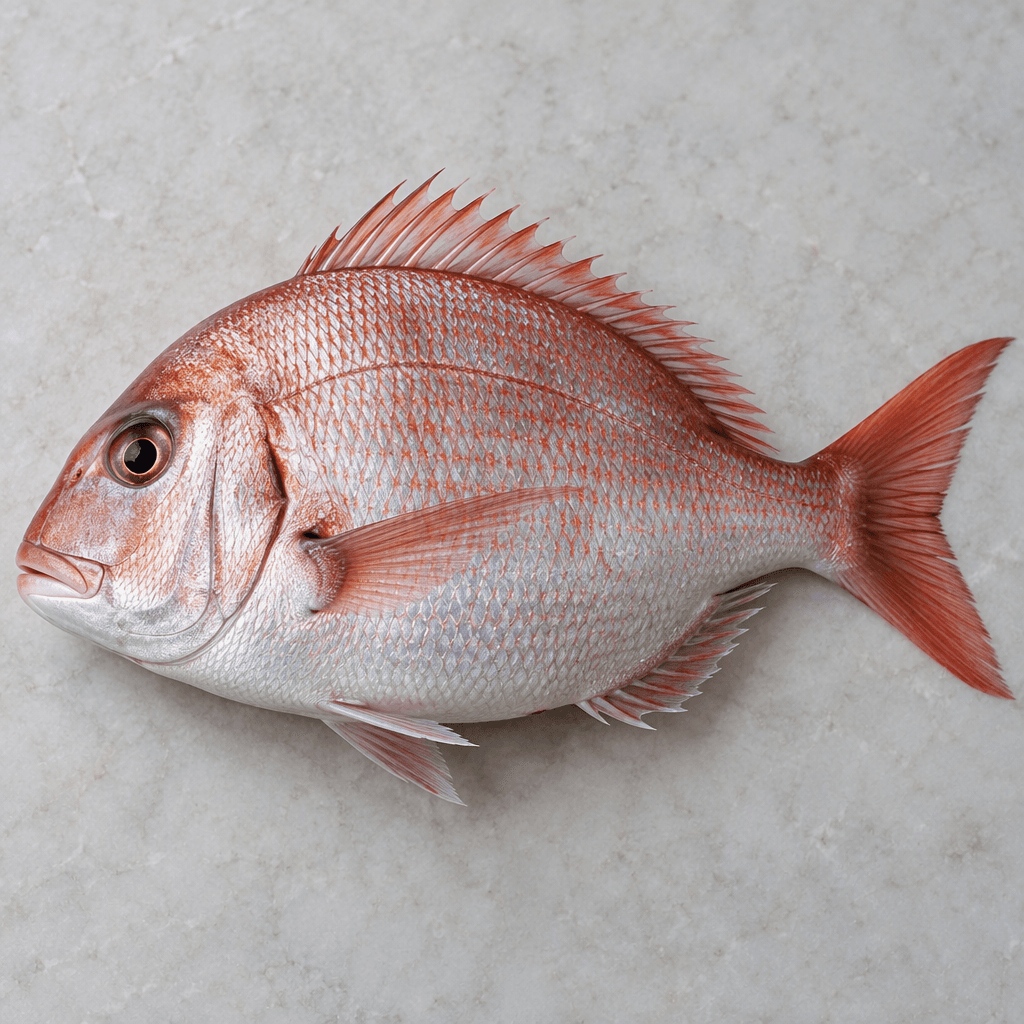
Red seabream Calories
High-quality protein, omega-3, low fat, source of selenium and B vitamins
In season: Spring · Summer · Autumn · Winter
CALORIES · 100 G
GI
POTASSIUM · 100 G
FIBER · 100 G
Quick answer
1 piece (medium) of Red seabream (150 g) has 146 calories. That works out to 97 calories per 100 g. It contains 0 g of carbs, 30.8 g of protein, 2.6 g of fat and 0 g of fiber. Its 3.6 µg of B12 covers 150% of the Daily Value. Its glycemic index is 0 (low), so it raises blood sugar slowly.
Red seabream Nutrition Facts
Selected: 1 piece (medium) · 150 g
146
KCAL / 150G
Carbs
0g
· 0% DV
Protein
30.8g
· 62% DV
Fat
2.6g
· 3% DV
Fiber
0g
· 0% DV
DV is the share of the daily value covered, on a 2,000 kcal reference diet.
Calories come from: Carbs 0% · Protein 84% · Fat 16%
Red seabream nutrition facts table · 1 piece (medium) (150 g)
| Nutrient | Amount | % DV |
|---|---|---|
| Calories | 146 kcal | |
| Total fat | 2.6 g | 3% |
| Saturated fat | 0.6 g | 3% |
| Trans fat | 0 g | |
| Sodium | 98 mg | 4% |
| Total carbohydrate | 0 g | 0% |
| Fiber | 0 g | 0% |
| Protein | 30.8 g | 62% |
Calories: Calories measure energy. Average daily need is 2,000 kcal. Excess calories are stored as fat, too few cause weight loss.
Carbs: Your body's primary energy source. The brain runs exclusively on carbs. Daily need: 275g.
Protein: Essential for muscle repair and cell growth. Daily need: 50g. Keeps you full and boosts metabolism.
Fat: Needed for hormone production and vitamin absorption. Daily need: 78g. Limit saturated fats, choose unsaturated.
Fiber: Critical for digestive health and satiety. Daily need: 28g. Stabilizes blood sugar, lowers cholesterol.

Log this food in EatBetter
100,000+ people use it
- Get your daily calorie target
- Snap your meal, log it in seconds
- See every vitamin and mineral

📸 Scan the code to get the app free.

How Many Calories in 1 Medium Red seabream?
| Serving | Amount | Calories |
|---|---|---|
| 1 piece (medium) | 150 g | 146 kcal |
| 1 slice (thin) | 50 g | 49 kcal |
| 1 slice (thick) | 80 g | 78 kcal |
| 100 g | 100 g | 97 kcal |
| 1 piece (small) | 100 g | 97 kcal |
| 1 serving (medium) | 120 g | 116 kcal |
| 1 serving (large) | 200 g | 194 kcal |
| 1 piece (large) | 250 g | 243 kcal |
| 1 piece (extra large) | 300 g | 291 kcal |
Calculated from 97 calories per 100 g.
Frequently Asked Questions About Red seabream
What is the best way to cook red seabream?
Red seabream works well grilled, pan-fried, or baked whole. Keep the cooking simple and avoid overcooking: the flesh should turn opaque and separate easily from the backbone while staying moist.
What does red seabream taste like?
Red seabream has a mild, slightly sweet flavor and firm, white flesh. Its taste is delicate rather than strongly fishy, so lemon, olive oil, and a light seasoning are usually enough.
Is red seabream the same as red snapper?
No, red seabream and red snapper are different fish, despite their similar names and reddish appearance. They can often be cooked in similar ways, but they are not interchangeable names for the same species.
Does red seabream have a lot of bones?
Red seabream has a central backbone and smaller bones along the flesh, so it is not completely boneless. Lift the fillets carefully from the backbone after cooking and check each portion for fine bones before serving.
Can you eat the skin of red seabream?
Yes, red seabream skin is edible once the scales have been removed and the fish is thoroughly cooked. Pan-frying can make the skin crisp; avoid eating it if scales remain.
How can you tell if red seabream is fresh?
Fresh red seabream should have clear, not cloudy eyes, moist-looking skin, and a clean, mild sea smell. Its flesh should spring back when pressed; a sour or ammonia-like odor is a reason to reject it.
Can you freeze red seabream?
Yes, red seabream can be frozen after it has been cleaned and dried. Wrap it tightly to limit air exposure, thaw it in the refrigerator, and do not refreeze it after it has thawed.
Can you eat red seabream raw?
Red seabream should not be eaten raw unless it has been handled and frozen specifically for raw consumption. Ordinary fresh fish is not automatically safe for sushi or sashimi, because freezing and careful handling help manage parasite and bacterial risks.
What should you serve with red seabream?
Serve red seabream with a crisp salad, roasted vegetables, or simply dressed greens. These sides complement its mild flavor without overwhelming it; lemon and olive oil also work well alongside the fish.
Can you cook red seabream from frozen?
Yes, you can cook red seabream from frozen, but it may cook less evenly than thawed fish. For the most even result, thaw it in the refrigerator first; if cooking it frozen, allow extra time and check that the center is fully cooked.
Red seabream Vitamins & Minerals
Vitamins
B12
3.6µg · 150% DV
B3
3.3mg · 21% DV
B6
0.27mg · 16% DV
Vitamin D
3.15µg · 16% DV
Minerals
Selenium
54µg · 98% DV
Phosphorus
315mg · 45% DV
Iodine
45µg · 30% DV
Potassium ⭐
510mg · 15% DV
Sodium
98mg · 4% DV
Red seabream Glycemic Index
GLYCEMIC INDEX
GLYCEMIC LOAD
Accounts for portion size — a more realistic measure than GI alone.
How to Burn Off Red seabream
To burn the 146 calories in 1 piece (medium) (150 g):
🚶
Walking (5 km/h)
🏃
Running (8 km/h)
🚴
Cycling
🏊
Swimming
Times are calculated with the MET equation for a 70 kg adult. Actual burn varies with your weight, age and pace.
What is Red seabream?
Red seabream is a white-fleshed fish found in Mediterranean waters and nearby parts of the Atlantic. Its flavour is mild and slightly sweet, and the cooked flesh is firm yet flakes apart easily. Around the Mediterranean it is often cooked whole, grilled or baked, and served with lemon, herbs and vegetables; it also works well pan-fried. For a lighter meal, roast or grill it with just a little oil and pair it with a crisp salad.
It is a lean source of protein: a 100 g portion provides 20.5 g of protein and 1.7 g of fat. Check carefully for bones when serving a whole fish.
How Nutritious Is Red seabream?
Nutrient density
High
How many vitamins, minerals and how much fiber this food carries per calorie. A high score means a lot of nutrition for few calories.
Satiety score
High
An EatBetter score computed from fiber, protein and calorie density. A high score means staying full longer on the same calories.
Both scores are calculated per 100 g and do not change with the selected portion. The satiety score is EatBetter's own calculation, not a clinical measure.
Is Red seabream Processed?
NOVA 1
Unprocessed
1. Unprocessed
2. Minimally Processed
3. Processed
4. Ultra-Processed
NOVA classifies foods into 4 groups by industrial processing. NOVA 1 (unprocessed) is the healthiest.
Does Red seabream Contain Allergens?
Contains these allergens:
Which Diets Is Red seabream Good For?
Vegan
— Not suitable
Vegetarian
— Not suitable
Gluten-Free
✓ Suitable
Dairy-Free
— Not suitable
Mediterranean
✓ Suitable
Paleo
✓ Suitable
Whole30
— Not suitable
DASH
— Not suitable
Keto
✓ Suitable
Low FODMAP
— Not suitable
Red seabream Fat Profile
SATURATED
0.6g
MONOUNSATURATED
0.75g
POLYUNSATURATED
0.9g
Omega 6:3 ratio 0.2:1
Below the ideal 4:1 — a good omega balance.
Compare Red seabream
Foods Similar to Red seabream
Have another question about Red seabream?
Ask the AI nutrition coach — calories, portions, alternatives and more, answered in seconds in the app.

Scan calories with your camera
Instant AI nutrition analysis

Nutrition data compiled from USDA FoodData Central and scientific sources.