

Ready & Packaged Foods
All →Vegetables & Legumes
All →Desserts & Confectionery
All →Meat & Protein
All →Grains & Bakery
All →Beverages
All →Milk & Dairy
All →

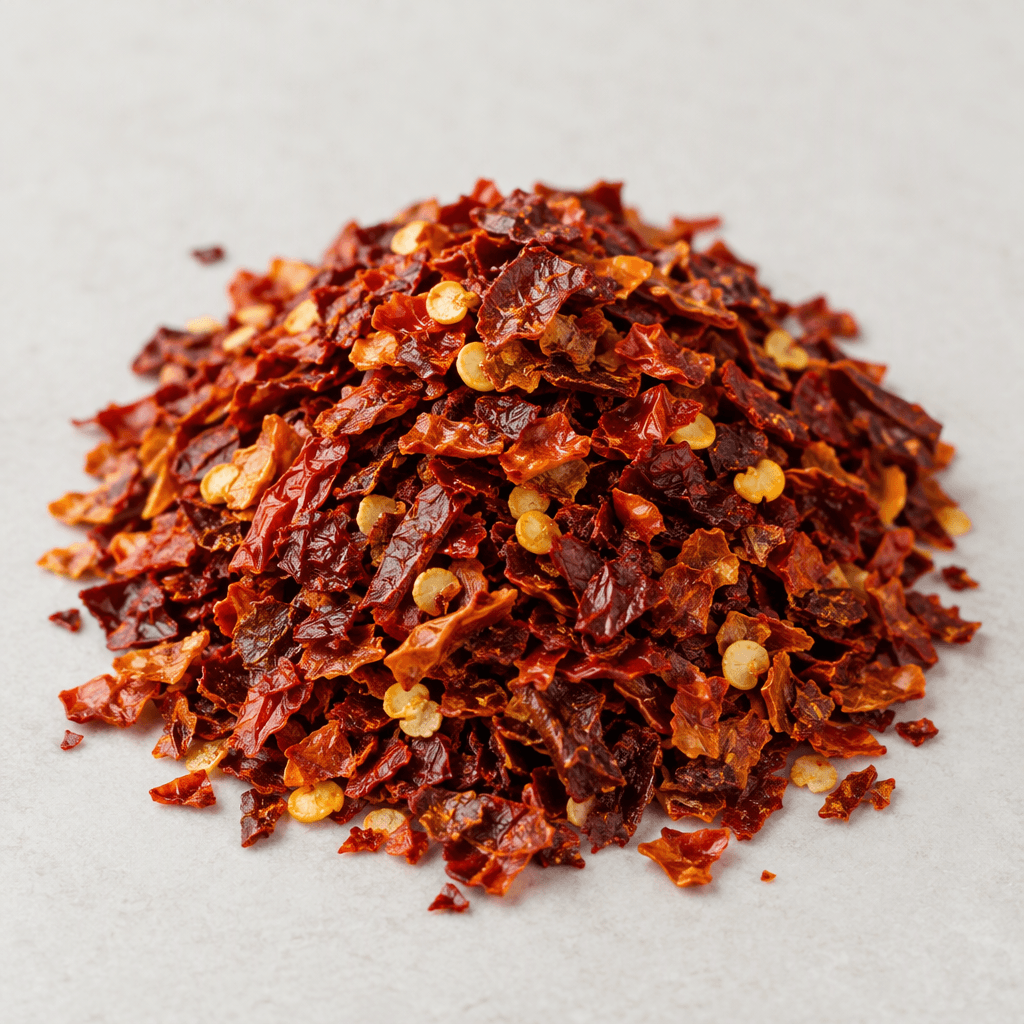
Red chili flakes Calories
Spicy, antioxidant source, rich in vitamin C
In season: Summer · Autumn
CALORIES
GI
POTASSIUM
FIBER
Quick answer
1 tablespoon (medium) of Red chili flakes (6 g) has 17 calories. That works out to 282 calories per 100 g. It contains 2.9 g of carbs, 0.7 g of protein, 0.8 g of fat and 2.1 g of fiber. Its 0.2 mg of B6 covers 9% of the Daily Value. Its glycemic index is 15 (low), so it raises blood sugar slowly.
What is Red chili flakes?
Red chili flakes are made by drying red peppers and crushing them into small, irregular pieces, often with some seeds. Their heat and flavour vary with the peppers used, from gently warm and fruity to sharply hot.
They are a familiar table seasoning in Turkey, sprinkled over dishes such as eggs, beans, soups and grilled meats; elsewhere, cooks often add them to pasta, pizza, sauces and marinades. The flakes add heat without much bulk, and a small pinch is usually enough. Stirring them briefly into warm oil can bring out their aroma, but avoid overheating them, which can make them taste bitter. They are fibre-rich by weight, though typically eaten in very small servings.
Red chili flakes Nutrition Facts
Selected: 100 g
282
KCAL / 100G
Carbs
49g
· 18% DV
Protein
12g
· 24% DV
Fat
14g
· 18% DV
Fiber
35g
· 125% DV
DV is the share of the daily value covered, on a 2,000 kcal reference diet.
Calories come from: Carbs 53% · Protein 13% · Fat 34%
Red chili flakes Vitamins & Minerals
Vitamins
B6
2.5mg · 147% DV
Biotin
30µg · 100% DV
B3
13.5mg · 84% DV
Vitamin C
76mg · 84% DV
Minerals
Manganese
2mg · 87% DV
Potassium ⭐
2010mg · 59% DV
Iron
8mg · 44% DV
Magnesium
152mg · 36% DV
How Nutritious Is Red chili flakes?
Nutrient density
High
How many vitamins, minerals and how much fiber this food carries per calorie. A high score means a lot of nutrition for few calories.
Satiety score
High
An EatBetter score computed from fiber, protein and calorie density. A high score means staying full longer on the same calories.
Both scores are calculated per 100 g and do not change with the selected portion. The satiety score is EatBetter's own calculation, not a clinical measure.
Red chili flakes Glycemic Index
GLYCEMIC INDEX
GLYCEMIC LOAD
Accounts for portion size — a more realistic measure than GI alone.
How to Burn Off Red chili flakes
To burn the 282 calories in 100 g:
🚶
Walking (5 km/h)
🏃
Running (8 km/h)
🚴
Cycling
🏊
Swimming
Times are calculated with the MET equation for a 70 kg adult. Actual burn varies with your weight, age and pace.
Is Red chili flakes Processed?
NOVA 2
Minimally Processed
1. Unprocessed
2. Minimally Processed
3. Processed
4. Ultra-Processed
NOVA classifies foods into 4 groups by industrial processing. NOVA 1 (unprocessed) is the healthiest.
Does Red chili flakes Contain Allergens?
No known major allergens
Which Diets Is Red chili flakes Good For?
Vegan
✓ Suitable
Vegetarian
✓ Suitable
Gluten-Free
✓ Suitable
Dairy-Free
— Not suitable
Mediterranean
✓ Suitable
Paleo
✓ Suitable
Whole30
— Not suitable
DASH
— Not suitable
Keto
✓ Suitable
Low FODMAP
— Not suitable
Red chili flakes Fat Profile
SATURATED
2.5g
MONOUNSATURATED
1.6g
POLYUNSATURATED
2.5g
Omega 6:3 ratio 28.7:1
Above the ideal 4:1 (28.7:1).
Compare Red chili flakes
Foods Similar to Red chili flakes
Frequently Asked Questions About Red chili flakes
What are red chili flakes made from?
Red chili flakes are made from dried red chili peppers that have been crushed into small pieces; some blends include the seeds. The pepper variety and processing determine how hot and flavorful a particular jar will be.
How hot are red chili flakes?
Red chili flakes can range from mildly warm to quite hot, depending on the chilies used and the batch. Taste a small pinch before seasoning a whole dish, then add more gradually rather than relying on the color.
What can I use instead of red chili flakes?
Cayenne pepper can replace red chili flakes when you want heat, but it is finer and often more concentrated, so start with less. Fresh chopped chili also works, though it adds moisture and texture that flakes do not.
When should I add red chili flakes while cooking?
Add red chili flakes near the end of cooking to keep their flavor bright, or briefly bloom them in oil to infuse the oil. Use gentle heat for the latter; high heat can scorch the flakes and make them bitter.
How should I store red chili flakes?
Store red chili flakes in a tightly sealed container in a cool, dry cupboard away from sunlight and the stove. Moisture can cause clumping or spoilage, while heat and light gradually dull the aroma and color.
Can I make red chili flakes at home?
Yes, you can make red chili flakes by thoroughly drying red chilies and crushing them into small pieces. Remove the stems first, and avoid touching your eyes or face while handling hot peppers or their seeds.
Are red chili flakes the same as cayenne pepper?
No, red chili flakes are coarse pieces of dried chili, while cayenne pepper is a finely ground powder, usually made from cayenne peppers. Their heat can differ, and flakes also add visible pieces and texture to food.
Do the seeds in red chili flakes make them hotter?
The seeds can contribute some heat, but much of a chili pepper’s pungency comes from capsaicin concentrated in the pale inner membranes. Removing visible seeds may change the texture, but it will not necessarily make the flakes mild.
Are red chili flakes good for you?
Red chili flakes can add strong flavor without needing much, and chili peppers contain antioxidant compounds. They are a seasoning rather than a meaningful source of nutrition in typical portions, so use them for taste rather than health effects.
Can eating too many red chili flakes cause side effects?
Yes, large amounts of red chili flakes can cause mouth irritation, stomach discomfort, or worsen heartburn in sensitive people. Start with a small amount, especially if you are not used to spicy food.
Have another question about Red chili flakes?
Ask the AI nutrition coach — calories, portions, alternatives and more, answered in seconds in the app.

Scan calories with your camera
Instant AI nutrition analysis

Nutrition data compiled from USDA FoodData Central and scientific sources.