

Ready & Packaged Foods
All →Vegetables & Legumes
All →Desserts & Confectionery
All →Meat & Protein
All →Grains & Bakery
All →Beverages
All →Milk & Dairy
All →

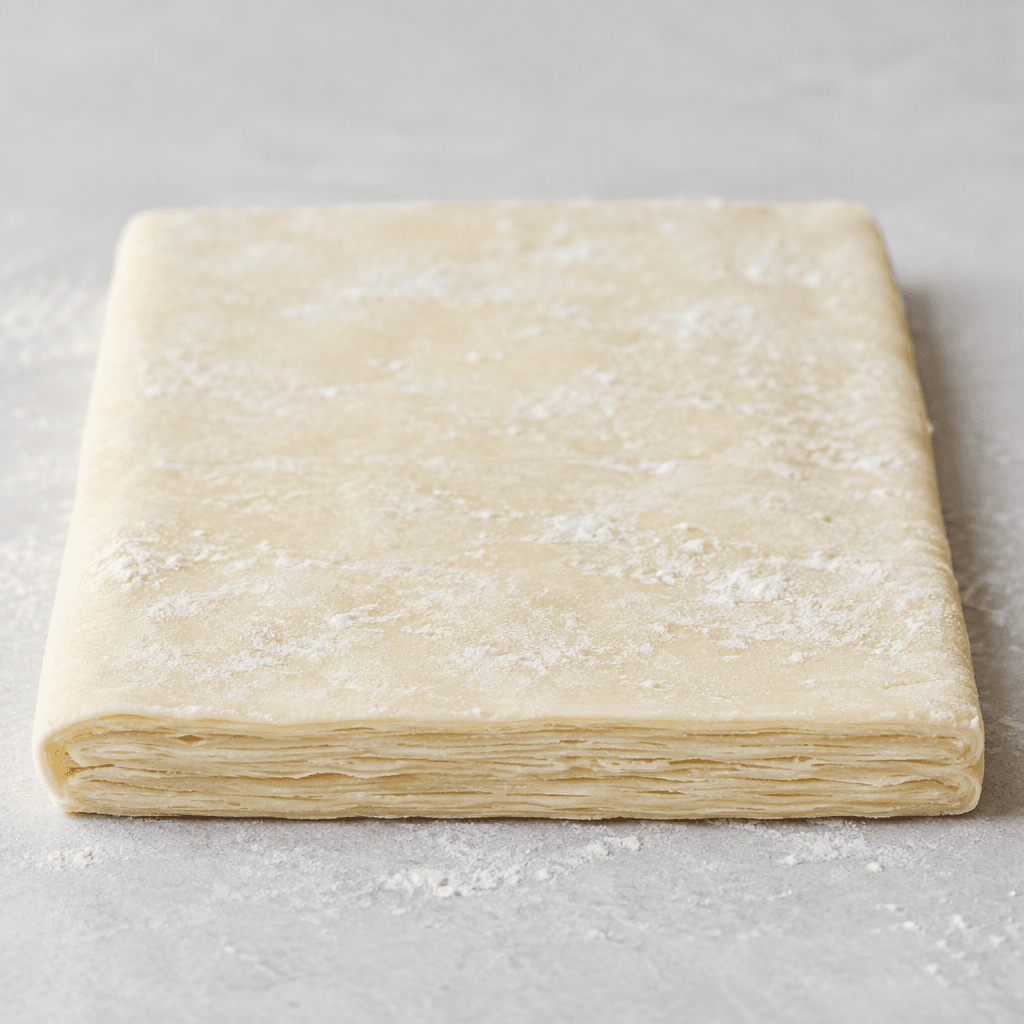
Raw puff pastry Calories
High-fat laminated dough; energy-dense
CALORIES · 100 G
GI
POTASSIUM · 100 G
FIBER · 100 G
Quick answer
1 piece (medium) of Raw puff pastry (50 g) has 279 calories. That works out to 558 calories per 100 g. It contains 19 g of carbs, 3 g of protein, 19 g of fat and 1 g of fiber. Its 9 µg of Selenium covers 16% of the Daily Value. Its glycemic index is 55 (medium), so it raises blood sugar at a moderate pace.
Raw puff pastry Nutrition Facts
Selected: 1 piece (medium) · 50 g
279
KCAL / 50G
Carbs
19g
· 7% DV
Protein
3g
· 6% DV
Fat
19g
· 24% DV
Fiber
1g
· 4% DV
DV is the share of the daily value covered, on a 2,000 kcal reference diet.
Calories come from: Carbs 29% · Protein 5% · Fat 66%
Raw puff pastry nutrition facts table · 1 piece (medium) (50 g)
| Nutrient | Amount | % DV |
|---|---|---|
| Calories | 279 kcal | |
| Total fat | 19 g | 24% |
| Saturated fat | 8.75 g | 44% |
| Trans fat | 0.3 g | |
| Sodium | 190 mg | 8% |
| Total carbohydrate | 19 g | 7% |
| Fiber | 1 g | 4% |
| Protein | 3 g | 6% |
Calories: Calories measure energy. Average daily need is 2,000 kcal. Excess calories are stored as fat, too few cause weight loss.
Carbs: Your body's primary energy source. The brain runs exclusively on carbs. Daily need: 275g.
Protein: Essential for muscle repair and cell growth. Daily need: 50g. Keeps you full and boosts metabolism.
Fat: Needed for hormone production and vitamin absorption. Daily need: 78g. Limit saturated fats, choose unsaturated.
Fiber: Critical for digestive health and satiety. Daily need: 28g. Stabilizes blood sugar, lowers cholesterol.

Log this food in EatBetter
100,000+ people use it
- Get your daily calorie target
- Snap your meal, log it in seconds
- See every vitamin and mineral

📸 Scan the code to get the app free.

How Many Calories in 1 Medium Raw puff pastry?
| Serving | Amount | Calories |
|---|---|---|
| 1 piece (medium) | 50 g | 279 kcal |
| 1 piece (small) | 25 g | 140 kcal |
| 1 slice (thin) | 30 g | 167 kcal |
| 1 slice (thick) | 45 g | 251 kcal |
| 1 piece (large) | 80 g | 446 kcal |
| 100 g | 100 g | 558 kcal |
| 1 serving (double) | 100 g | 558 kcal |
| ½ pack (half) | 125 g | 698 kcal |
| 1 pack (whole) | 250 g | 1395 kcal |
Calculated from 558 calories per 100 g.
Frequently Asked Questions About Raw puff pastry
How do you thaw raw puff pastry?
Thaw raw puff pastry in the refrigerator until the sheets are flexible enough to separate without tearing. Keep it covered so it does not dry out, and avoid leaving it warm for long: softened fat can make the layers stick and reduce the pastry’s rise.
Why doesn’t raw puff pastry rise when baked?
Raw puff pastry often fails to rise when its layers are sealed together or its fat has become too warm. Handle it while cool, cut with a sharp knife without pressing the edges, and bake in a fully preheated oven without opening the door repeatedly.
What temperature should raw puff pastry be baked at?
Raw puff pastry is commonly baked in a hot oven, around 200°C (400°F). The exact setting and baking time vary with the recipe, pastry thickness, and oven, so follow the package directions and bake until the layers are puffed and golden.
Can you bake raw puff pastry from frozen?
Usually, raw puff pastry should be thawed until pliable before baking, so it can be shaped without cracking. Some products can be baked from frozen, but the results and timing vary; follow the package instructions rather than forcing or bending a frozen sheet.
Is it safe to eat raw puff pastry?
No, raw puff pastry should not be eaten. Uncooked flour can carry harmful bacteria, so bake the pastry fully before eating it. Tasting even a small piece of raw dough is not a safe way to check its flavor.
Can raw puff pastry be refrozen after thawing?
Raw puff pastry thawed in the refrigerator can generally be refrozen, but its texture and ability to puff may suffer. Do not refreeze pastry that has been left at room temperature for a long time; use thawed pastry promptly for the best results.
How long does thawed raw puff pastry last in the fridge?
Keep thawed raw puff pastry covered in the refrigerator and use it within a day or two. The exact limit depends on the product, so follow its package directions, especially if it has already been opened or was thawed before you bought it.
Should you brush raw puff pastry with egg?
Yes, brushing raw puff pastry with beaten egg gives its baked surface a glossy, golden finish. Apply a thin layer just before baking, and keep the egg wash off the cut edges so it does not glue the pastry layers together.
What is the difference between raw puff pastry and phyllo dough?
Raw puff pastry is laminated with fat between its dough layers, which expand in the oven to create a tall, flaky texture. Phyllo is made of very thin sheets that are usually layered with butter or oil, producing a more delicate, crisp result.
How do you stop raw puff pastry from getting soggy underneath?
To keep raw puff pastry from getting soggy underneath, drain wet fillings well and bake it on a preheated tray in a fully heated oven. Avoid adding a hot, watery filling to the pastry, and bake until the underside is cooked and lightly browned.
Raw puff pastry Vitamins & Minerals
Vitamins
B1
0.17mg · 14% DV
B3
1.6mg · 10% DV
Vitamin K
12µg · 10% DV
Folate
34µg · 9% DV
Minerals
Selenium
9µg · 16% DV
Sodium
190mg · 8% DV
Manganese
0.17mg · 7% DV
Iron
1.15mg · 6% DV
Potassium ⭐
46mg · 1% DV
Raw puff pastry Glycemic Index
GLYCEMIC INDEX
GLYCEMIC LOAD
Accounts for portion size — a more realistic measure than GI alone.
How to Burn Off Raw puff pastry
To burn the 279 calories in 1 piece (medium) (50 g):
🚶
Walking (5 km/h)
🏃
Running (8 km/h)
🚴
Cycling
🏊
Swimming
Times are calculated with the MET equation for a 70 kg adult. Actual burn varies with your weight, age and pace.
What is Raw puff pastry?
Raw puff pastry is a flour-and-water dough folded around layers of fat, then rolled and folded repeatedly. The technique is associated with French baking, while the pastry is now sold chilled or frozen around the world. Once baked, its layers separate into a crisp exterior and tender interior, making it a base for both savoury and sweet dishes.
Use it for turnovers, tarts, pies or bite-sized party pastries; fillings and toppings vary by region. It has a mild flavour, but is rich in fat and energy, so a modest portion can be satisfying. For a lighter bake, pair it with vegetables or fruit and keep rich fillings and toppings simple.
How Nutritious Is Raw puff pastry?
Nutrient density
Low
How many vitamins, minerals and how much fiber this food carries per calorie. A high score means a lot of nutrition for few calories.
Satiety score
Low
An EatBetter score computed from fiber, protein and calorie density. A high score means staying full longer on the same calories.
Both scores are calculated per 100 g and do not change with the selected portion. The satiety score is EatBetter's own calculation, not a clinical measure.
Is Raw puff pastry Processed?
NOVA 3
Processed
1. Unprocessed
2. Minimally Processed
3. Processed
4. Ultra-Processed
NOVA classifies foods into 4 groups by industrial processing. NOVA 1 (unprocessed) is the healthiest.
Does Raw puff pastry Contain Allergens?
Contains these allergens:
Which Diets Is Raw puff pastry Good For?
Vegan
— Not suitable
Vegetarian
✓ Suitable
Gluten-Free
— Not suitable
Dairy-Free
— Not suitable
Mediterranean
— Not suitable
Paleo
— Not suitable
Whole30
— Not suitable
DASH
— Not suitable
Keto
— Not suitable
Low FODMAP
— Not suitable
Raw puff pastry Fat Profile
SATURATED
8.75g
MONOUNSATURATED
6.2g
POLYUNSATURATED
1.8g
Omega 6:3 ratio 17.8:1
Above the ideal 4:1 (17.8:1).
Compare Raw puff pastry
Foods Similar to Raw puff pastry
Have another question about Raw puff pastry?
Ask the AI nutrition coach — calories, portions, alternatives and more, answered in seconds in the app.

Scan calories with your camera
Instant AI nutrition analysis

Nutrition data compiled from USDA FoodData Central and scientific sources.