

Ready & Packaged Foods
All →Vegetables & Legumes
All →Desserts & Confectionery
All →Meat & Protein
All →Grains & Bakery
All →Beverages
All →Milk & Dairy
All →

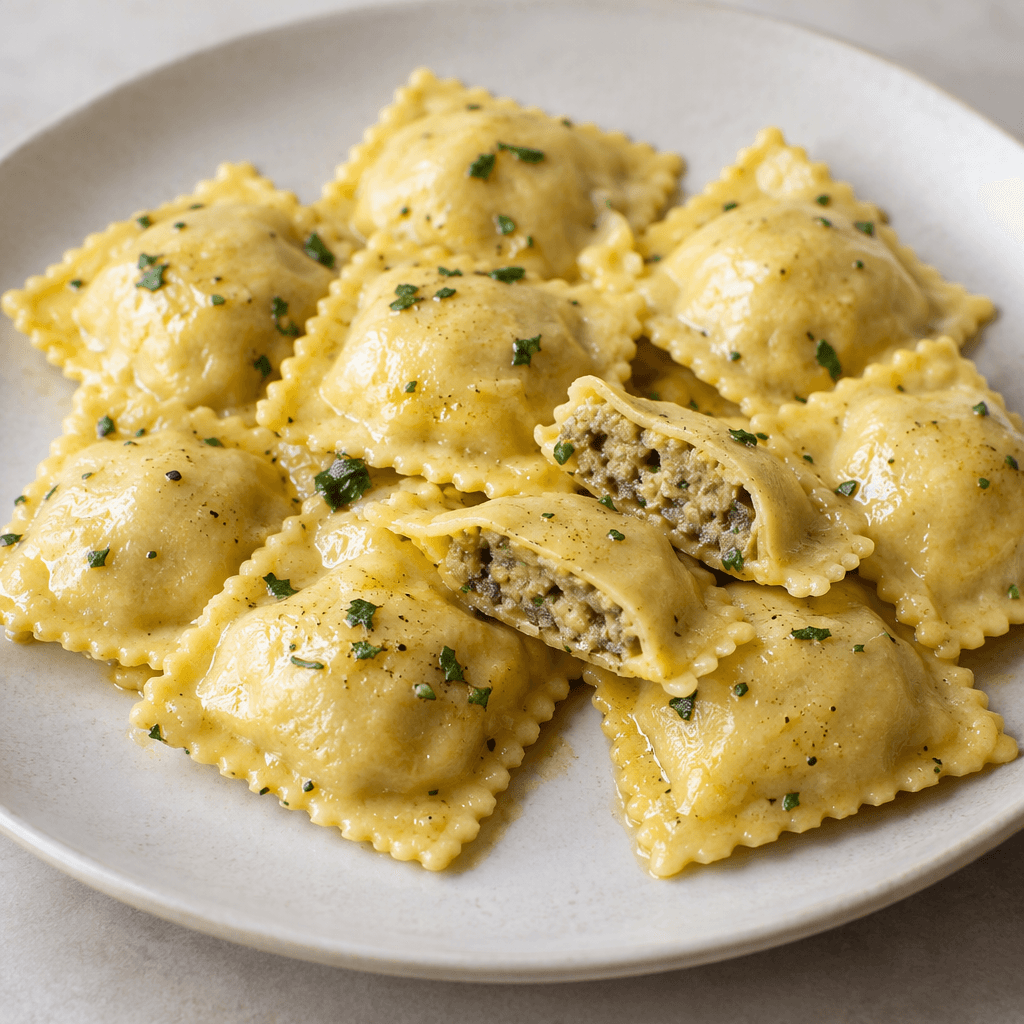
Ravioli Calories
Stuffed pasta, typically filled with cheese or meat
In season: Autumn · Winter
CALORIES
GI
POTASSIUM
FIBER
Quick answer
8 piece (medium) of Ravioli (120 g) has 192 calories. That works out to 160 calories per 100 g. It contains 32.4 g of carbs, 6.6 g of protein, 4.2 g of fat and 2.5 g of fiber. Its 11.4 µg of Selenium covers 21% of the Daily Value. Its glycemic index is 45 (medium), so it raises blood sugar at a moderate pace.
What is Ravioli?
Ravioli are Italian filled pasta parcels, usually made by sealing a savoury filling—often cheese, meat or vegetables—between thin sheets of pasta. Their small, neat shapes make them easy to portion, and the filling varies by region, season and household.
They are typically boiled and served with a sauce: tomato, butter and herbs, or a simple drizzle of olive oil are all common choices. The pasta is tender, while the centre may be creamy or more substantial depending on its filling. Ravioli are mainly a carbohydrate-based meal with some protein; a 100 g portion provides 160 calories. For a lighter plate, use a modest amount of sauce and serve with vegetables or a green salad.
Ravioli Nutrition Facts
Selected: 100 g
160
KCAL / 100G
Carbs
27g
· 10% DV
Protein
5.5g
· 11% DV
Fat
3.5g
· 4% DV
Fiber
2.1g
· 8% DV
DV is the share of the daily value covered, on a 2,000 kcal reference diet.
Calories come from: Carbs 67% · Protein 14% · Fat 19%
Ravioli Vitamins & Minerals
Vitamins
B1
0.13mg · 11% DV
B12
0.22µg · 9% DV
B2
0.09mg · 7% DV
B3
1.1mg · 7% DV
Minerals
Selenium
9.5µg · 17% DV
Zinc
1mg · 9% DV
Sodium
210mg · 9% DV
Phosphorus
65mg · 9% DV
How Nutritious Is Ravioli?
Nutrient density
Low
How many vitamins, minerals and how much fiber this food carries per calorie. A high score means a lot of nutrition for few calories.
Satiety score
Medium
An EatBetter score computed from fiber, protein and calorie density. A high score means staying full longer on the same calories.
Both scores are calculated per 100 g and do not change with the selected portion. The satiety score is EatBetter's own calculation, not a clinical measure.
Ravioli Glycemic Index
GLYCEMIC INDEX
GLYCEMIC LOAD
Accounts for portion size — a more realistic measure than GI alone.
How to Burn Off Ravioli
To burn the 160 calories in 100 g:
🚶
Walking (5 km/h)
🏃
Running (8 km/h)
🚴
Cycling
🏊
Swimming
Times are calculated with the MET equation for a 70 kg adult. Actual burn varies with your weight, age and pace.
Is Ravioli Processed?
NOVA 3
Processed
1. Unprocessed
2. Minimally Processed
3. Processed
4. Ultra-Processed
NOVA classifies foods into 4 groups by industrial processing. NOVA 1 (unprocessed) is the healthiest.
Does Ravioli Contain Allergens?
Contains these allergens:
Which Diets Is Ravioli Good For?
Vegan
— Not suitable
Vegetarian
✓ Suitable
Gluten-Free
— Not suitable
Dairy-Free
— Not suitable
Mediterranean
— Not suitable
Paleo
— Not suitable
Whole30
— Not suitable
DASH
— Not suitable
Keto
— Not suitable
Low FODMAP
— Not suitable
Ravioli Fat Profile
SATURATED
1.1g
MONOUNSATURATED
1.2g
POLYUNSATURATED
0.25g
Omega 6:3 ratio 6:1
Above the ideal 4:1 (6:1).
Compare Ravioli
Foods Similar to Ravioli
Frequently Asked Questions About Ravioli
What is ravioli made of?
Ravioli is made from pasta dough wrapped around a filling, commonly cheese, meat, or vegetables. The two pasta layers are sealed around the filling and cut into individual parcels; the exact ingredients vary by regional style and recipe.
How do you cook ravioli without it falling apart?
Cook ravioli gently in a large pot of boiling water and avoid vigorous stirring. Fresh ravioli is delicate, so lift it out with a slotted spoon once cooked rather than pouring it roughly into a colander.
Can you cook ravioli straight from frozen?
Yes, frozen ravioli can usually go directly into boiling water without thawing. Thawing can make the pasta sticky or fragile; follow the package directions because cooking time and method vary between products.
What sauce goes best with ravioli?
The best sauce depends on the filling: tomato sauce suits meat or cheese ravioli, while browned butter and sage complement many cheese-filled versions. A simple sauce lets the filling remain the main flavor instead of overwhelming it.
What is the difference between ravioli and tortellini?
Ravioli are usually flat, square or round pasta pockets, while tortellini are smaller rings formed by folding pasta around a filling. Both are filled pasta, but their shapes and customary ways of serving them differ.
Where did ravioli originate?
Ravioli originated in Italy, though its precise early history is difficult to pin to one place or date. Italian regions developed different fillings and serving styles, and ravioli is now made in many forms around the world.
How do you stop homemade ravioli from leaking?
Keep the edges free of filling, press out trapped air, and seal the pasta firmly before cutting. Too much filling or a weak seam lets water enter during cooking, so use a modest mound and check each edge.
Can ravioli be baked instead of boiled?
Yes, ravioli can be baked in a sauce, often layered in a casserole with cheese. Use enough sauce to keep the pasta moist and follow a recipe suited to the type of ravioli, since dried, fresh, and frozen versions behave differently.
How long does cooked ravioli last in the refrigerator?
Cooked ravioli keeps for about three to four days in the refrigerator when promptly chilled in a covered container. Store it with a little sauce to limit drying, and reheat until steaming hot throughout.
Can ravioli be served in soup?
Yes, ravioli can be served in broth as a pasta soup. Add it near the end of cooking so it does not turn overly soft, and choose a broth that complements the filling rather than masking it.
Have another question about Ravioli?
Ask the AI nutrition coach — calories, portions, alternatives and more, answered in seconds in the app.

Scan calories with your camera
Instant AI nutrition analysis

Nutrition data compiled from USDA FoodData Central and scientific sources.