

Ready & Packaged Foods
All →Vegetables & Legumes
All →Desserts & Confectionery
All →Meat & Protein
All →Grains & Bakery
All →Beverages
All →Milk & Dairy
All →

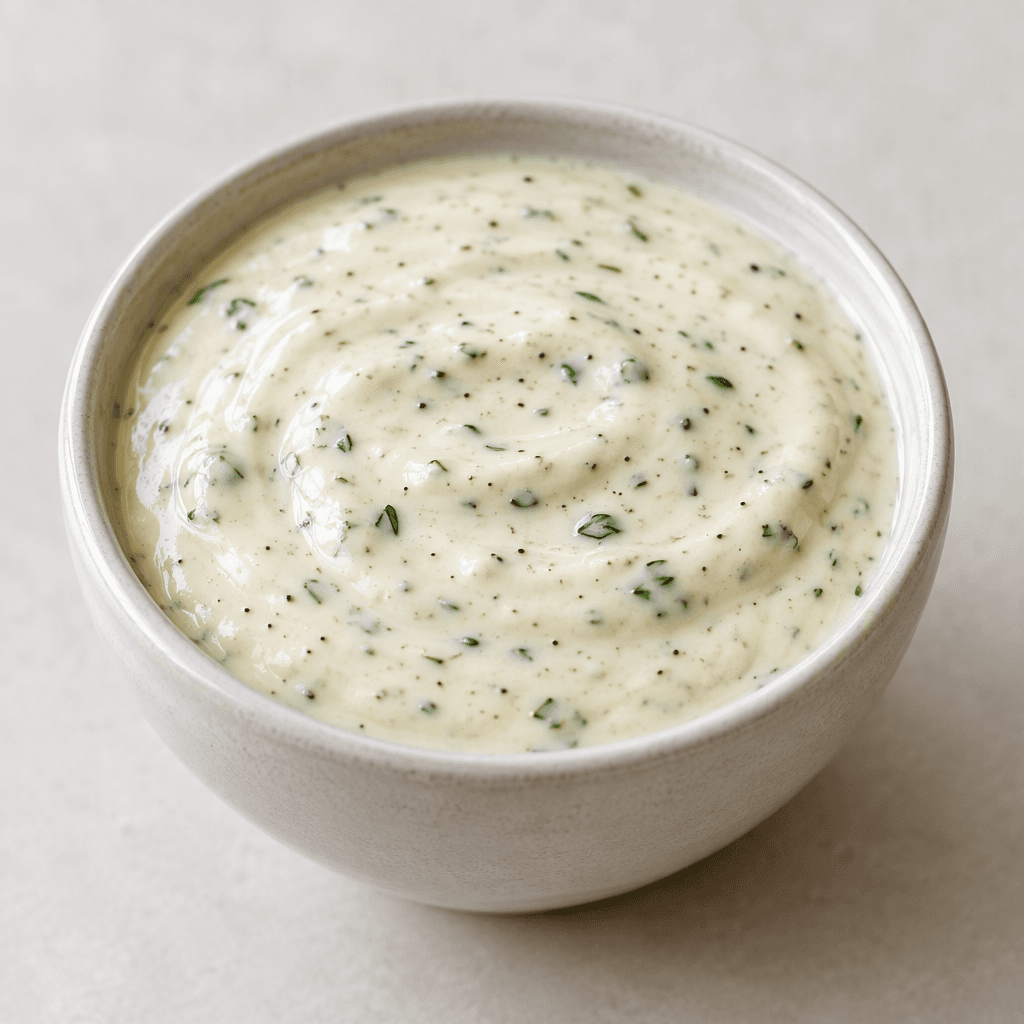
Ranch Sauce Calories
Creamy, herbed, popular American sauce
In season: Spring · Summer · Autumn · Winter
CALORIES
GI
POTASSIUM
FIBER
Quick answer
2 tablespoon (medium) of Ranch Sauce (30 g) has 144 calories. That works out to 480 calories per 100 g. It contains 1.9 g of carbs, 0.4 g of protein, 14.7 g of fat and 0.1 g of fiber. Its 285 mg of Sodium covers 12% of the Daily Value. Its glycemic index is 35 (low), so it raises blood sugar slowly.
What is Ranch Sauce?
Ranch Sauce is a creamy American dressing, commonly made with a mayonnaise and buttermilk or sour-cream base, then seasoned with herbs, garlic and onion. Its tangy, savoury flavour and thick texture make it a familiar dip for raw vegetables, wings, fries and other snacks, as well as a dressing for salads. In the United States it is also served with pizza and sandwiches; elsewhere, it works much the same way as a dip or drizzle.
It is energy-dense and high in fat, with very little protein; 100 g contains 49 g of fat. For a lighter dip, mix some with plain yoghurt, or use a smaller amount to add flavour to a salad or wrap.
Ranch Sauce Nutrition Facts
Selected: 100 g
480
KCAL / 100G
Carbs
6.2g
· 2% DV
Protein
1.3g
· 3% DV
Fat
49g
· 63% DV
Fiber
0.2g
· 1% DV
DV is the share of the daily value covered, on a 2,000 kcal reference diet.
Calories come from: Carbs 5% · Protein 1% · Fat 94%

Log this food in EatBetter
100,000+ people use it
- Get your daily calorie target
- Snap your meal, log it in seconds
- See every vitamin and mineral

📸 Scan the code to get the app free.

Ranch Sauce Vitamins & Minerals
Vitamins
Vitamin E
2.1mg · 14% DV
Vitamin A
120µg · 13% DV
B12
0.18µg · 8% DV
Vitamin K
9µg · 8% DV
Minerals
Sodium
950mg · 41% DV
Phosphorus
42mg · 6% DV
Calcium
38mg · 4% DV
Selenium
2µg · 4% DV
Potassium ⭐
60mg · 2% DV
How Nutritious Is Ranch Sauce?
Nutrient density
Low
How many vitamins, minerals and how much fiber this food carries per calorie. A high score means a lot of nutrition for few calories.
Satiety score
Low
An EatBetter score computed from fiber, protein and calorie density. A high score means staying full longer on the same calories.
Both scores are calculated per 100 g and do not change with the selected portion. The satiety score is EatBetter's own calculation, not a clinical measure.
Ranch Sauce Glycemic Index
GLYCEMIC INDEX
GLYCEMIC LOAD
Accounts for portion size — a more realistic measure than GI alone.
How to Burn Off Ranch Sauce
To burn the 480 calories in 100 g:
🚶
Walking (5 km/h)
🏃
Running (8 km/h)
🚴
Cycling
🏊
Swimming
Times are calculated with the MET equation for a 70 kg adult. Actual burn varies with your weight, age and pace.
Is Ranch Sauce Processed?
NOVA 3
Processed
1. Unprocessed
2. Minimally Processed
3. Processed
4. Ultra-Processed
NOVA classifies foods into 4 groups by industrial processing. NOVA 1 (unprocessed) is the healthiest.
Does Ranch Sauce Contain Allergens?
Contains these allergens:
Which Diets Is Ranch Sauce Good For?
Vegan
— Not suitable
Vegetarian
— Not suitable
Gluten-Free
— Not suitable
Dairy-Free
— Not suitable
Mediterranean
✓ Suitable
Paleo
— Not suitable
Whole30
— Not suitable
DASH
— Not suitable
Keto
— Not suitable
Low FODMAP
— Not suitable
Ranch Sauce Fat Profile
SATURATED
7.5g
MONOUNSATURATED
17g
POLYUNSATURATED
9g
Omega 6:3 ratio 68.3:1
Above the ideal 4:1 (68.3:1).
Compare Ranch Sauce
Foods Similar to Ranch Sauce
Frequently Asked Questions About Ranch Sauce
What is ranch sauce made of?
Ranch sauce is usually made with a creamy base such as mayonnaise, sour cream, or buttermilk, mixed with herbs, garlic, and onion. Dill and chives are common; recipes and store-bought versions vary.
What does ranch sauce taste like?
Ranch sauce tastes creamy, tangy, and savory, with a noticeable blend of herbs, garlic, and onion. It is usually mild rather than hot, though the seasoning and tanginess can differ between brands and recipes.
What do you eat ranch sauce with?
Ranch sauce is commonly served with chicken wings, fries, and raw vegetables as a dip. It also works as a sandwich or burger spread, or as a salad dressing when thinned to a pourable consistency.
How do you make ranch sauce at home?
To make ranch sauce at home, stir a creamy base such as mayonnaise and sour cream or yogurt with garlic, onion, dill, and chives. Add a little buttermilk or milk to thin it, then chill before serving.
Is ranch sauce the same as ranch dressing?
They usually refer to the same ranch-style flavor, but ranch sauce is often thicker for dipping while ranch dressing is thinner for pouring over salads. Recipes and product names commonly use the terms interchangeably.
How long does homemade ranch sauce last in the fridge?
Homemade ranch sauce usually keeps for about 3–4 days in a covered container in the refrigerator. Because it commonly contains dairy or mayonnaise, discard it if it has been left out for an extended time or its smell or appearance changes.
Can you freeze ranch sauce?
You can freeze ranch sauce, but it may separate and become grainy when thawed because of its creamy dairy or mayonnaise base. Stirring can help, but freezing is generally a poor choice if you want to preserve its original smooth texture.
Can ranch sauce be heated?
Ranch sauce can be heated, but high heat may cause its creamy base to separate. For a smoother result, add it after cooking or warm it gently over low heat while stirring rather than boiling it.
What is the difference between ranch sauce and blue cheese dressing?
Ranch sauce gets its flavor mainly from herbs, garlic, and onion, while blue cheese dressing has a distinct tangy, salty taste from blue cheese. Both are creamy dips often served with chicken wings and vegetables.
Is ranch sauce healthy?
Ranch sauce can add flavor, but creamy versions are often rich and easy to use generously as a dip or dressing. A smaller portion or a homemade yogurt-based version can make it a lighter addition to a meal.
Have another question about Ranch Sauce?
Ask the AI nutrition coach — calories, portions, alternatives and more, answered in seconds in the app.

Scan calories with your camera
Instant AI nutrition analysis

Nutrition data compiled from USDA FoodData Central and scientific sources.