

Ready & Packaged Foods
All →Vegetables & Legumes
All →Desserts & Confectionery
All →Meat & Protein
All →Grains & Bakery
All →Beverages
All →Milk & Dairy
All →

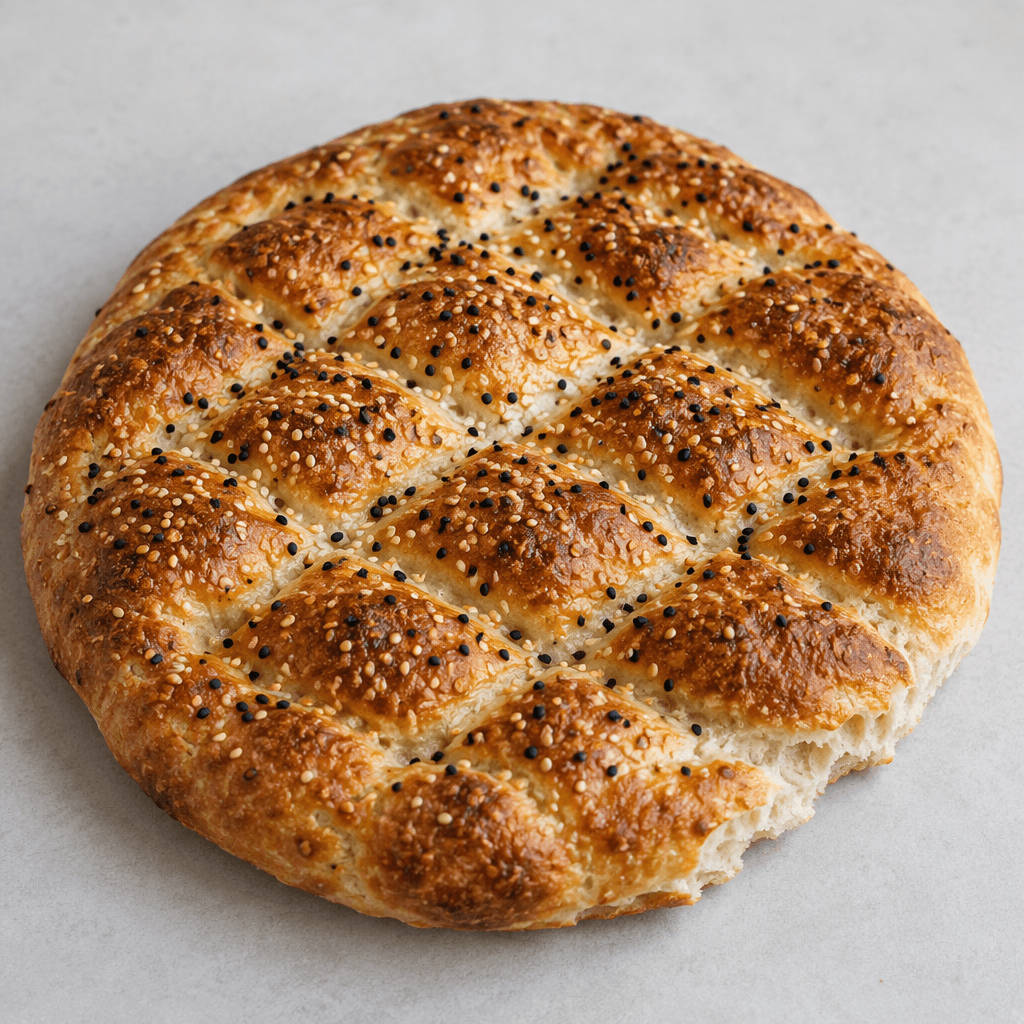
Ramadan Pide Calories
Traditional Turkish Ramadan pide, soft and slightly fluffy bread.
In season: Spring
CALORIES
GI
POTASSIUM
FIBER
Quick answer
1 piece (medium) of Ramadan Pide (120 g) has 312 calories. That works out to 260 calories per 100 g. It contains 60 g of carbs, 10.2 g of protein, 3 g of fat and 2.6 g of fiber. Its 504 mg of Sodium covers 22% of the Daily Value. Its glycemic index is 70 (high), so it raises blood sugar quickly.
What is Ramadan Pide?
Ramadan Pide is a soft, leavened Turkish bread traditionally baked fresh during Ramadan. Its round or oval loaf is dimpled into a diamond pattern and often topped with sesame or nigella seeds, with a lightly browned crust and fluffy crumb.
In Turkey, it is especially associated with the iftar table, where it is torn and shared alongside soup, cheese, olives and other dishes; it can also be eaten at sahur. Outside Ramadan, it makes a versatile table bread. Its nutritional profile is mainly carbohydrate-led, with 50 g of carbohydrate per 100 g. Pair it with eggs, yogurt, beans or another protein-rich food to make a more substantial meal.
Ramadan Pide Nutrition Facts
Selected: 100 g
260
KCAL / 100G
Carbs
50g
· 18% DV
Protein
8.5g
· 17% DV
Fat
2.5g
· 3% DV
Fiber
2.2g
· 8% DV
DV is the share of the daily value covered, on a 2,000 kcal reference diet.
Calories come from: Carbs 78% · Protein 13% · Fat 9%
Ramadan Pide Vitamins & Minerals
Vitamins
B3
2.1mg · 13% DV
B1
0.13mg · 11% DV
B5
0.3mg · 6% DV
Folate
25µg · 6% DV
Minerals
Sodium
420mg · 18% DV
Selenium
9µg · 16% DV
Iron
2mg · 11% DV
Phosphorus
70mg · 10% DV
How Nutritious Is Ramadan Pide?
Nutrient density
Medium
How many vitamins, minerals and how much fiber this food carries per calorie. A high score means a lot of nutrition for few calories.
Satiety score
Medium
An EatBetter score computed from fiber, protein and calorie density. A high score means staying full longer on the same calories.
Both scores are calculated per 100 g and do not change with the selected portion. The satiety score is EatBetter's own calculation, not a clinical measure.
Ramadan Pide Glycemic Index
GLYCEMIC INDEX
GLYCEMIC LOAD
Accounts for portion size — a more realistic measure than GI alone.
How to Burn Off Ramadan Pide
To burn the 260 calories in 100 g:
🚶
Walking (5 km/h)
🏃
Running (8 km/h)
🚴
Cycling
🏊
Swimming
Times are calculated with the MET equation for a 70 kg adult. Actual burn varies with your weight, age and pace.
Is Ramadan Pide Processed?
NOVA 3
Processed
1. Unprocessed
2. Minimally Processed
3. Processed
4. Ultra-Processed
NOVA classifies foods into 4 groups by industrial processing. NOVA 1 (unprocessed) is the healthiest.
Does Ramadan Pide Contain Allergens?
Contains these allergens:
Which Diets Is Ramadan Pide Good For?
Vegan
— Not suitable
Vegetarian
✓ Suitable
Gluten-Free
— Not suitable
Dairy-Free
— Not suitable
Mediterranean
✓ Suitable
Paleo
— Not suitable
Whole30
— Not suitable
DASH
— Not suitable
Keto
— Not suitable
Low FODMAP
— Not suitable
Ramadan Pide Fat Profile
SATURATED
0.5g
MONOUNSATURATED
0.6g
POLYUNSATURATED
0.35g
Omega 6:3 ratio 16:1
Above the ideal 4:1 (16:1).
Compare Ramadan Pide
Foods Similar to Ramadan Pide
Frequently Asked Questions About Ramadan Pide
What is Ramadan pide?
Ramadan pide is a soft, leavened Turkish flatbread traditionally baked in bakeries during Ramadan. It is usually round or oval, marked with a distinctive diamond pattern, and topped with sesame seeds and sometimes nigella seeds.
How is Ramadan pide different from pita bread?
Ramadan pide is a soft, fluffy Turkish loaf with a dimpled, patterned top; it is not usually baked as a hollow pocket. Pita is commonly shaped to puff into a pocket, so the breads differ in both texture and typical use.
How do you make Ramadan pide at home?
Ramadan pide is made from risen yeast dough, shaped into a round or oval, and pressed with a diamond pattern. Brush the top with an egg or yogurt mixture, add sesame or nigella seeds, then bake in a hot oven until golden.
Why does Ramadan pide have a diamond pattern?
The diamond pattern is made by pressing lines into the shaped dough with fingertips before baking. It is a traditional feature of Ramadan pide, and deep, clear impressions help the pattern remain visible as the dough rises in the oven.
Why is Ramadan pide associated with iftar?
Ramadan pide is a Turkish Ramadan tradition, and bakeries make it especially for the evening meal that breaks the daily fast. Its freshly baked smell and soft texture have made it a familiar part of many iftar tables.
How should you store Ramadan pide?
Let Ramadan pide cool, then keep it in a bread box or a cloth bag at room temperature. Avoid sealing it while warm, which traps steam and softens the crust; eat it within a few days for the best texture.
Can you freeze Ramadan pide?
Yes, Ramadan pide freezes well. Once cool, wrap it tightly whole or in portions and freeze it; thaw it when needed and warm it briefly in the oven to refresh the crust and soft interior.
How do you reheat Ramadan pide without drying it out?
Warm Ramadan pide briefly in a preheated oven to revive its crust without drying the inside. For a softer result, heat it for a short time in the microwave, then serve immediately because it can turn chewy as it cools.
What do you serve with Ramadan pide?
Ramadan pide is served with soups, stews, cheese, olives, and other dishes on a Turkish iftar table. Its soft interior is also useful for dipping into soup or sauces, while the seeded crust can be enjoyed on its own.
Can you eat Ramadan pide at suhoor?
Yes, Ramadan pide can be part of suhoor, but pairing it with eggs, yogurt, or cheese makes the meal more filling than eating the bread alone. Drink water as well, especially if the other foods are salty.
Have another question about Ramadan Pide?
Ask the AI nutrition coach — calories, portions, alternatives and more, answered in seconds in the app.

Scan calories with your camera
Instant AI nutrition analysis

Nutrition data compiled from USDA FoodData Central and scientific sources.