

Ready & Packaged Foods
All →Vegetables & Legumes
All →Desserts & Confectionery
All →Meat & Protein
All →Grains & Bakery
All →Beverages
All →Milk & Dairy
All →

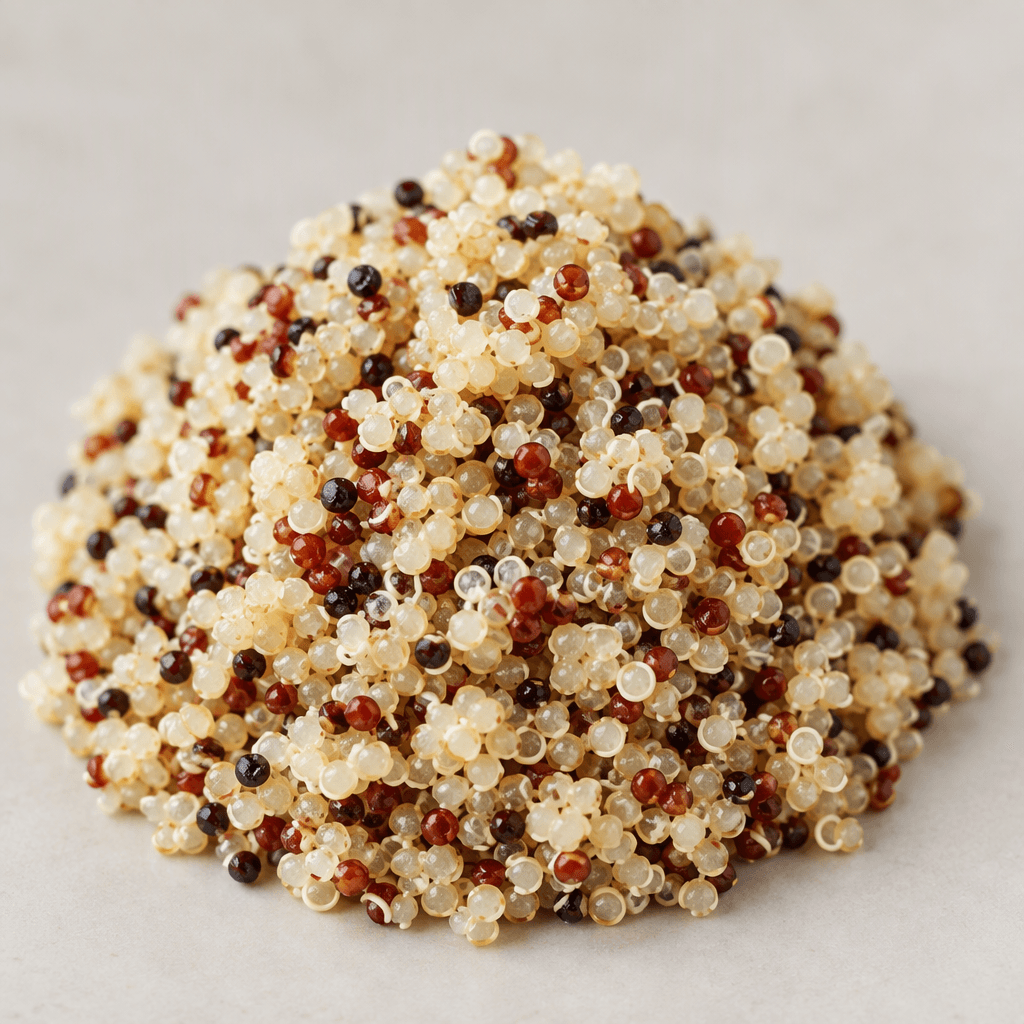
Quinoa Calories
Complete protein, high fiber, gluten-free
In season: Spring · Summer · Autumn
CALORIES
GI
POTASSIUM
FIBER
Quick answer
1 cup (medium) of Quinoa (185 g) has 222 calories. That works out to 120 calories per 100 g. It contains 39.4 g of carbs, 7.6 g of protein, 3.5 g of fat and 5.2 g of fiber. Its 1.1 mg of Manganese covers 48% of the Daily Value. Its glycemic index is 53 (medium), so it raises blood sugar at a moderate pace.
What is Quinoa?
Quinoa is the seed of a plant native to the Andes of South America. Though it is technically a seed, it is cooked and served much like rice or other grains. You’ll find white, red and black varieties, with subtle differences in texture.
Its mild, slightly nutty flavour and tender, pleasantly distinct grains make it easy to use in salads, bowls and as a side for vegetables, fish or meat. In the Andes it has long been a staple; today it’s also popular in home cooking worldwide. Quinoa provides fibre and plant protein, making it a useful base for vegetarian and vegan meals. Rinse it before cooking to wash away its naturally bitter coating, then pair it with herbs, citrus and olive oil for a bright salad.
Quinoa Nutrition Facts
Selected: 100 g
120
KCAL / 100G
Carbs
21.3g
· 8% DV
Protein
4.1g
· 8% DV
Fat
1.9g
· 2% DV
Fiber
2.8g
· 10% DV
DV is the share of the daily value covered, on a 2,000 kcal reference diet.
Calories come from: Carbs 72% · Protein 14% · Fat 14%
Quinoa Vitamins & Minerals
Vitamins
Folate
42µg · 11% DV
B1
0.1mg · 8% DV
B2
0.1mg · 8% DV
Biotin
2µg · 7% DV
Minerals
Manganese
1mg · 43% DV
Phosphorus
152mg · 22% DV
Magnesium
64mg · 15% DV
Iron
2mg · 11% DV
How Nutritious Is Quinoa?
Nutrient density
High
How many vitamins, minerals and how much fiber this food carries per calorie. A high score means a lot of nutrition for few calories.
Satiety score
Medium
An EatBetter score computed from fiber, protein and calorie density. A high score means staying full longer on the same calories.
Both scores are calculated per 100 g and do not change with the selected portion. The satiety score is EatBetter's own calculation, not a clinical measure.
Quinoa Glycemic Index
GLYCEMIC INDEX
GLYCEMIC LOAD
Accounts for portion size — a more realistic measure than GI alone.
How to Burn Off Quinoa
To burn the 120 calories in 100 g:
🚶
Walking (5 km/h)
🏃
Running (8 km/h)
🚴
Cycling
🏊
Swimming
Times are calculated with the MET equation for a 70 kg adult. Actual burn varies with your weight, age and pace.
Is Quinoa Processed?
NOVA 2
Minimally Processed
1. Unprocessed
2. Minimally Processed
3. Processed
4. Ultra-Processed
NOVA classifies foods into 4 groups by industrial processing. NOVA 1 (unprocessed) is the healthiest.
Does Quinoa Contain Allergens?
No known major allergens
Which Diets Is Quinoa Good For?
Vegan
✓ Suitable
Vegetarian
✓ Suitable
Gluten-Free
✓ Suitable
Dairy-Free
— Not suitable
Mediterranean
✓ Suitable
Paleo
✓ Suitable
Whole30
— Not suitable
DASH
— Not suitable
Keto
— Not suitable
Low FODMAP
— Not suitable
Quinoa Fat Profile
SATURATED
0.2g
MONOUNSATURATED
0.5g
POLYUNSATURATED
1.2g
Omega 6:3 ratio 11:1
Above the ideal 4:1 (11:1).
Compare Quinoa
Foods Similar to Quinoa
Frequently Asked Questions About Quinoa
How do you cook quinoa?
Rinse quinoa under cold running water, then simmer one part quinoa with two parts water until the grains are tender and the liquid is absorbed. Let it stand briefly off the heat, then fluff it with a fork for a lighter texture.
Do you need to rinse quinoa before cooking it?
Yes, rinsing quinoa in a fine-mesh sieve removes some of the naturally occurring saponins on its surface. These compounds can taste bitter or soapy. Rub the grains gently under running water until the water runs clear and the bitter smell fades.
Why does my quinoa taste bitter?
Quinoa usually tastes bitter when its surface saponins have not been rinsed off sufficiently. Rinse the grains thoroughly before cooking; if the cooked quinoa is still noticeably bitter, it may also have been poorly stored or become rancid.
Is quinoa a grain or a seed?
Quinoa is botanically a seed, not a true cereal grain, though it is cooked and eaten like one. It comes from a flowering plant related to amaranth, which is why it is often called a pseudocereal.
How do you make quinoa fluffy instead of mushy?
For fluffy quinoa, rinse it well, use the right amount of liquid, and avoid stirring while it simmers. Once the liquid has been absorbed, let the covered pot rest off the heat, then gently separate the grains with a fork.
Can quinoa replace rice in recipes?
Yes, quinoa can replace rice in many bowls, salads, and side dishes. It cooks into smaller, slightly springy grains with a mild, nutty flavor, so the texture and taste will differ from rice rather than imitate it exactly.
Can you eat quinoa raw?
Dry, uncooked quinoa is hard and is not usually eaten as-is. You can cook it or sprout it instead; sprouted quinoa is still uncooked, so handle it hygienically and refrigerate it promptly because sprouts can carry harmful bacteria.
How long does cooked quinoa last in the fridge?
Cooked quinoa keeps for about three to five days in a covered container in the refrigerator. Cool and refrigerate it promptly rather than leaving it at room temperature, and discard it if it develops an unusual smell or appearance.
Can cooked quinoa be frozen?
Yes, cooked quinoa freezes well. Cool it first, divide it into meal-sized portions, and store them in airtight freezer-safe containers. Thaw it in the refrigerator or reheat it from frozen with a splash of water to restore moisture.
Is quinoa a complete protein?
Yes, quinoa is considered a complete protein because it contains all nine essential amino acids. That makes it a useful plant-based option, but it does not mean quinoa has to be the only protein source in a meal.
Have another question about Quinoa?
Ask the AI nutrition coach — calories, portions, alternatives and more, answered in seconds in the app.

Scan calories with your camera
Instant AI nutrition analysis

Nutrition data compiled from USDA FoodData Central and scientific sources.