

Ready & Packaged Foods
All →Vegetables & Legumes
All →Desserts & Confectionery
All →Meat & Protein
All →Grains & Bakery
All →Beverages
All →Milk & Dairy
All →

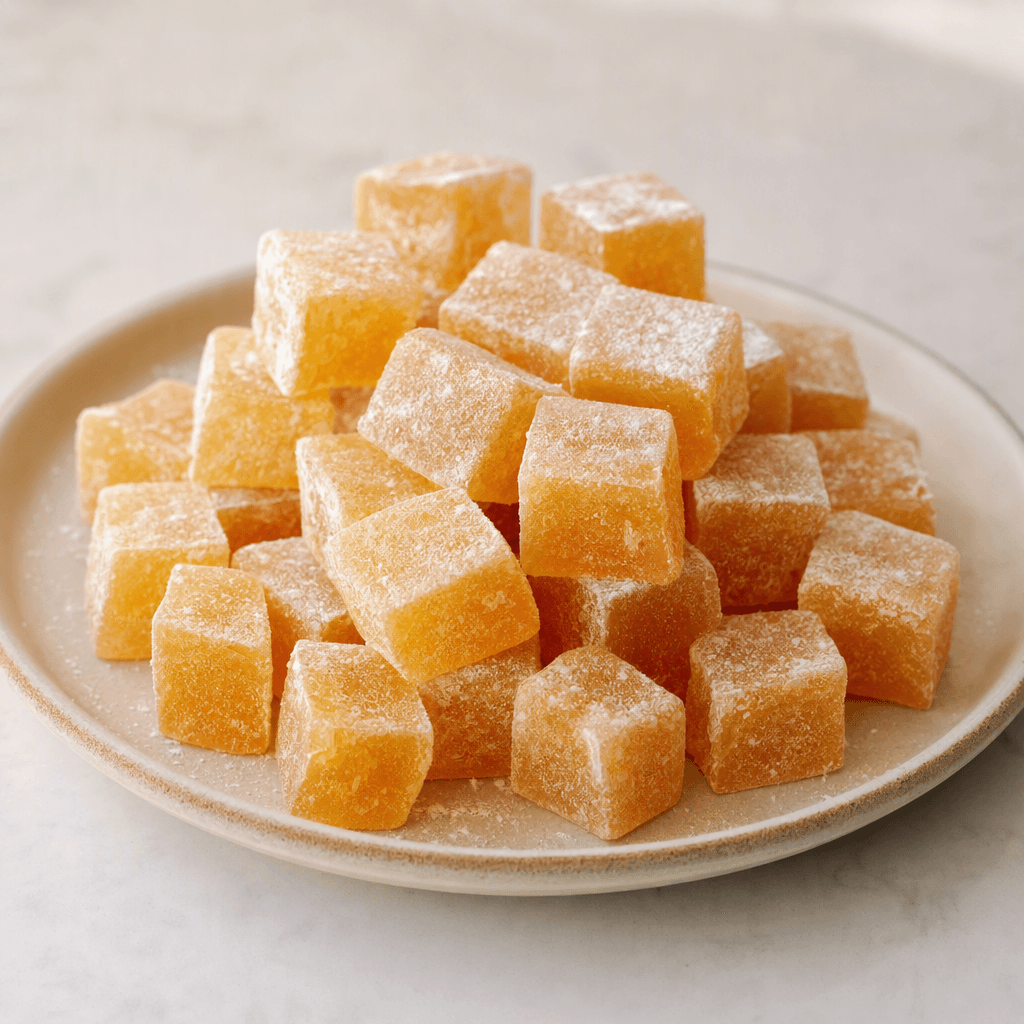
Quince Turkish delight Calories
Traditional Turkish delight flavored with quince, high in sugar
CALORIES
GI
POTASSIUM
FIBER
Quick answer
2 piece (medium) of Quince Turkish delight (40 g) has 144 calories. That works out to 360 calories per 100 g. It contains 35.6 g of carbs, 0.1 g of protein, 0 g of fat and 0.3 g of fiber. Its glycemic index is 78 (high), so it raises blood sugar quickly.
What is Quince Turkish delight?
Quince Turkish delight is a Turkish lokum flavoured with quince, a fragrant fruit with a gentle tartness. Sugar and starch are cooked into a soft, springy confection, then cut into small cubes and often lightly dusted with powdered sugar. Its flavour is sweet and fruity, while the quince adds a pleasantly aromatic note.
In Turkey, lokum is commonly offered with Turkish coffee or tea and served to guests during visits and celebrations. Elsewhere, it works well as a small after-dinner sweet or alongside unsweetened tea. It is mostly carbohydrate and very high in sugar, with little protein or fibre, so a modest portion is a practical way to enjoy it. Pair it with plain coffee or tea to balance its sweetness.
Quince Turkish delight Nutrition Facts
Selected: 100 g
360
KCAL / 100G
Carbs
89g
· 32% DV
Protein
0.2g
· 0% DV
Fat
0.1g
· 0% DV
Fiber
0.8g
· 3% DV
DV is the share of the daily value covered, on a 2,000 kcal reference diet.
Calories come from: Carbs 100% · Protein 0% · Fat 0%
Quince Turkish delight Vitamins & Minerals
Vitamins
B1
0.01mg · 1% DV
B2
0.01mg · 1% DV
B3
0.1mg · 1% DV
B5
0.03mg · 1% DV
Minerals
Calcium
8mg · 1% DV
Magnesium
3mg · 1% DV
Sodium
18mg · 1% DV
Phosphorus
5mg · 1% DV
How Nutritious Is Quince Turkish delight?
Nutrient density
Low
How many vitamins, minerals and how much fiber this food carries per calorie. A high score means a lot of nutrition for few calories.
Satiety score
Low
An EatBetter score computed from fiber, protein and calorie density. A high score means staying full longer on the same calories.
Both scores are calculated per 100 g and do not change with the selected portion. The satiety score is EatBetter's own calculation, not a clinical measure.
Quince Turkish delight Glycemic Index
GLYCEMIC INDEX
GLYCEMIC LOAD
Accounts for portion size — a more realistic measure than GI alone.
How to Burn Off Quince Turkish delight
To burn the 360 calories in 100 g:
🚶
Walking (5 km/h)
🏃
Running (8 km/h)
🚴
Cycling
🏊
Swimming
Times are calculated with the MET equation for a 70 kg adult. Actual burn varies with your weight, age and pace.
Is Quince Turkish delight Processed?
NOVA 3
Processed
1. Unprocessed
2. Minimally Processed
3. Processed
4. Ultra-Processed
NOVA classifies foods into 4 groups by industrial processing. NOVA 1 (unprocessed) is the healthiest.
Does Quince Turkish delight Contain Allergens?
No known major allergens
Which Diets Is Quince Turkish delight Good For?
Vegan
✓ Suitable
Vegetarian
✓ Suitable
Gluten-Free
✓ Suitable
Dairy-Free
— Not suitable
Mediterranean
✓ Suitable
Paleo
— Not suitable
Whole30
— Not suitable
DASH
— Not suitable
Keto
— Not suitable
Low FODMAP
— Not suitable
Quince Turkish delight Fat Profile
SATURATED
0.02g
MONOUNSATURATED
0.01g
POLYUNSATURATED
0.01g
Compare Quince Turkish delight
Foods Similar to Quince Turkish delight
Frequently Asked Questions About Quince Turkish delight
What is quince Turkish delight, and how is it made?
Quince Turkish delight is a soft, gelled sweet flavored with quince. Traditional methods cook sugar with quince purée or juice and starch until the mixture thickens; it is then left to set, cut into cubes, and dusted to keep the pieces from sticking.
Does quince Turkish delight contain real quince?
It can contain real quince purée or juice, but recipes and commercial products vary. To find out whether a particular quince Turkish delight uses the fruit rather than only flavoring, look for quince or quince purée in its ingredient list.
What does quince Turkish delight taste like?
Quince Turkish delight tastes sweet with a fruity, gently tart aroma that is often compared with cooked quince or apple. Its flavor can be subtle or pronounced depending on the recipe, while its texture is typically soft and chewy rather than crisp.
How do you make quince Turkish delight at home?
To make quince Turkish delight at home, cook quince until soft and purée it, then combine it with sugar and starch and stir over heat until thick. Let the mixture set in a lined tray, cut it into cubes, and coat the pieces with starch or powdered sugar.
Why is quince Turkish delight amber-colored?
Quince Turkish delight can turn amber as the fruit and sugar change color during cooking. The quince’s ripeness, the cooking time, and the amount of fruit in the recipe all affect the shade, which may range from pale gold to deeper amber.
How should you store quince Turkish delight?
Keep quince Turkish delight in an airtight container in a cool, dry place, away from heat and moisture. For packaged sweets, follow the storage instructions and date on the package; homemade batches are best eaten while fresh.
Why does quince Turkish delight get sticky?
Quince Turkish delight gets sticky when it absorbs moisture or sits somewhere warm. Separate the cubes and lightly dust them with starch or powdered sugar, then store them in a dry, airtight container to help keep their surfaces from clumping.
Is quince Turkish delight the same as quince paste or membrillo?
No. Quince Turkish delight is a soft, starch-set confection cut into cubes, while quince paste, often called membrillo, is a denser fruit paste made by cooking quince and sugar. They share a fruit flavor but have different textures and uses.
Can quince Turkish delight be frozen?
Freezing quince Turkish delight is usually not recommended because thawing can make it wet, overly soft, or sticky. To preserve its texture, keep it in a sealed container in a cool, dry place instead of putting it in the freezer.
Can people with diabetes eat quince Turkish delight?
People with diabetes should be cautious with quince Turkish delight because it is high in sugar and can raise blood glucose. Whether it fits an individual eating plan depends on their treatment and glucose management, so they should ask their clinician or dietitian.
Have another question about Quince Turkish delight?
Ask the AI nutrition coach — calories, portions, alternatives and more, answered in seconds in the app.

Scan calories with your camera
Instant AI nutrition analysis

Nutrition data compiled from USDA FoodData Central and scientific sources.