

Ready & Packaged Foods
All →Vegetables & Legumes
All →Desserts & Confectionery
All →Meat & Protein
All →Grains & Bakery
All →Beverages
All →Milk & Dairy
All →

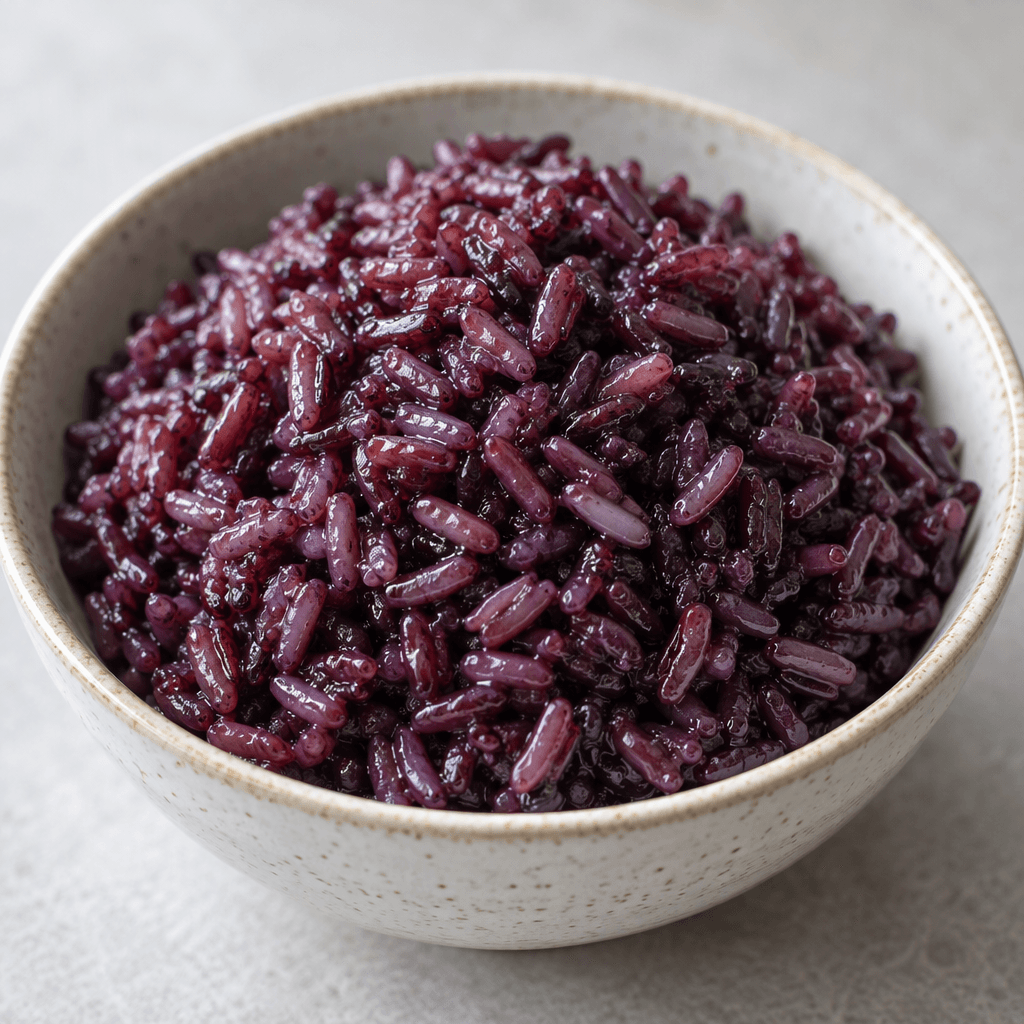
Purple Rice Calories
Rich in antioxidants, high fiber, gluten-free
In season: Spring · Summer · Autumn · Winter
CALORIES
GI
POTASSIUM
FIBER
Quick answer
1 cup (medium) of Purple Rice (200 g) has 700 calories. That works out to 350 calories per 100 g. It contains 153 g of carbs, 15 g of protein, 5 g of fat and 9 g of fiber. Its 2.4 mg of Manganese covers 104% of the Daily Value. Its glycemic index is 50 (medium), so it raises blood sugar at a moderate pace.
What is Purple Rice?
Purple rice is a pigmented rice variety whose dark outer layer gives the cooked grains their violet-to-reddish hue. It is grown and eaten in parts of Asia, where it may be served as a staple grain or used in both savoury dishes and sweets.
The grains cook up plump and pleasantly chewy, with a fuller, subtly nutty flavour than white rice. You can serve Purple Rice alongside vegetables, beans or a curry, or use it as the base for a grain bowl. It provides more fibre than refined white rice and is naturally gluten-free. For a balanced, lighter meal, pair it with plenty of vegetables and a lean protein or legumes.
Purple Rice Nutrition Facts
Selected: 100 g
350
KCAL / 100G
Carbs
76.5g
· 28% DV
Protein
7.5g
· 15% DV
Fat
2.5g
· 3% DV
Fiber
4.5g
· 16% DV
DV is the share of the daily value covered, on a 2,000 kcal reference diet.
Calories come from: Carbs 85% · Protein 8% · Fat 7%
Purple Rice Vitamins & Minerals
Vitamins
B3
5.2mg · 33% DV
B1
0.35mg · 29% DV
B6
0.45mg · 26% DV
B5
1.1mg · 22% DV
Minerals
Manganese
1mg · 43% DV
Phosphorus
210mg · 30% DV
Magnesium
110mg · 26% DV
Zinc
2mg · 18% DV
How Nutritious Is Purple Rice?
Nutrient density
High
How many vitamins, minerals and how much fiber this food carries per calorie. A high score means a lot of nutrition for few calories.
Satiety score
Medium
An EatBetter score computed from fiber, protein and calorie density. A high score means staying full longer on the same calories.
Both scores are calculated per 100 g and do not change with the selected portion. The satiety score is EatBetter's own calculation, not a clinical measure.
Purple Rice Glycemic Index
GLYCEMIC INDEX
GLYCEMIC LOAD
Accounts for portion size — a more realistic measure than GI alone.
How to Burn Off Purple Rice
To burn the 350 calories in 100 g:
🚶
Walking (5 km/h)
🏃
Running (8 km/h)
🚴
Cycling
🏊
Swimming
Times are calculated with the MET equation for a 70 kg adult. Actual burn varies with your weight, age and pace.
Is Purple Rice Processed?
NOVA 2
Minimally Processed
1. Unprocessed
2. Minimally Processed
3. Processed
4. Ultra-Processed
NOVA classifies foods into 4 groups by industrial processing. NOVA 1 (unprocessed) is the healthiest.
Does Purple Rice Contain Allergens?
No known major allergens
Which Diets Is Purple Rice Good For?
Vegan
✓ Suitable
Vegetarian
✓ Suitable
Gluten-Free
✓ Suitable
Dairy-Free
— Not suitable
Mediterranean
✓ Suitable
Paleo
✓ Suitable
Whole30
— Not suitable
DASH
— Not suitable
Keto
— Not suitable
Low FODMAP
— Not suitable
Purple Rice Fat Profile
SATURATED
0.6g
MONOUNSATURATED
0.7g
POLYUNSATURATED
1.1g
Omega 6:3 ratio 15:1
Above the ideal 4:1 (15:1).
Compare Purple Rice
Foods Similar to Purple Rice
Frequently Asked Questions About Purple Rice
What is purple rice?
Purple rice is a naturally pigmented rice variety whose grains can look purple or deep reddish-purple after cooking. Its color comes from anthocyanins, the same group of pigments found in foods such as blueberries; uncooked grains may look nearly black.
How do you cook purple rice?
Rinse purple rice, then simmer it with water until the grains are tender. Cooking time and the amount of water vary by variety, so follow the package directions; letting it rest covered after cooking helps the texture settle.
What does purple rice taste like?
Purple rice typically has a mild nutty flavor and a chewier, fuller texture than white rice. The exact taste and firmness vary between varieties, so adjust the cooking time to get the softness you prefer.
Is purple rice the same as black rice?
Not always. Purple rice and black rice are sometimes used as overlapping market names, and some black rice turns purple when cooked. The labels are not standardized across every variety, so color alone does not reliably identify the grain.
Why does purple rice turn the cooking water purple?
Purple rice releases some of its water-soluble natural pigments into the cooking water, tinting it purple. This is a normal effect of the colored grain, not a sign that the rice has spoiled.
Do you need to soak purple rice before cooking it?
No, soaking purple rice is optional. It can help the grains soften sooner, but soaked rice has already absorbed water, so adjust the cooking liquid rather than using the same amount as for unsoaked rice.
Can you cook purple rice in a rice cooker?
Yes, purple rice can be cooked in a rice cooker. Rinse it first and use the cooker’s whole-grain setting if available; since varieties absorb water differently, follow the package guidance if the cooker’s standard rice setting leaves it too firm.
How should you store uncooked purple rice?
Keep uncooked purple rice in an airtight container in a cool, dry cupboard, away from sunlight and moisture. A sealed container helps protect it from pantry pests and keeps the grains from absorbing odors.
What foods go well with purple rice?
Purple rice works well with roasted vegetables, beans, tofu, meat, or fish, and it can add color and chewiness to grain bowls and salads. Its nutty flavor pairs especially well with savory sauces and ingredients with a little acidity.
Is purple rice good for you?
Purple rice can be a nutritious whole-grain choice: its natural pigments provide antioxidants, and it contains fiber. It is best used as part of varied meals rather than treated as a remedy or as a substitute for a balanced diet.
Have another question about Purple Rice?
Ask the AI nutrition coach — calories, portions, alternatives and more, answered in seconds in the app.

Scan calories with your camera
Instant AI nutrition analysis

Nutrition data compiled from USDA FoodData Central and scientific sources.