

Ready & Packaged Foods
All →Vegetables & Legumes
All →Desserts & Confectionery
All →Meat & Protein
All →Grains & Bakery
All →Beverages
All →Milk & Dairy
All →

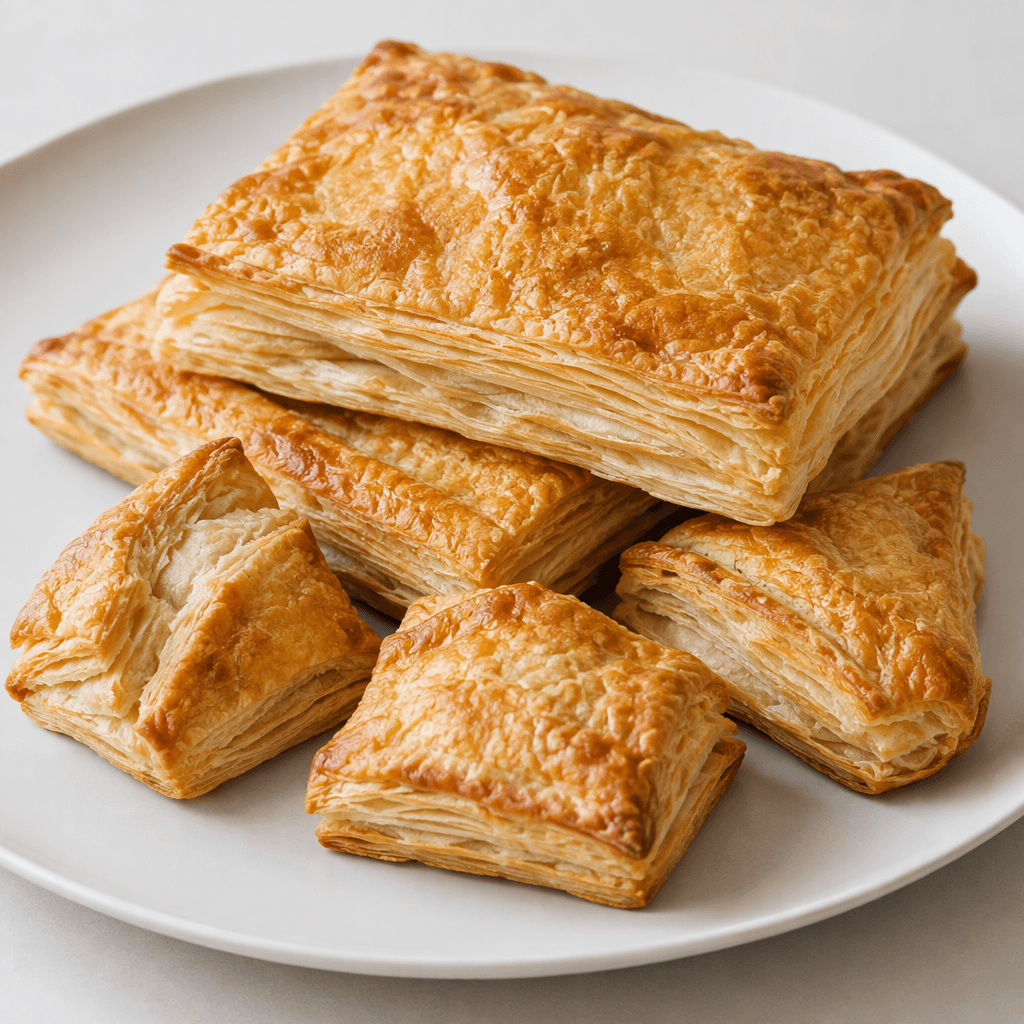
Puff Pastry Calories
Multi-layered, buttery pastry, used in sweet and savory recipes
In season: Spring · Summer · Autumn · Winter
CALORIES
GI
POTASSIUM
FIBER
Quick answer
1 piece (medium) of Puff Pastry (40 g) has 148 calories. That works out to 370 calories per 100 g. It contains 18 g of carbs, 2.6 g of protein, 8 g of fat and 0.8 g of fiber. Its 0.1 mg of B1 covers 6% of the Daily Value. Its glycemic index is 70 (high), so it raises blood sugar quickly.
What is Puff Pastry?
Puff pastry is a laminated dough made by folding layers of fat into dough, traditionally associated with French baking. It puffs in the oven into crisp, delicate layers and is sold ready-made in sheets as well as made from scratch.
Its light crunch works in both sweet and savoury baking: use it for tarts, turnovers, savoury pies or quick pastries with fruit or cheese. In many English-speaking kitchens, frozen sheets are a convenient shortcut for entertaining or an easy weekend bake. Puff pastry is relatively high in fat and provides little fibre, so a modest portion alongside a vegetable-filled dish can make for a more balanced meal.
Puff Pastry Nutrition Facts
Selected: 100 g
370
KCAL / 100G
Carbs
45g
· 16% DV
Protein
6.5g
· 13% DV
Fat
20g
· 26% DV
Fiber
2.1g
· 8% DV
DV is the share of the daily value covered, on a 2,000 kcal reference diet.
Calories come from: Carbs 47% · Protein 7% · Fat 46%

Log this food in EatBetter
100,000+ people use it
- Get your daily calorie target
- Snap your meal, log it in seconds
- See every vitamin and mineral

📸 Scan the code to get the app free.

Puff Pastry Vitamins & Minerals
Vitamins
B1
0.18mg · 15% DV
B3
2.1mg · 13% DV
B2
0.13mg · 10% DV
Biotin
2.5µg · 8% DV
Minerals
Sodium
320mg · 14% DV
Selenium
6µg · 11% DV
Phosphorus
55mg · 8% DV
Potassium ⭐
80mg · 2% DV
Manganese
0mg · 0% DV
How Nutritious Is Puff Pastry?
Nutrient density
Low
How many vitamins, minerals and how much fiber this food carries per calorie. A high score means a lot of nutrition for few calories.
Satiety score
Low
An EatBetter score computed from fiber, protein and calorie density. A high score means staying full longer on the same calories.
Both scores are calculated per 100 g and do not change with the selected portion. The satiety score is EatBetter's own calculation, not a clinical measure.
Puff Pastry Glycemic Index
GLYCEMIC INDEX
GLYCEMIC LOAD
Accounts for portion size — a more realistic measure than GI alone.
How to Burn Off Puff Pastry
To burn the 370 calories in 100 g:
🚶
Walking (5 km/h)
🏃
Running (8 km/h)
🚴
Cycling
🏊
Swimming
Times are calculated with the MET equation for a 70 kg adult. Actual burn varies with your weight, age and pace.
Is Puff Pastry Processed?
NOVA 3
Processed
1. Unprocessed
2. Minimally Processed
3. Processed
4. Ultra-Processed
NOVA classifies foods into 4 groups by industrial processing. NOVA 1 (unprocessed) is the healthiest.
Does Puff Pastry Contain Allergens?
Contains these allergens:
Which Diets Is Puff Pastry Good For?
Vegan
— Not suitable
Vegetarian
✓ Suitable
Gluten-Free
— Not suitable
Dairy-Free
— Not suitable
Mediterranean
— Not suitable
Paleo
— Not suitable
Whole30
— Not suitable
DASH
— Not suitable
Keto
— Not suitable
Low FODMAP
— Not suitable
Puff Pastry Fat Profile
SATURATED
8.5g
MONOUNSATURATED
7.2g
POLYUNSATURATED
1.1g
Omega 6:3 ratio 11.7:1
Above the ideal 4:1 (11.7:1).
Compare Puff Pastry
Foods Similar to Puff Pastry
Frequently Asked Questions About Puff Pastry
How do you thaw puff pastry?
Thaw puff pastry in the refrigerator until the sheets are flexible enough to separate. Keeping it cool helps the butter stay firm between the layers, which is important for a flaky rise. Avoid leaving it out until it becomes soft or sticky.
Why is my puff pastry not puffing up?
Puff pastry often fails to rise if it gets warm before baking or goes into an oven that is not hot enough. Keep the dough cold, preheat the oven, and avoid pressing the cut edges together, which can seal the layers.
What temperature should you bake puff pastry at?
Bake puff pastry in a preheated oven at about 400–425°F (200–220°C). It is ready when the layers have risen and the pastry is golden brown; the baking time varies with the size of the pieces and their filling.
Can you use puff pastry instead of pie crust?
Yes, puff pastry can replace pie crust in many recipes, especially savory pies and open tarts. It will rise into flaky layers rather than bake into the flatter, more crumbly texture of a traditional pie crust.
Can you refreeze puff pastry after thawing it?
It is best not to refreeze thawed puff pastry, because moisture and softened butter can damage its layers and affect how it bakes. If you thawed it in the refrigerator, keep it cold and use it soon instead.
Should you brush puff pastry with egg wash?
Yes, brushing puff pastry with beaten egg gives the surface a glossy, golden finish. Brush lightly and keep egg wash off the cut edges, since it can stick the layers together and interfere with rising.
What can you make with puff pastry?
Puff pastry works for savory turnovers, cheese straws, tarts, and pot-pie toppings, as well as fruit pastries and desserts. Choose fillings that are not too wet, since excess liquid can make the crisp pastry soggy.
Can you eat puff pastry raw?
No, puff pastry should be baked before eating. Raw dough can contain uncooked flour, and its layers and butter are designed to develop their crisp texture and flaky structure in the oven.
How do you store leftover puff pastry?
Wrap unused puff pastry airtight and keep it refrigerated, following the storage directions on its package. Use it soon after opening; if it dries out or warms until greasy and soft, it may not bake into distinct flaky layers.
Is puff pastry the same as phyllo dough?
No, puff pastry and phyllo are different doughs. Puff pastry contains layers of dough and fat that rise in the oven, while phyllo is made of very thin sheets that are usually brushed with butter or oil between layers.
Have another question about Puff Pastry?
Ask the AI nutrition coach — calories, portions, alternatives and more, answered in seconds in the app.

Scan calories with your camera
Instant AI nutrition analysis

Nutrition data compiled from USDA FoodData Central and scientific sources.